
The Storm 1994 / Death Trap Kailua
A dreary, windless day in Kailua Bay tempted me into a reckless decision that turned into a harrowing Hawaii windsurfing survival story. Ignoring the warnings of the locals, I launched my board into an offshore breeze and found myself trapped in a deadly tangle of gear. What began as a stubborn search for wind quickly escalated into a desperate fight for survival when a sudden hurricane-force squall trapped me underwater in a deadly tangle of my own gear. This is the harrowing story of my narrow escape from the deep and the miraculous, grueling journey back to shore.
Home / Stories
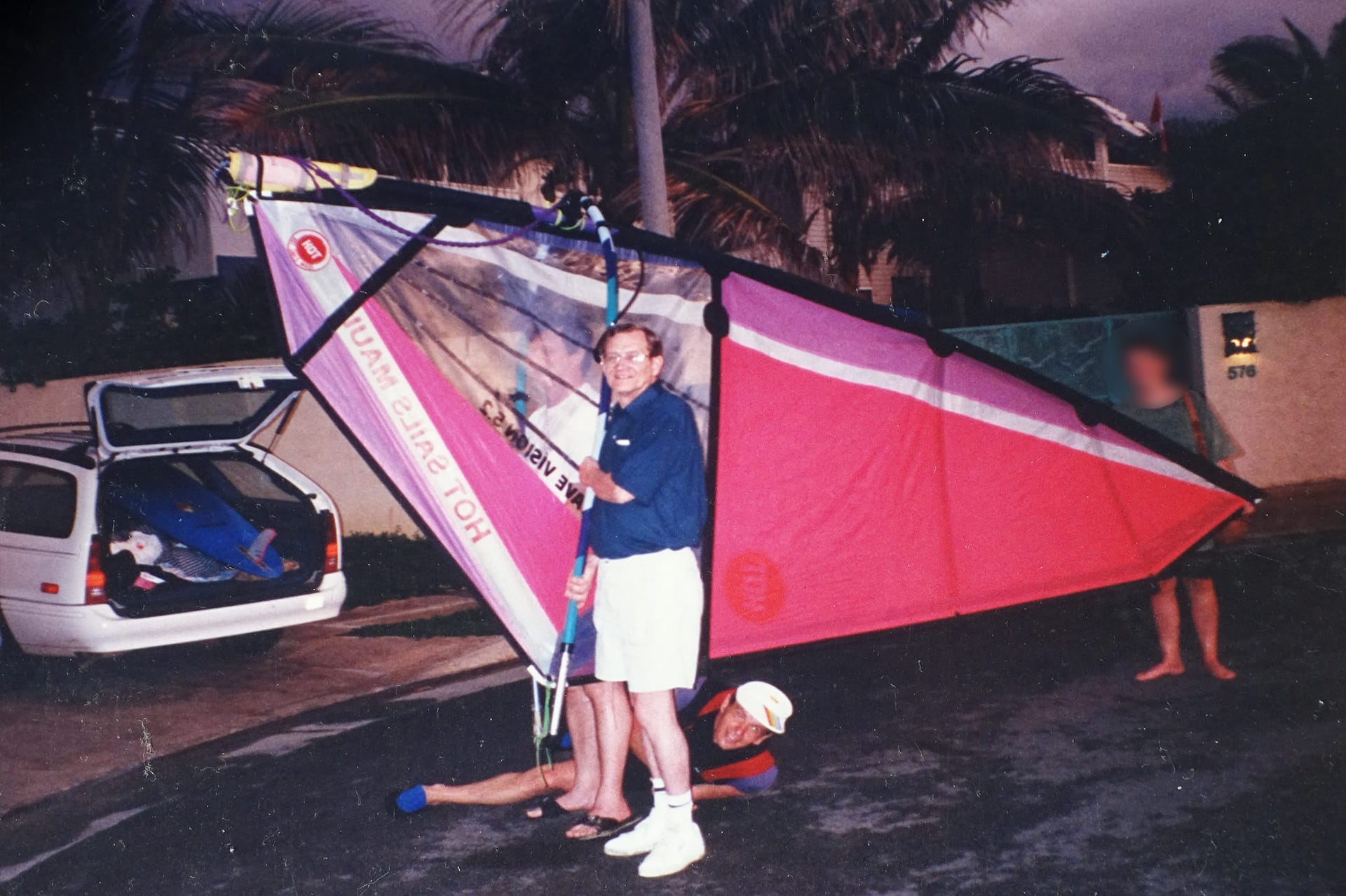
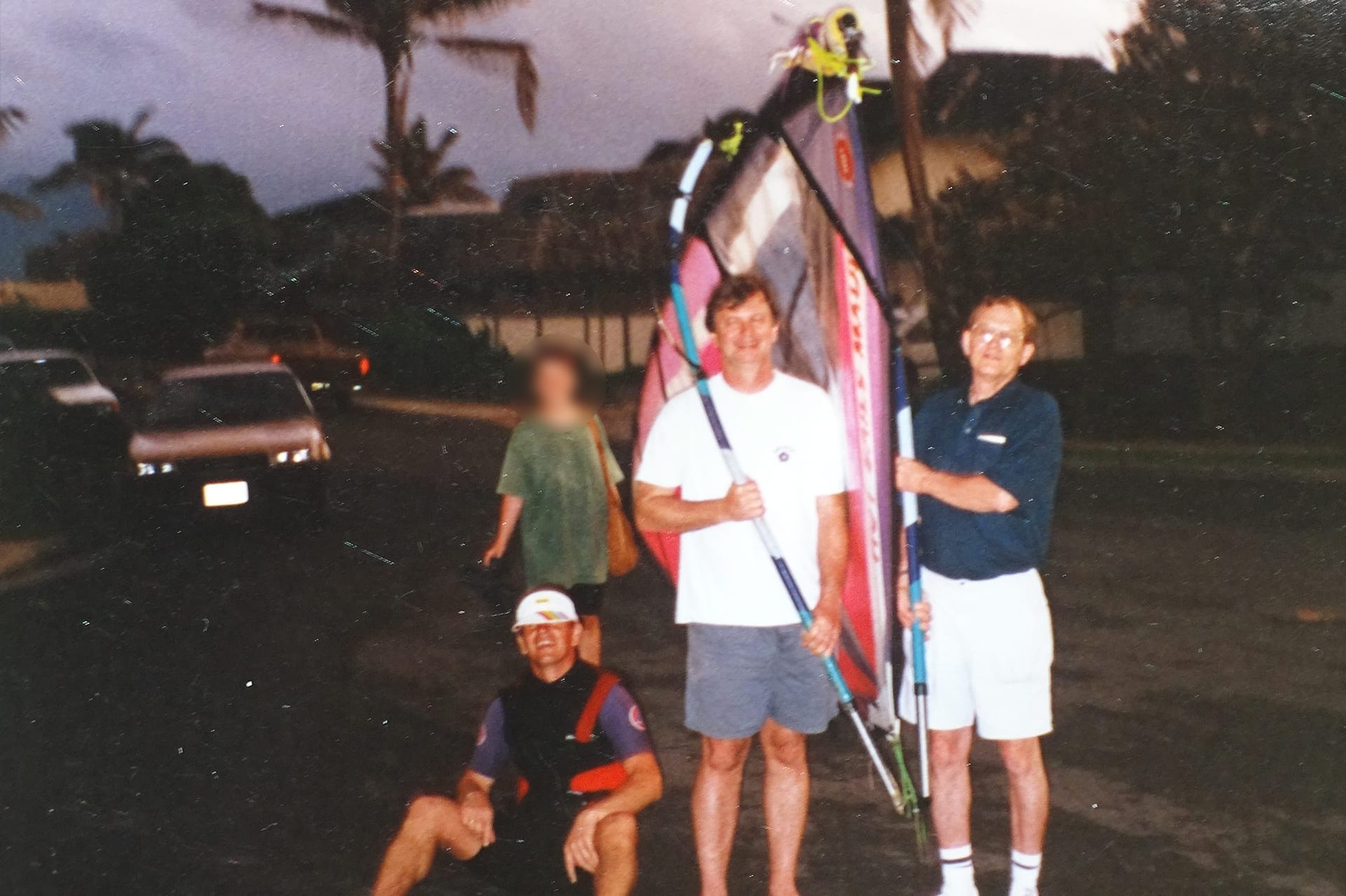
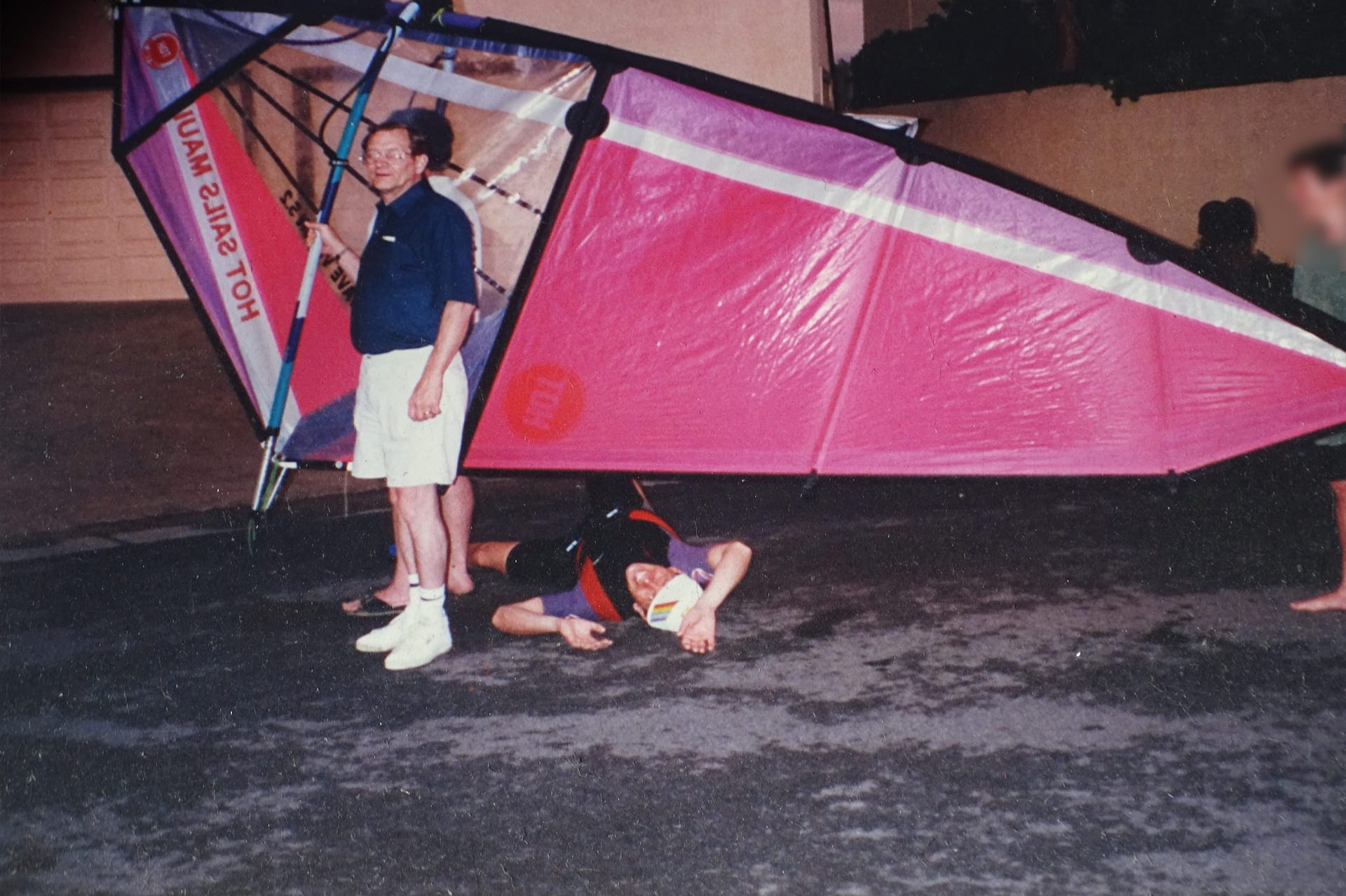
CHAPTER I
It is three o’clock in the afternoon here in Kailua Bay, one of the most beautiful beaches on the island of Oahu, Hawaii. Normally, our eyes are spoiled by turquoise-green water and bright sunshine, but since this morning, a thick layer of gray clouds has been reflecting on the water’s surface all day long. When you look at the ocean, it looks as if someone tried to paint a beautiful picture but ruined it with dreary gray paint.
Normally, we see walkers strolling along the three-kilometer-long sandy beach every now and then, but since this morning, the two of us have been completely alone. The locals are still at work, and there are no tourists from Honolulu to be seen on the public beach either.
When the sun shines, you don’t know where to look. To the east, over the turquoise-green water where the waves break about four hundred meters out in the ocean; or to the left, where the military has its base and where our bed and breakfast is located. The most beautiful view is to our right, in the south. You can see the entire bay with its white, powdery sand stretching all the way to Lanikai. Opposite Lanikai, there is a small bird sanctuary island on the left side. Not far from Lanikai, two solitary green islands rise out of the water into the sky.
Tourists love to capture memories here on the beach with the turquoise-green water and the beautiful green islands in the background. Green palm trees tower over the white sandy beach. They grow on the private properties lined with a chain of houses, mostly built of wood, some looking quite weathered from the damp climate and the saltwater air.
While the roofs are mostly gray and look rather dilapidated, the walls are partially painted in various colors.
The east side of Oahu is known for its rain. I remember during our second vacation, it rained here continuously for seven days. Even in the rain, we still went swimming because it is actually very warm here. At some point after about seven days, I had had enough. We drove to Honolulu; I just wanted to get out of there and head to Australia.
When we were told the price of the tickets, that idea was off the table. We would have had to fly from Honolulu to Los Angeles first, and then from there to Australia. Thank God the price and the circumstances prevented it back then.
On the day we drove from Honolulu to Kailua, we noticed that the sun was shining all day in Honolulu. But as we crossed the mountains on our way back to Kailua, it was still raining here on the east side.
Since then, we’ve known that if it’s raining on one side of the island, it doesn’t necessarily mean it’s raining on the other. If you think about it, Hawaii wouldn’t be as beautiful if it didn’t rain so much. At the time, I didn’t know that the rainy season here in Hawaii lasts from the beginning of December until the end of March.
CHAPTER II
Today, there has been an absolute dead calm in the bay since this morning. It is warm but muggy. Heavy black clouds have been hanging motionless over the mountains behind us all this time. Despite these gray clouds covering the sky over the beach all day, we went swimming several times. For days, Mischko had wanted to go shopping in Honolulu, but somehow we never got around to it. Around three o’clock, I had finally had enough of the dreary atmosphere, with no sun and no wind. I suggested to Mischko that we could go shopping in Honolulu today.
We shook the sand off our towels, she rolled them up, and I grabbed my windsurfing gear—boom, mast, sail—and walked across the sand to the parking lot in the middle of the bay. I had to go back once more to help Mischko bring the rest of our things to the car. Once in the car, it was about a ten-minute drive from the parking lot, covering about thirty miles, to get home.
We lived here at the end of the bay, where the military base is located, on Kaimalino Street, with Ed and Nancy. Ed was some kind of office worker for the military and made decent money, so his wife Nancy stayed home all day.
The first time we stayed here in the last house on the Kaimalino Street cul-de-sac, with Tom and Lucinda, Nancy would always be sitting on her wooden terrace in the shade in front of her house and would greet us whenever we rode our bikes past to go shopping in the morning. Next to her on the railing sat her black cat, Sam. Her passing greetings eventually turned into a friendship. This year, Tom and Lucinda had renovated their house, so we stayed right next door at Nancy’s. When we got home today, Nancy wasn’t on her terrace.
I parked the car in the garage, which was located under our large balcony.
Her balcony above the garage was huge—five meters wide and eight meters long. The length of the balcony ran the width of the house, and its width covered the two-car garage below us. On the balcony, which only we used while staying there, she had a ping-pong table, a Jacuzzi with a whirlpool, and a leather couch. The floor of the balcony under the table was covered with artificial green grass. The house stretched at least twelve meters along the oceanfront.
Mischko and I carried our things, including all my windsurfing gear, up to the balcony. While Mischko went to take a shower, I stored my board up in the attic space under the roof. The opening to the attic was right next to the Jacuzzi. I closed the hatch and briefly stepped over to the ocean side of the balcony. While waiting for Mischko to finish her shower, I looked out at the spot in the bay we had just come from. The open ocean under the gray clouds looked truly uninviting. Large waves crashed onto the rocks about fifteen meters away from me, right below the balcony. It seemed to me as if I could see smaller waves forming far out to the right on the otherwise smooth surface of the sea. When we had been down at the bay, it had been dead calm all day.
CHAPTER III
While she was showering, the smaller waves on the ocean’s surface became clearer and clearer by the minute. Interesting, I thought at that moment. It looked as if the wind was picking up. I started to feel a tingling sensation. It was only half-past three. Maybe I can still go windsurfing today after all, I told myself internally.
I walked down the wooden stairs located on the south side of the house. Once at the bottom, a meter away from the stairs, a wooden fence separated the property from the neighbor’s yard.
According to Nancy, the neighbor was an Austrian who had lived here for thirty years and owned a jewelry store in Kailua. When I heard that, my first thought was: How can someone survive with a jewelry store in a tiny nest like Kailua? Who buys that much jewelry here? Tourists, maybe?
I walked along the narrow path between Nancy’s house and the fence, heading toward the rocks. At the end of the house, I had to cross a four-meter-wide stretch of damp lawn.
In the middle of the lawn in front of the house sat a white, round plastic table and four chairs, which I had never seen anyone use. It was probably put there so that tourists staying here, like us, could sit outside if they wanted to. Leaving the lawn, I walked down a steep incline, first crossing about two meters of sand that had accumulated between the black lava rocks and the green grass.
After the waves crashed against the rocks, a thick white carpet of salty sea foam would repeatedly roll toward me, completely covering the razor-sharp black lava stones. The wave almost reached the sand, so I stopped at the edge.
While standing on the sand for a while, observing the spot where we had spent the entire day, I realized that the wind out in the ocean was indeed getting stronger by the minute! I went back up to the balcony, grabbed the sail, mast, and boom, and walked back down the stairs to the lawn. I started threading the mast into the sail.
CHAPTER IV
While I was right in the middle of rigging my gear, Mischko stepped out onto the balcony and asked, “What are you doing?”
I pointed out at the ocean.
“I thought we were going shopping,” she said.
“That can wait. I’ve been waiting for wind all day, and now it looks like I have a chance to windsurf today.”
“You can’t go in the water there! It’s life-threatening.”
“Don’t worry,” I replied.
While we were talking, our landlady, Nancy, walked up with her relative from Texas, who was visiting her.
“What are you doing?” Nancy asked.
“I’m going windsurfing,” I said, pointing out at the ocean. I barely spoke any English.
“You can’t go in here!” Nancy said, laughing.
I laughed back. “Don’t worry about it.”
“No one has ever gone into the water here. The reefs are sharp. The waves could kill you,” she warned.
I just laughed. “I can try!”
Nancy and her relative (her brother) discussed something among themselves, but I couldn’t understand a word. While I was rigging my sail, another neighbor from next door came over to see what I was doing. He also tried to talk me out of it, telling me I should go in somewhere else—about a hundred and fifty meters from here, right around the curve.
I remained stubborn, with only one thought in my mind: I am going windsurfing today, whatever the cost.
Looking back as I write this today, thinking about what I did at that moment—it was simply crazy, practically suicide. I had gained experience with rocks in heavy surf back in the former Yugoslavia. But the locals couldn’t have known that. We used to call those games playing with death.
The thing I hate most about windsurfing is rigging the sail. While putting it together, I felt a knot in my stomach; I was simply nervous. Maybe it was the thought: Will I manage to drag my windsurfing gear out of the death zone (where the waves crash) before a wave catches me?
After about twenty minutes, I was done rigging. Now I had to get the board out of the attic again. When I dropped the board at my feet on the balcony, Mischko was standing next to me, clearly annoyed and unhappy because we weren’t going shopping as planned when we left the beach.
I put on my wetsuit right there on the balcony, grabbed the board, and went back down the stairs. Mischko followed me.
Even though I had everything ready, I was still nervous and had a bad feeling about this. It was an offshore wind. Back in 1981, I had read in a windsurfing manual: Rule number one. Never go into the water in offshore winds.
I said goodbye to Mischko, Nancy, her brother, and the neighbor.
CHAPTER V
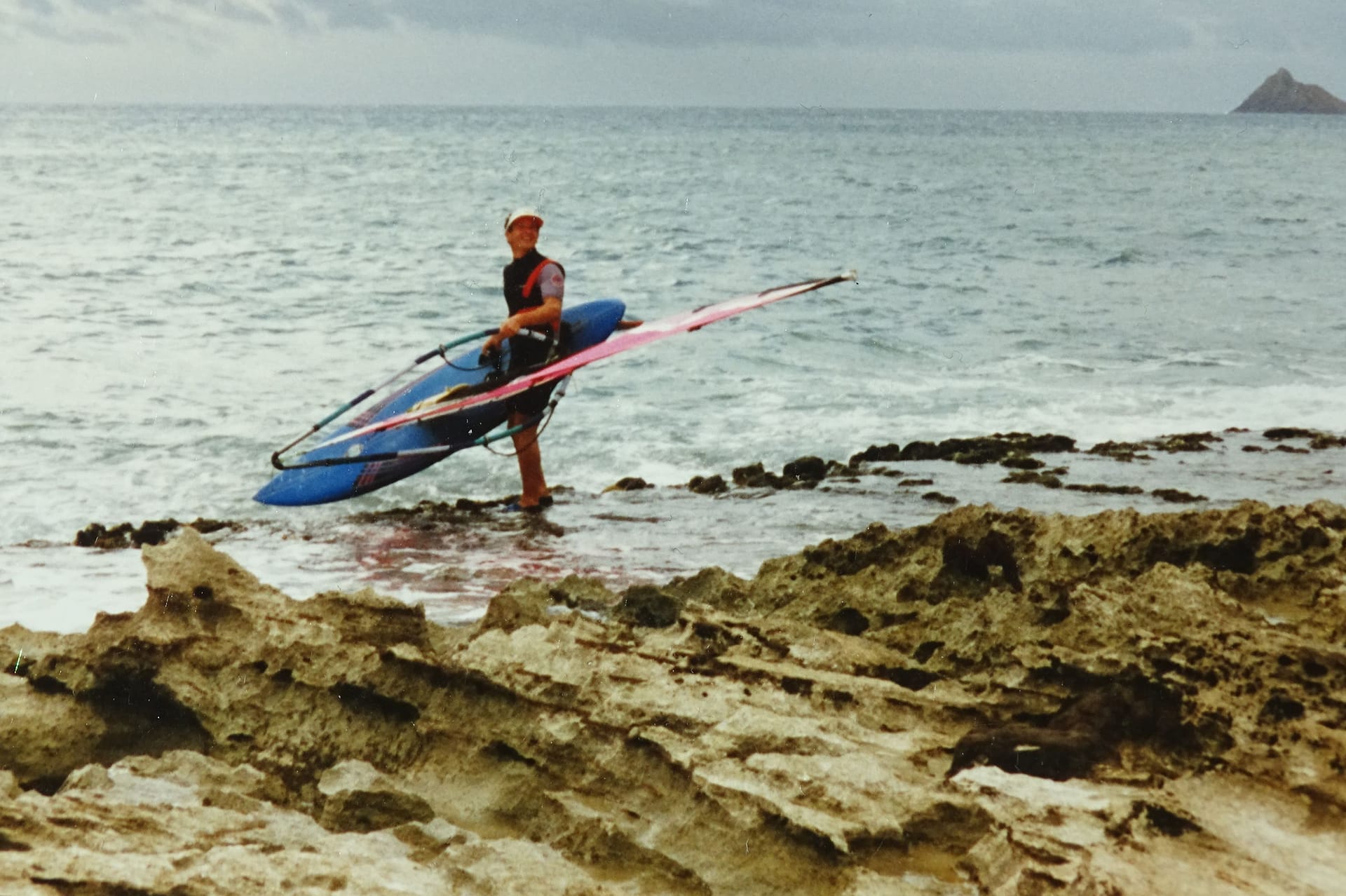
Once I had my gear in hand, I hoisted the board and sail over my head. After a few steps, I reached the two-meter stretch of sand before stepping barefoot onto the razor-sharp reefs.
As I walked, I watched the waves crash against the rocks. Then I saw a thick mass of white foam moving toward me, covering the entire ten-meter stretch of rocks leading out to the ocean.
This meant I had to walk slowly and carefully through the white saltwater foam so I wouldn’t step into a hole between the rocks or slip. The nervousness throughout my body intensified in that moment, as I had to walk at least ten meters to the edge across razor-sharp reefs.
Since I had gone swimming in the bay several times that day, the soles of my feet were softened and therefore even more sensitive. From the very first step onto the reef, I could feel how sharp the black lava stones were. It felt as if I were stepping on nails.
Despite the locals’ warnings and my softened, sensitive feet, I felt my way forward slowly, step by step, through the white foam beneath me. The first wave caressed my feet. While this wave was dying out and slowly retreating, the next wave crashed ten meters away from me, and another thick layer of saltwater rolled toward me. Before the wave reached me, I stopped to ensure I had solid footing.
The previous wave, which had passed me and reached the sand, was now making its way back to the ocean, colliding with the incoming wave. Upon impact, the returning wave was pushed back, causing an even larger wave to roll toward me. The next moment, the wave passed me again toward Nancy’s house, leaving me standing right in the middle of white saltwater foam.
The wave behind me hadn’t even reached the sand before the next wave crashed against the rock wall in front of me, pushing the exact same thick carpet of white foam toward me once again.
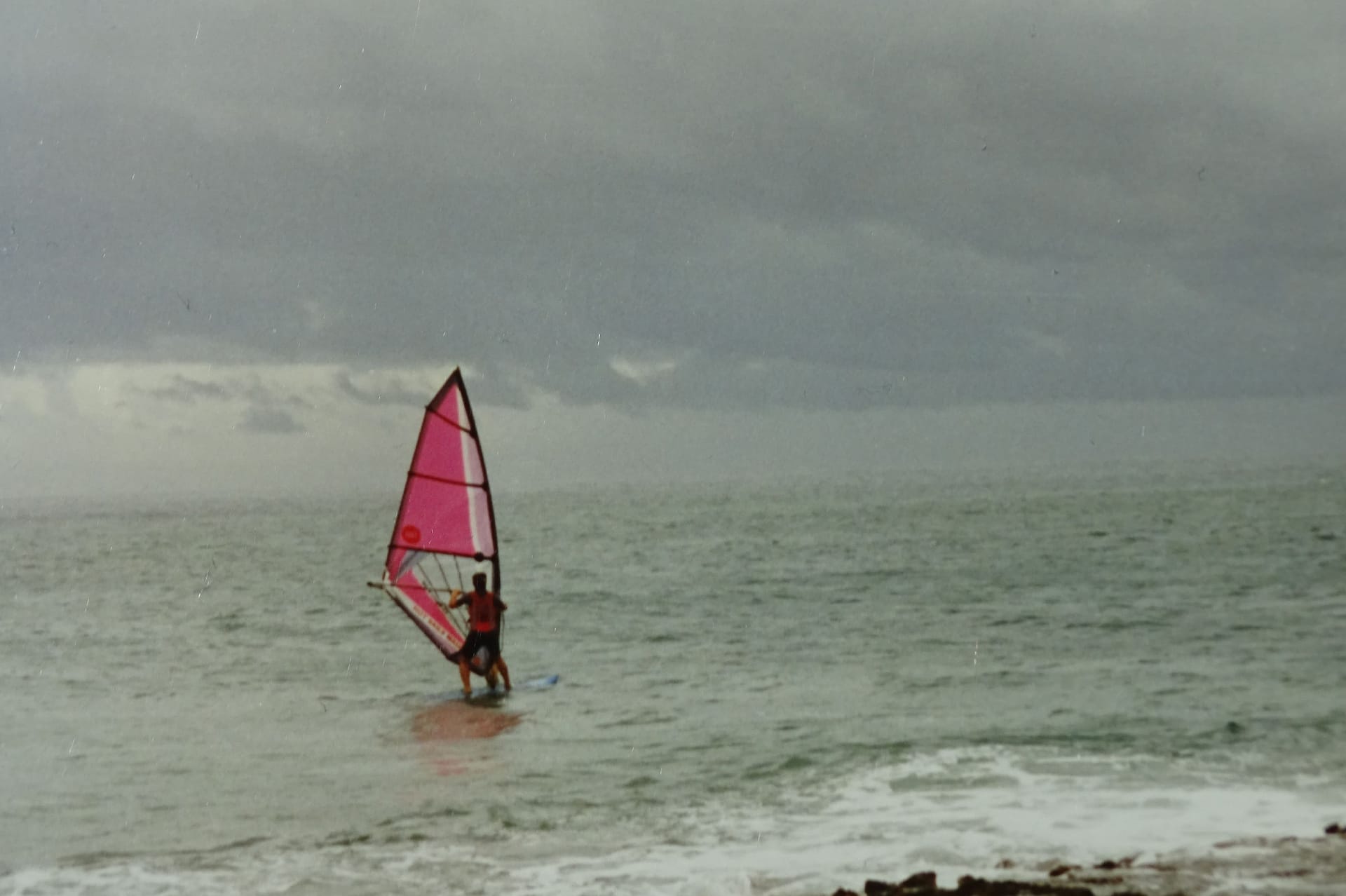
After taking just two steps, I stopped again on solid ground. This time, I felt the current pulling me backward toward Nancy’s house. With my pink sail and blue custom board balanced on my head, my only thought was: Whatever you do, don’t slip.
Here in the middle, the white foam was almost up to my knees. Once the wave passed, I wanted to take another step. But in that moment, I found no solid ground under my foot. Because I had already shifted my weight slightly forward, my foot sank deeper and deeper into the white foam.
With the sail and board over my head, my foot sank almost half a meter deep into a hole between the rocks. At that exact moment, my sail and board slammed onto the surface of the white foam.
Unhappy, with the sail and board resting on my back and over my head, I cursed.
While my left foot was almost a meter deep in the hole, my right foot was still up on the rock, slightly behind me. I was trapped and practically covered by my gear, so Mischko, Nancy, her brother, and the neighbor couldn’t see me. The next wave of white spray washed over my face and dragged the sail backward. Because I was still holding tightly to the boom with both hands, I was pulled backward along with it. In that moment, the hip of the leg that was stuck in the hole slammed hard against the sharp reef. I cursed for a second time.
Standing in the middle of the white foam on one foot stuck in a hole between the rocks, my pink sail pressed down over my head. Simultaneously, the sail was being pulled backward by the current, forcing my hip against the razor-sharp reefs the entire time.
While the current washed past me, I was powerless. As soon as it passed, the pressure and the pain slowly subsided. But every time the next wave crashed against the rocks and the current rushed past me, my hip was repeatedly shoved against the rocks. Despite my wetsuit, I couldn’t help but groan in intense pain. It felt as if my hip were being skewered on a knife.
My observers had surely noticed I was in trouble, but they were powerless to help me.
Great job, I groaned under the sail. I hadn’t even made it into the ocean yet, and I already had my first injury—the exact thing everyone had warned me about.
No one has ever gone into the water here, Nancy had told me.
After about a minute and a half with one foot stuck in a hole between the rocks and my gear over my head, the wave set finally ended. As the last wave retreated from the sand, I shifted my back foot, which wasn’t in the hole, forward. While my front foot, up on the rock, was now completely twisted, my other leg was still stretched out deep in the hole. I was still holding my windsurfing gear over my head with both hands, so my observers still couldn’t see me.
Now I had to shift the entire weight of my gear and my body onto my twisted front foot. Because I had shifted my entire weight forward right as the white saltwater foam was retreating to the ocean, and my sail was resting on the water’s surface, the current helped me, pulling the sail and my whole body toward the ocean. In that moment, my entire body weight, along with the sail over my head, rested on the one foot standing on the edge of the hole. Slowly, I pulled my other foot out of the hole and felt for a rock next to my upper foot.
The current had been a huge help, even though it still required an intense physical effort.
Surrounded by white foam, with the sail and board over my head, I was currently on my knees. At that moment, I heard the next crash and saw water spraying from the edge in my direction. I had to get up from my knees quickly and lift the sail out of the foam; otherwise, the half-meter-high wave would knock me backward onto my back.
Before the wave reached me, I hoisted my entire body out of the water foam and stood waiting in that position until the wave set (a set consists of six waves) passed me by.
Since I was injured and the pain was intense, the most sensible thing to do at that moment would have been to turn back. But what would Nancy and her neighbor say? Because he didn’t listen to us, he injured himself before even getting into the ocean. What would have happened if he had jumped down into the surf? He surely would have died. That’s what they would think, I figured. At that moment, I was resolute. No, I’m not going back to the lawn where my observers are standing. After all, I had my pride.
During the next lull between the waves, I slowly felt my way forward again, step by step, from one reef to the next. One meter before the edge where the waves were crashing, I stopped. For the first time, I stood on the edge of the razor-sharp reefs in front of Nancy’s house and was amazed by how many sea urchins there were. At that moment, I thought: If I actually end up crashing against the rocks, I’m going to have hands full of spines on top of it all.
CHAPTER VI
As the white foam from the last wave retreated from my feet, flowing off the land and cascading over the rocks and countless sea urchins into the ocean like a waterfall, the next wave crashed right in front of me. I was still holding my board and sail high above my head. Because I had gained experience back in Yugoslavia, I stood sideways as the wave hit, exactly as I had learned. This way, I didn’t take the full force of the wave directly onto the front of my body and chest. The water sprayed hard into the side of my face, while a half-meter-high white wave formed and immediately tried to pull me backward again.
Standing sideways to gain better resistance against the wave’s impact, I looked straight toward the bay where I had spotted the smaller waves from the balcony. Everything looked so uninviting and gray. The incoming waves were dark and looked equally menacing. Mentally, I was unhappy with what I was seeing.
At that moment, I thought about how much time had passed since I said goodbye to my observers. It was completely windless where I stood because Nancy’s tall house blocked the wind from the land.
Beneath my wetsuit, I still felt a sharp pain in my hip. I was probably bleeding slightly too, though I didn’t think about that at the time. What was I thinking about?
When I finally jumped into the water with my gear, I would have to swim and drag it at least thirty to fifty meters behind me into the open ocean before reaching the first smaller waves and the wind.
When the last wave of this set crashed in front of me, I had to squeeze my eyes shut again to keep the saltwater spray out. At that moment, another wave of white foam rolled past my feet toward my observers. The rest of the white foam that hadn’t made it onto land immediately flowed down the black rocks in front of me, cascading over the countless sea urchins into the ocean.
Right before my eyes and beneath my feet, it kept looking like a waterfall as the white saltwater foam flowed over the sea urchins into the sea. At the same time, the ocean level dropped as the water retreated from the rocks in front of me. As the water pulled back, a drop of at least three to four meters formed between my feet and the sea level. I started to get scared at the thought of throwing my gear that deep into the sea and then jumping in after it. The last wave was still rolling toward my observers. In that moment, a smooth, icy surface formed on the ocean in front of me, exactly where I intended to throw my gear.
Standing almost three meters above the smooth ocean surface, I thought to myself: If I didn’t have the sail and board, I would never jump into the water at this spot and from this height. I was simply terrified and on the verge of giving up. Yet, even though I was close to quitting, I pictured the following scenario:
I have just thrown the sail and board into the water and jumped in after them. I surface immediately, grab the board in my hand after about two seconds, and start swimming. Now I imagine myself swimming, dragging the gear behind me, keeping an eye on the next incoming wave. After those two seconds, I estimate how long it will take for the next wave to crash against the rocks. Simultaneously, I visualize roughly how far I can drag the sail and board out of the danger zone while swimming.
Meanwhile, the last wave rolled past my feet, carrying white foam toward my observers. In my ears, I heard the loud rush of water cascading over the sea urchins into the ocean like a waterfall.
I waited for at least four sets of six waves to pass me by. Every time a wave set paused, I checked everything carefully and precisely. It was like a study: I studied the current, timed how quickly the next wave set rolled in, and estimated how far I could swim out with my gear during the lull.
I was well aware that a lot of time had passed since I had been standing here on the edge with no wind, but I wanted to play it safe and not risk my life. What must Mischko, Nancy, and the others have been thinking while I stood there for at least ten minutes, if not longer?
When the last wave of the fourth set passed me by, with a bit of fear and a bad feeling in my gut, I hurled the gear over my head and down into the water as far as I could. It fell about three meters deep, but not very far out—barely two meters from the rocks. I immediately jumped over the black sea urchins after it. Surfacing from the depths, I grabbed my board by the foot straps and started swimming for my life, dragging the gear behind me.
Because I was down in the water behind the rocks, my observers couldn’t see me at that moment. And because my head was so low to the water while swimming and dragging, I couldn’t see the horizon. All I saw was a dark, threatening wave slowly approaching me as if in slow motion.
After about five seconds, I looked back. I saw the white foam from the last wave still flowing slowly off the land, down the rocks, and over the sea urchins like a waterfall.
At the same time, I was surprised to realize that I had managed to put a considerable distance between myself and the rocks—more than I had thought. The water flowing off the land and the current had likely pushed me a few meters away from the rocks into the ocean. Just as the current had pushed me away from the rocks into the ocean, the exact same thing could happen when the first wave hit me—only this time, it would push me toward the rocks.
A few seconds later, the moment arrived, and I felt deeply threatened. The wave loomed over me like a dark ghost about to swallow me whole in the next second.
The wave had reached almost a third of its full size when I had to close my eyes. In that exact fraction of a second, it slapped against my face. My body was shaken, lifted up, and shoved backward toward the rocks along with my gear. In the next moment, I felt a strong tension in my hand.
The wave was pulling the sail back onto the rocks while I tried to keep swimming against the current and hold on. Shortly after, the wave passed beneath my sail, and the tension slowly eased. I opened my eyes and saw a smooth water surface all around me.
Even though the first wave had passed and nothing had happened to me, I was still very anxious and agitated, and I kept swimming continuously. The second wave was much easier to handle than I had expected. Because it had only reached a quarter of the size of the ones crashing onto the rocks, it spared my face, and this time I didn’t even have to close my eyes. When it hit me, I felt like I was on a swing. First, my body and the gear went up, and then we slid down the back of the wave.
CHAPTER VII
At that moment, I turned around and looked back. Relief! Even though I was out of the death zone, I kept swimming to distance myself even further from the rocks. When the third wave passed beneath me, it was almost the same as the second—a pleasant, rocking motion on the water.
Only then did I cast a glance toward my observers for the first time, and I could actually see them. They were probably just as relieved, and as I watched, they waved at me, and I waved back. By the time this first wave set was over, I was about fifteen meters away from the rocks.
I was almost out of breath, my heart pounding wildly against my ribs, so I decided to take a short break. With one hand on the board, I looked across the ocean surface to the southeast. Ahead of me, the ocean was dark. For the first thirty meters, the surface was as smooth as ice. Where the first small waves were visible, the houses began to move away from the ocean, as the road at that spot curves to the right, heading west toward the main highway.
Rule number one for a windsurfer: Never go into the water with a board and sail when the wind is blowing offshore. I hadn’t thought of that rule today. That’s why I hadn’t realized the danger I was actually in. If I had remembered it, I never would have gone into the water.
After resting, I continued swimming, dragging my board toward the southeast. When I turned my head back during my next break, I saw that I was at least fifty meters away from the spot where I had originally thrown the board into the water. That should be enough, I thought.
My board was a fiberglass sinker, suitable only for water starts. Without enough wind, only the best windsurfers can manage to climb onto the board and pull the sail out of the water. I had never done that either.
My first start attempt. As soon as I stood on the board with my feet and took the uphaul rope in my hand, the board sank beneath the surface of the water. I stood there, wobbly, knee-deep in the water like a beginner.
When I pulled the sail out of the water while standing, with my back to the wind, I barely felt any breeze. As a result, I lost my balance and landed in the water. I knew I was being watched by Nancy, her brother from Texas, and the neighbor, so I felt embarrassed. But it was simply impossible to stand on the board without enough wind. My observers couldn’t have known that.
I had to drag the sail further out to the southeast, which meant more swimming. Would my observers understand why I was still swimming and dragging my gear? Hardly, I thought.
After several minutes of swimming and dragging, I was slowly running out of breath again. Time for another short break. My second attempt failed just like the first.
I tried to start for a second time in the exact same spot because I had no desire to swim any further. Once again, I stood wobbly, knee-deep in the water on my blue fiberglass sinker board. The sail was on the surface, the uphaul rope tight in my hand, ready to go. When I pulled the sail up, standing unsteadily like a shipwreck survivor, I only felt a slight bit of pressure at the very tip of the sail. It was still way too little wind. I landed in the water again.
I cursed and muttered to myself. I need more wind, damn it. Then I looked back toward the spot where we had spent the entire day. It had been blowing decently over there. If only I hadn’t left the beach so early, I’d definitely be out riding by now.
I was relentless. My next attempt was in the exact same spot. The water was dark gray. I stood on the blue board, knee-deep in the water. The uphaul rope of my pink sail was taut, and I was wobbling again. This time, I tried a trick. I pulled the mast about a meter out of the water. The sail was halfway up, still touching the water. The rope in my hand was tense. Whenever I felt like I was falling backward, I lowered the mast and sail deeper into the water. This helped me keep my balance, and I remained standing on the board. I was still wobbly, but I was standing knee-deep in the water.
When I finally felt a bit more wind at my back, I quickly pulled the sail out of the water, almost simultaneously extending my hand to grab the mast. In a fraction of a second, with lightning speed, I pulled the mast close to my body, let go of the uphaul rope with my other hand, and switched my grip from the rope to the boom with my left hand. Standing knee-deep in the water, even though I was wobbly on the board, I was standing on the submerged board for the first time, trying to find my balance without falling.
CHAPTER VIII
It was still shaky under my feet, feeling as if the middle of the board was balanced on a round ball. To maintain my balance, my hands worked like shock absorbers on a car driving down a bumpy road. Every second, with short, quick hand movements, I pushed the wobbly mast away from my body and pulled it back again. Whenever I felt like I was falling backward into the water, I pushed the mast and sail away from me. Whenever I felt like I was going to fall forward onto the sail, I quickly leaned my back against the wind. I repeated this several times over a few seconds until the upper half of my five-square-meter pink sail finally caught some light pressure. At that moment, the wobbling beneath my feet stopped, and I felt the sinker board begin to move very slowly just beneath the water’s surface. A few seconds later, the sail caught even more wind, and I watched as the tip of my blue slalom board surfaced from the dark water beneath my feet like a submarine.
What I couldn’t see behind me was that after a few seconds, I had reached a point where there were no houses left on the land at my back. Suddenly, the sail caught a lot more wind. In the next second, the entire board lifted out of the water and began to plane. As the board accelerated, I suddenly heard a loud rushing sound from the fin on the left side behind me. I hooked my chest harness onto the line attached to the boom, then slipped one foot after the other into the foot straps.
At that moment, I turned my head back and waved to Mischko and the others. Second by second, the wind grew stronger and began to whistle loudly around my ears. I leaned my back against the wind, hovering just above the icy-smooth ocean surface, having just reached top speed. From my left side, at the tail of the board, I could hear the roar of the fin cutting through the water.
In my mind, I was relieved. I finally made it. This thought stayed with me for only a few seconds…
Just as I was cruising along, liberated, at full speed, and in a state of pure bliss, I unexpectedly received a massive shove to my back. Like a projectile fired from a catapult, my back lifted off the icy-smooth ocean surface, and my five-square-meter pink sail yanked me up into the air. In that exact fraction of a second, the board beneath my feet detached from the water’s surface.
After flying several meters through the air to the east, the sail slapped down onto the icy, dark water. Because I was still hooked into the harness lines on the boom, I landed violently, my ribs slamming hard against the round aluminum tube of the boom. My outstretched hands and face smashed into the sail almost in the exact same fraction of a second.
Due to the sheer force and the long flight through the air, upon landing, while trying to brace myself with my outstretched hands above my head and sliding forward on the sail, my ribs simultaneously scraped across the hard aluminum boom all the way to my stomach. I probably would have slid even further forward over the sail, but my short harness line connecting me to the boom wouldn’t allow it.
Because I landed on my stomach, the board beneath my feet twisted ninety degrees. Since the gliding surface of my board was no longer resting on the icy-smooth water in that split second, only the edge of the board briefly touched the water, while the bottom of the board faced west, directly into the oncoming wind.
The moment the edge of the board touched the water, the strong gust of wind and the forward momentum forcefully flipped the board another ninety degrees in that same fraction of a second. At the same time, my legs buckled, and the board slammed down behind me, right next to my head and onto my back.
The gliding surface of the board and the fin were now pointing toward the gray sky. My feet were stuck deep and tight inside the foot straps; they were now immobilized, as if someone had tied my legs together with a rope and taken me prisoner. The soles of my feet pressed against the standing surface of the board inside the straps, pointing upward. My aluminum boom pressed hard into my stomach. The right side of my face and my ear were half-submerged in the water, resting on the sail, which immediately began to sink under my body weight upon landing. My legs were folded up, my calves close to my back, and my knees pressed into the sail beneath my body. I was trapped in an incredibly unfortunate and unbelievable position.
With the board twisted a hundred and eighty degrees over my back, my arms outstretched, and my face pressed against the sail—which was slowly filling with water under my weight—I was pinned, feeling like a living sandwich, a bratwurst trapped in a bun. Lying on my stomach with both arms extended over the sail, my neck craned backward, I felt like a frog stranded on a giant leaf in the water, unable to move its folded hind legs because they were locked in the foot straps.
First, I craned my neck to the left, curious to know what had suddenly thrown me into the water.
With my neck strained, I propped myself up by placing both hands under my chin, resting them on the sail, which had already sunk at least fifteen centimeters beneath the surface in those first two seconds. Because the board on my back blocked my view, I looked horizontally across the icy-smooth water over my hip, peering through the small gap between my twisted blue board—pinned to my feet—and the ocean’s surface.
The first thing I noticed was how the blue board vibrated violently in the strong wind, clattering against the water’s surface just above my back.
While the sail and the tip of the mast slowly sank deeper beneath my hands and knees, I craned my neck further to the left to look over my shoulder. The small window between the twisted board on my back and the water was barely fifteen centimeters wide. That was my entire field of vision. Horizontally across the dark, icy ocean surface, I caught sight of the white sandy beach and the gray sky.
At that moment, I thought the sudden crash had made me lose my orientation and my eyes were playing tricks on me. Behind the sandy beach, all I could see was a gray wall of fog. I assumed it was just the gray sky. So, I asked myself: Where are the houses that sit on the properties not far from the beach? Where is the green lawn with the palm trees in front of the houses? And where is the land with the green mountains in the background to the west?
Still thinking I had lost my bearings from the sudden fall, I craned my neck even further to the left, trying to look through the small gap beneath my board while gazing across the icy-smooth dark ocean. My hands, knees, and right ear were still half-submerged, pressing against the sail film, causing the sail to sink deeper by the second.
Still staring at the sandy beach and the gray wall of fog without seeing any houses or mountains in the background, my next thought was that it must be a massive cloud of smoke, as if something were burning on land. Trapped and immobilized, with my face and right ear resting on the submerged sail, I tried to push my body up off the sail to peer over the blue board and find the edge of the white smoke. Unfortunately, because I shifted my entire body weight onto my hands during this effort, the sail sank even faster into the depths beneath me.
As I peered over the gliding surface of my board, the strong wind blew so fiercely directly into my eyes that I could barely keep them open in that direction. I’m certain it’s smoke, I thought, searching in vain for the edge of the plume.
What could possibly be burning that intensely? Wondering this internally, I widened my eyes inquisitively in that very second, straining my neck even further to the left over my shoulder. And finally, I saw the houses. But the mountains that should have been behind them in the background were nowhere to be seen. Hmm… I was speechless and bewildered. Against my bare arms, I could feel my sail continuously, slowly sinking deeper into the depths.
With my neck still craned over the gliding surface of my board, I watched as, after just a few seconds, the houses vanished into the smoke as if in slow motion. It looked as if a painter had carefully and slowly dragged a brushstroke over a painting, erasing them. The houses were no longer visible. A few seconds later, as the palm trees standing on the properties between the beach and the houses also slowly faded from my sight, I realized what was happening.
That gray wall of fog, or white cloud of smoke, was moving toward me. Curious to see if it looked the same over at the Public Beach, and unable to twist my head any further to the left, I continued to prop myself up on the sail and turned my head toward Kailua Bay. By now, the tip of the mast and the sail had sunk deeper, submerging my elbows entirely beneath the water’s surface. My mouth was about ten centimeters above sea level. To keep my head above water a while longer and avoid drowning, I had to grab the mast closer to the board to support myself properly with my right hand.
Since my ribs had slid across the boom toward the mast tip during the landing, the aluminum tube was now pressing hard against my stomach. When I grabbed the mast with my right hand, I tried to shift my body backward along the sail, moving from the tip of the mast toward the board. With this new grip, my entire body weight rested on my right hand. By leaning on the mast with my right hand, I forced it deeper into the water with all my weight. Because the mast was attached to my board, it pulled the board down with it, pressing it harder against my back. In that moment, I felt as if someone were physically pushing the board down onto my back, forcing me—and my head—unintentionally deeper into the water.
Without realizing it, I was on my way to drowning myself, all because of my curiosity about what was happening over at the Public Beach. While supporting myself with my right hand on the mast, which caused the mast tip to sink deeper and deeper, I turned my head to the right and cast a quick glance across the entire expanse of Kailua Bay.
While my left arm, with its elbow beneath the surface and almost fully extended, pressed deep into the sail, my right hand continued to hold onto the mast to keep my head above sea level.
My face and mouth were now fully submerged. Only my eyes remained above the water.
Because I was on the verge of drowning, I had to adjust my grip with my right hand again, moving even closer to the board to hold onto the mast. It was the only way I could keep my head above water. As I grabbed closer to the board and tried to push my body up toward it, I pressed my knees into the sail film and felt the hard boom rubbing and pressing against my stomach, right up to my ribs. When my lower rib felt the grip of the boom, I suddenly got stuck. I couldn’t move my body any higher over the boom.
While pressing my rear against the board, I became puzzled, wondering why I couldn’t slide my ribs any further over the boom. I tried again. Supporting myself with my right hand on the mast, I pushed my entire body higher out of the depths. Again, nothing happened.
With only my eyes above sea level and my mouth in the water, these two attempts exhausted me, and I ran out of breath. I jerked my head out of the water, took a deep breath, and looked across the dark ocean surface toward the Public Beach.
Wow, I thought to myself. What is that?
Along the entire expanse of Kailua Bay, not a single house was visible.
During those few seconds, with my eyes just centimeters above the icy-smooth, dark ocean surface looking toward the Public Beach, my mouth and nose were almost in the water. At that exact moment, a raindrop hit my forehead, and the entire beach vanished. Instantly, it became clear to me: the gray wall of fog was not smoke. It was rain.
In that very second, I instinctively let go of the mast with my right hand. Even though I was desperate for air, I ducked my head beneath the surface for a fraction of a second and started swimming with both hands. In the next second, I surfaced, finally taking a deep breath of air. Then, I turned my head back to the left and looked horizontally across the dark gray ocean surface.
With both feet still securely locked in the foot straps and swimming with both hands, I looked toward my observers. Since Nancy’s house was right by the sea, it and the neighboring houses were still visible. What I couldn’t see behind me was that the rain was closing in, the raindrops intensifying and splashing louder and louder on the water’s surface around me. Within a few seconds, the first houses around the curve on Nancy’s street disappeared. My observers seemed to notice the rain approaching me, but what they likely hadn’t realized was that the rain behind them was slowly reaching Nancy’s house.
That’s why they were still standing on the lawn, looking in my direction. As I watched them, I saw Nancy’s house and the entire neighborhood fade away after just a few seconds, disappearing from my sight into the gray rain as if in slow motion. A few seconds later, the gray rain reached all four observers. I watched as they too slowly faded, vanishing from my sight into the gray downpour. The world before my eyes was simply erased. It felt like the end of the world. Suddenly, I felt incredibly alone in the vast ocean.
It felt as if the gray shockwave of an atomic bomb was slowly moving toward me, and I was the last person left on the planet.
CHAPTER IX
A few seconds later. The wind howled and the rain intensified. The raindrops grew larger, and the splashing on the water’s surface became increasingly loud. Second by second, visibility diminished.
My feet were still firmly stuck deep inside the foot straps, immobilized as if someone had bent my legs behind my back, tied them with a rope, and held me captive. Because the sail beneath my swimming hands, along with the mast, had sunk to an angle of at least thirty to forty degrees beneath the surface and was still sinking, my bent, immobilized legs hung with my knees almost suspended in mid-air. When the raindrops hit my thick hair, it felt almost as if I were being pelted forcefully from above by small stones. The board vibrated and clattered violently against my back.
As I swam, using both hands to keep myself above water, my mouth grazed the surface. Because of the torrential downpour, the water flowed like a waterfall from my forehead, over my eyes, and down across my tightly pressed lips. The heavy raindrops bored deep into the water. On the icy, gray surface of the sea, holes up to two centimeters wide appeared, as if heavy stones were falling from a great height directly beside my head and closed mouth. The water splashed several centimeters high into the air and directly into my eyes, forcing me to blink constantly just to see clearly. To avoid inhaling the water in the heavy downpour, I breathed through my nose.
If I sank just a few more centimeters deeper with my sail in the next few seconds, I would be pulled under completely because I was still hooked to the harness line, and I wouldn’t be able to breathe.
Because the line was still attached to the harness hook, I instinctively tried to quickly free myself from the boom. After taking a deep breath through my nose, I dove beneath the surface in the direction of the wind. The soles of my feet remained on the surface, pressing against the board, while my head hung suspended in the depths, my eyes closed. In this position, I felt like an astronaut floating in space. While my forehead pressed lightly against the sail, I blindly searched with both hands, eyes closed, trying to find my harness hook and free myself from the line.
Assuming the line I normally hung from while windsurfing was floating freely somewhere in the water between the sail and the boom grip, I moved my hand through the water several times, feeling along the inside of my boom. When I didn’t find the line near the boom, I spent a few more seconds moving my hands up and down through the water, still with my eyes closed, searching the space between the boom grip and the sail (a gap of about 40 centimeters). Without looking underwater, I couldn’t find any line.
So, I shifted my focus and felt for my stomach and ribs, where my harness hook was located and where the line was actually supposed to be hooked. Upon first touching the metal hook, I felt the aluminum tube of my boom—covered in soft black rubber—resting directly beneath it. For a second, I was confused as to why I was touching the boom grip inside the hook instead of the line. What confused me even more was that I absolutely couldn’t wedge my finger between the boom and the hook. The only thing that belonged inside the harness hook was the line, not the round boom grip I was currently feeling with my fingers.
At that moment, I was completely unaware that I was in a state of shock. The sudden, catapult-like launch, the flight through the air, the violent crash landing with my ribs directly onto the hard boom grip, and now the torrential downpour—I had no idea these events had impaired my clear thinking. I didn’t realize I was caught in a deadly trap.
When I felt only the black rubber of my boom grip inside the harness hook and no line, I was confused and automatically grabbed the round boom grip above my hips with both hands. Under my fingers, I once again felt the soft black rubber covering the aluminum tube.
While the soles of my feet pressed against the board on the water’s surface, and the lower part of the board absorbed the heavy raindrops, my forehead continuously pressed into the sail film. With my eyes closed, my body floated beneath the sea level above my sail and the deep abyss, just like an astronaut in space. I tried, with my eyes still closed, to push my body away from the boom so I could finally feel the line inside the hook and pull it out.
With all my might, I pushed the boom away from my body. While my head floated above the depths in that fraction of a second, I was hit by a massive wave of terror and goosebumps! Nothing happened! If it had worked, my boom grip should have moved at least thirty centimeters away from my body. I was confused, terrified, and in mortal fear. This is impossible, flashed through my mind.
I strained myself, working hard to try a second time to push the boom away from me. It felt as if it were welded to my belly button. Again, nothing! My lower ribs clung to the boom as if fused to it. Only then did it hit me: I was in a death trap.
The soles of my feet pressed against the board on the water’s surface; my feet were immobilized, stuck deep and tight inside the foot straps on the deck of the board behind my back. My folded legs were also immobilized behind me, squeezed together as tightly as if they were bound by a rope.
Since the boom was likely broken and jammed into my wetsuit somewhere near my ribs, it meant one thing in that split second: from my feet up to my lower ribs, I was completely immobilized, as if I were stiff and frozen solid. It felt as if someone had wrapped a rope around me from my feet to my ribs multiple times and tied it tight.
At the moment, my entire body was submerged beneath the sea level in this rainstorm. If I surfaced now, I would only have my two free-swimming hands and my brain left to save myself.
Because I had been underwater for a while, exerting myself with two forceful attempts to push away, and suddenly realizing that my mast was broken and jammed into my wetsuit, I ran out of air in that exact second. Terrified, in mortal fear, and almost frantic, I was forced to surface.
During the roughly half-minute I had spent struggling in the depths, with my body floating freely beneath the surface, the strong wind above had continuously pushed the board eastward, centimeter by centimeter, along with the current. At the same time, beneath the surface, my forehead pressed lightly against the sail, forcing the tip of the mast deeper and deeper into a vertical position—it had already sunk to an angle of nearly forty to fifty degrees.
Because my ribs were fused to the boom beneath the surface like they were welded together, when I tried to surface in pure mortal fear, my back couldn’t even reach a horizontal position on the water. My head remained below sea level. Terrified and fearing for my life, with my back, shoulders, and head underwater, I gasped for air, knowing that in the next second I would have to open my mouth and take a deep breath.
When I realized that the mast, sail, and boom had dragged me even deeper into the water, I instinctively saw the end of my life in that fraction of a second. In pure mortal terror, I jerked my head up toward the surface.
With fear in my bones, my body trembling, my mouth closed, and death flashing before my eyes, my first frantic gasp for air brought a few drops of water into my mouth and nasal cavity. My lips were just barely above the water, grazing the surface. At the same time, I felt my ribs being pulled downward by the boom.
It felt as if an invisible force from the depths were dragging me down into the abyss. At that moment, I was terrified and saw myself drowning. My lips touched the surface, and my ribs were pulled down even further.
I coughed loudly, expelling the raindrops from the downpour that had entered my mouth when I stretched my neck and inhaled. Realizing my chin was completely submerged, I pressed my lips tightly together and breathed frantically only through my nose.
With my chin fully submerged and my lips pressed together, I moved my hands quickly, swimming frantically in mortal fear. While the strong wind and current pushed the board eastward toward the open ocean, the tip of my mast sank deeper and deeper. Consequently, I felt a continuous downward pull on my ribs, as the sail dragged me toward the abyss. It felt as if a heavy iron chain were hooked to my harness.
I looked at the icy, gray, smooth ocean surface in front of me. By now, visibility had dropped to just one and a half meters. That was how dense and heavy the downpour was.
When the massive raindrops slammed into my head, they felt like small stones dropping onto me and shattering into countless tiny water droplets.
The splashing on the smooth gray surface was so loud, and the raindrops pierced deep into the water right in front of my eyes. This created massive holes, up to two centimeters wide, from which water sprayed several centimeters high into the air, hitting me right in the eyes. I had to blink my eyelashes continuously just to cope. In the midst of the heavy downpour, water flowed from my forehead like a waterfall, over my eyes and tightly pressed lips. The wind whistled loudly in my ears. I was terrified, fearing that the sail would soon pull me even deeper into the water, forcing me to open my mouth, leading to my drowning.
The biggest threat to me at that moment was the wind. It was pushing my board eastward, centimeter by centimeter, in the direction it was blowing. Because there was no water current in the depths, the mast tip sank into an increasingly vertical position. Since my ribs were firmly fused to the boom as if welded, and the mast kept sinking deeper, I constantly felt a strong downward pull on my ribs from the depths. My chin was almost touching the surface, where the heavy raindrops pierced the water like heavy stones crashing through a thin pane of glass.
Water sprayed violently from the holes in the surface straight into my eyes. I could barely see, as if someone were holding a water hose right in front of my face and spraying a jet directly into my eyes.
The mast and boom were already pulling my chin and mouth underwater. I saw death before my eyes. For the moment, I kept my mouth shut and breathed only through my nostrils. In a few seconds, I will drown, crossed my mind, if I don’t do something. My instincts told me I had to dive down and free my ribs from the boom, or these would be the last minutes of my life.
In a panic, I managed to stretch my mouth a few centimeters above the surface, took a deep breath, and dove at least half a meter underwater, down to my belly button. Since I could only see out of my right eye, and I never opened my eyes underwater without a mask…
Since I hadn’t managed to blindly find the line from my boom during my first dive, I was now forced to do something I hated: open my eyes underwater to locate my line.
Because my boom was glued to my ribs underwater as if welded—something that had never happened to me before—and because I knew exactly what kind of task awaited me, I was driven by mortal fear and morbid curiosity.
When I opened my eyes, I saw the pink sail film plastered almost right against my face. To see the harness hook, I had to curl my head even closer to my belly button. In this position, my forehead pressed hard against the sail film again, which wasn’t ideal, because the pressure pushed the mast tip and sail even deeper into the abyss. At that moment, it became clear to me: the mast tip had sunk further, which meant if I didn’t free myself now and ran out of air, when I surfaced to gasp for breath, my mouth wouldn’t clear the water. And if I opened my mouth to gasp for air while still submerged, I would drown.
I had to see the line to pull it out of the hook. Once again, like an astronaut in space, my feet hung on the board at the surface, while my head floated over the abyss. I looked up toward the surface and watched from below as the heavy raindrops pierced deep into the water like bullets fired from a rifle.
When I looked at my harness hook, barely twenty-five centimeters from my eyes, I still couldn’t see it, even with my eyes wide open. So I curled my head even closer to my stomach, driving my forehead and head even deeper into the sail. At the same time, I felt my chin pressing against my throat. Once again, I was unsuccessful. I absolutely could not see the harness hook that was barely twenty-five centimeters away.
Suddenly, a thought shot through my head. To free my body from the boom, I had to free myself from the harness, which meant taking it off. That would take a long time and could cost me my life underwater. If I had had the time, I would have tried to pull the harness off backward over my left shoulder. But because of the lack of time, and the fear that my left arm and upper bicep might get stuck in the harness—leaving me with only one free hand to surface and swim—I instantly banished the thought.
With both legs locked in the foot straps, hanging from the board at the surface while my head was deep underwater, and unable to see the strap on my left side, I felt with my fingers over my hip on the left side and touched the white plastic buckle. With one grip and a pull, I opened the folding clasp of the strap.
Because the strap was tight against my stomach, I had to squeeze my fingers between my body and the tight strap before it finally loosened and slid out of the opened plastic buckle. After a few seconds of pulling back and forth on the edge of the strap, it finally gave way.
Now that I had fully wedged my fingers in, I managed to pull the strap out by barely ten centimeters. I then tried to pull the back part of my red harness away from my back. I only managed about ten centimeters. With both hands, I grabbed my boom grip on either side and pushed my body backward. When my back touched the harness again, I had reached the end of the ten centimeters of free space I had just gained. Only then did I have a better angle, and I finally saw the harness hook on my lower rib.
When I saw the harness hook, I was speechless. My hook was wrapped around the round, black boom grip (the part I normally hold with my hands while windsurfing). That hook was where I was supposed to see the line I usually hung from.
Floating with my head over the abyss like an astronaut in space, my feet in the foot straps at the surface, the sail film pressing against my forehead, and looking half a meter up from my lowest rib toward the turbulent surface, I grabbed the boom grip pinned to my lower rib with both hands and pushed it upward over my stomach toward the surface with all my might.
Nothing happened. This can’t be true… the thought crossed my mind. I am so strong, I’ve pushed so hard, and the round boom covered in black material is still stuck and jammed against my lower rib. This terrified me even more because I knew that if I didn’t free the boom grip from the hook in the next few seconds, I would drown. With terror and panic in the back of my mind, I refused to give up.
I then grabbed the metal hook with my fingers and pulled it toward my chin into the depths with all my strength, hoping to slide it off the round aluminum tube covered in black rubber. As I pulled, seconds ticked by, but it was in vain. Nothing happened. My fear skyrocketed! The round boom grip was wedged incredibly tight inside the harness hook. Floating with my head in the depths, I stared in despair at the jammed hook, simultaneously glancing up at the restless ocean surface and the raindrops piercing deep into the icy water. Watching the rainstorm from below, and looking at the hook and the boom stuck inside it, I finally began to worry deeply. At that moment, I asked myself how this could have possibly happened. After at least half a minute underwater working frantically, I stared at the hook and desperately pulled it one last time. Still, nothing happened!
During that half-minute underwater, my forehead had pushed the sail even deeper, reaching an angle of about fifty degrees. This caused the sail to drag the boom and my ribs even further down into the depths. When I tried to surface and almost reached the top, my back still couldn’t fully clear the water. Unfastening the white buckle and loosening the strap by about ten centimeters had only granted me a few centimeters of freedom, just enough to get my lips slightly above the surface with my head tilted upward.
I jerked my head up quickly above the smooth ocean surface and gasped for air. As I inhaled, I caught another mouthful of the downpour. After repeatedly gasping for air and coughing loudly over the spray-covered surface, with my chin submerged, I pressed my lips together and tried to breathe only through my nose again.
I could feel on my ribs how the mast and boom were continuously pulling me under the surface.
Since the loosened strap gave me a little more freedom to keep my tilted head above the water, I tried to recover.
My third attempt… the hook comes loose.
After about fifteen seconds, when I was ready, I dove underwater for a third time, again with my eyes open. My feet were still stuck tight in the foot straps at the surface. My head hung over the abyss, my forehead pressed against the sail, and I was staring at my five-square-meter pink sail from just a few centimeters away. While looking at my hook, which was about twenty-five centimeters from my eyes, I could see in the background—about a meter above—the heavy raindrops smashing onto the gray, smooth surface, creating large holes. I immediately grabbed the boom with both hands and tried with all my might to push it upward toward the surface and out of the hook. It was like doing push-ups on the grass, but in reverse. The round boom was stuck in the hook as if it had been welded there. Nothing happened. This can’t be true, the thought crossed my mind again. I simply couldn’t believe it. I’m so strong, yet I can’t push the boom up out of the hook and free myself. I was now certain, and completely consumed by mortal fear. It was clear to me: I just couldn’t manage to free the boom from the hook… I was going to drown.
With tears in my eyes, I was completely desperate, still gripping the soft rubber of the boom tightly with both hands. Not knowing what else to do, amidst the despair and tears, I felt a deep internal sadness because I was out of options. I simply didn’t know how this had happened, and I didn’t know why I was about to drown and die. My last seconds were numbered. How did I know that? Because I knew that during this entire dive, my forehead had been pushing the sail further into the depths. The sail and the mast tip were almost vertical now. I knew that when I tried to surface, my back would remain even deeper underwater, and when I stretched my head up, my mouth wouldn’t reach the surface. In that case, I would inevitably inhale water through my open mouth while still submerged. These could be the last seconds of my life. I knew it…
My body floated below sea level, my hands continuously gripping the soft boom, my legs stuck tight in the foot straps on the board above. With despair and tears in my eyes, I looked up at the smooth water’s surface, restless and angry, threatening to drown me.
After several unsuccessful attempts to free myself, not knowing what else to do, I held the boom desperately with both hands. Suddenly, I became genuinely furious and started jerking my upper body violently from left to right. When I saw with my own eyes that the boom was still stuck in the hook, and knowing that my back would remain underwater when I surfaced, meaning I would have to fight just to get my stretched head above water as my air slowly ran out, I decided to surface a bit earlier. I had to surface before I completely ran out of air because I would need to fight just to get my head above the surface. Halfway up, I got a different angle on the hook, and unbelievably, I saw a gap of about five millimeters between the hook and the boom.
Instantly, my next thought told me… Those furious, jerky, rapid movements of my upper body from left to right actually did something. Instead of continuing to the surface to get fresh air—since I had surfaced early enough—I made a split-second decision halfway up to dive back down and free the rest of the boom from the hook. Running low on air, I dove back. On my first attempt to free the boom during the first second, nothing happened. My second attempt was also unsuccessful. I didn’t imagine it, the thought raced through my mind. My pinky finger fit into the gap between the boom and the curve of the hook, but it was still stuck fast. Completely desperate and out of air, I shot up toward the surface with lightning speed. Keeping my eyes on the harness hook, I saw the boom fall out of the hook at that exact moment. In the very next split second, I opened my mouth underwater to inhale air. Water immediately rushed into my mouth, and in the following fraction of a second, my head burst out of the water like a rocket. Now that my body was freed from the boom, my head shot up at least half a meter above the surface. With my mouth open and almost full of the water I had taken in while submerged, I inhaled, catching a few raindrops from the downpour on top of it. At that same moment, I started gagging and my throat cramped up, meaning I stopped breathing. In panic and mortal terror, my hands moved frantically and quickly back and forth for a moment.
Because my throat was cramped, I couldn’t inhale, and I stopped breathing. I began to gag loudly, trying to heave the water out. Since my head was horizontal, the water automatically flowed out of my mouth onto the surface. While gagging loudly and gasping for air with my throat cramped, my breathing had stopped, and I couldn’t get water or air into my lungs. Meanwhile, massive raindrops smashed against my head like small stones, shattering upon impact. The splashing was incredibly loud, the wind howled, and water flowed continuously from my forehead like a waterfall. Water sprayed relentlessly from the holes in the smooth surface right into my eyes, forcing me to blink constantly. After gagging several times and experiencing a few seconds of respiratory arrest with my head above the surface in the downpour, the cramp in my throat nerve finally released. This nerve protects the lungs from inhaling water. I started coughing out the remaining water from my mouth really loudly, while simultaneously being forced to swallow a large amount of water as if I were drinking it.
After about seven to ten seconds of distress, mortal terror, and swimming with trembling hands, I had almost all the water out of my mouth, and second by second, I felt my body slowly recovering from the state of panic and fear of death. Nevertheless, my heart was still pounding frantically, I could feel the vibration in my ribs, my whole body was shaking, and my breathing was calming down, getting slower with every second.
Even though my feet were still stuck tight in the foot straps, I was free from the boom and could finally swim with both hands and effortlessly keep my head above water.
I was free.
I had no time to think about how this could have happened. But as I write this now, I have an explanation.
When the gust of wind carried me forward through the air for several meters, I landed on the sail and slid over the boom with my chest harness, ending up on the upper half of the sail. Since my feet were trapped in the foot straps, my first instinct upon landing—to free my feet and avoid swallowing water from the sinking sail—was to unconsciously lean on the mast with one hand and hold on.
My other hand lay on the sail with its fingers spread, pushing the sail into the water. After instinctively bracing myself on the mast to avoid swallowing water, I wanted to move my body and hands closer to the board. So, I slid and pressed my stomach back over the boom along the sail. Because my hook and stomach slid from the upper half of the sail toward the lower half, and my stomach pressed against the boom, my hook caught and grabbed the round boom from above and got stuck. The closer I pushed myself toward the board from the upper half of the sail, the tighter the hook gripped the boom, completely crushing the rubber material. Because I repeatedly tried to pull myself up out of the water, the hook dug itself tighter and tighter into the boom.
It was only when I tried to blindly free my hands from the line underwater without looking that I realized I was trapped by my ribs against the boom.
I am certain that something like this has never happened to anyone else in the world.
CHAPTER X
After freeing myself from the hook and getting my breathing somewhat under control… I thought…
Now I have to free my feet from the foot straps. I knew this would be a grueling task because my legs aren’t made of rubber and aren’t flexible. The board was still twisted a hundred and eighty degrees relative to my stance, pressing against the water’s surface. The fin and the gliding underside of the board were pointing toward the sky, while the soles of my feet pressed against the deck from underneath. Beneath the board, which vibrated continuously on the water behind my back due to the strong wind, my calves were still pressed together. It still felt as if my feet were tied with a rope, though they were actually just stuck incredibly tight inside the foot straps. My stomach hung horizontally over the abyss, but I could finally move my hands freely while swimming. Massive raindrops continuously smashed onto my head like small stones, shattering on impact. The water flowed from my head, down my forehead, and over my tightly pressed lips like a waterfall onto the ocean surface. The splashing on the gray sea was deafening, and the wind howled. Everything before my eyes was gray. For what felt like an eternity, I had felt like I was trapped in a cage made of water.
The heavy raindrops bored deep into the icy-smooth, gray sea. All around the resulting holes, water droplets constantly sprayed up from the surface and into my eyes, forcing me to blink continuously.
Because visibility was barely a meter and a half, and it was pouring buckets, I had to be careful now. If I pulled my feet out of the straps, the wind was so strong it could rip the board away from the mast. If the board detached from the mast, I would be lost out here forever; even with better visibility, I would never be able to catch it.
Because my mast hung almost vertically in the depths, firmly attached to the board, preventing the board from sinking—though it still clattered wildly across my back—and because my stomach was still horizontal over the abyss while I continued to swim with my left hand, I held onto and braced myself against the mast at hip level with my right hand just to keep my head above water. Instinctively, I pulled my calves up toward my thighs to get even closer to my board. Then I twisted my left shoulder forty-five degrees toward the board, which tensed and twisted my abdominal muscles like a spring. By bracing myself on the mast with my right hand, I felt the sail and mast tip sink even deeper—they were already almost three meters down.
Once I grabbed the edge of the board with my left hand, my right shoulder was completely submerged. My abdominal muscles remained twisted tightly like a spring. All the while, my face—with my eyes closed and lips pressed tightly together—took the full force of the downpour on the left side.
Pushing the board away from my back with my left hand, I first tried to pull one foot out of the foot strap while keeping my calves pressed together. It was a painful endeavor, as my spine was practically contorted.
It took me at least a minute or two to finally pull one foot free from the tight strap. When I managed to awkwardly free my second foot with great effort, the board launched over my head like a rocket, carried by the wind. Because I was holding the board by one of the foot straps with one hand, I unconsciously managed to prevent it from hitting my head and injuring me. Now, hanging from the board with one hand, I pulled it toward me and grabbed the second foot strap with my other hand.
As I tried to briefly relax for the first time in the middle of the downpour, with visibility reduced to a meter and a half, my feet dangled over the abyss for a while as I held onto the foot straps with both hands. At the same time, the underwater current dragged the sail eastward, causing it to shift from the depths and slowly surface—something I didn’t realize at the moment because the sail had simply been too deep underwater.
The board, which had flipped over again when it flew over my head, had to finally be turned right side up so the fin and the gliding surface were facing down into the water. The massive raindrops splashed loudly all around me. It poured relentlessly, like buckets emptying from the sky.
While I fought the wind and the board in my hands on the water, the board clattered wildly and continuously against the smooth surface. When the heavy raindrops struck the hard blue board, they exploded, turning into a fine white mist that was immediately blown away by the wind right before my eyes.
The dull thud of the drops hitting the blue board sounded completely different from the loud splashing on the gray ocean surface. These raindrops hit my head with the force of small stones, a true ordeal for my scalp and hair roots. At the same time, the water continuously flowed down my forehead, over my eyes, and across my closed lips like a waterfall. The wind whistled in my ears.
Because I held the board with both hands right in front of my face, trying to turn it over, the constant barrage of raindrops hitting the board forced me to blink constantly like a pair of shutters.
While I was busy flipping the board, the underwater current caused the sail and mast tip to rise from their vertical position back up to the surface. Once I had the board right side up, I quickly climbed onto it to catch my breath.
Sitting on the board with my back to the wind, I realized that in this position, my back was catching an incredible amount of wind; my back was acting like a small storm sail.
At the thought that the wind might blow me out of the bay and into the open ocean, I panicked and jumped off the board. Back in the water, I leaned my back against the edge of the board while pressing my elbows onto the deck. Because I had no idea what might be swimming in the ocean here in Kailua Bay during such a heavy downpour, I decided to pull my feet out of the deep water and rest them on my sail. I lifted my feet from the depths and placed them on the soft, black boom grip. In this position, my feet were propped up on the boom grip in the air above the sail, with only my rear end submerged in the water. Now, only my shoulders and head were exposed to the wind.
It poured buckets.
The heavy raindrops slammed into the sail with full force, making a racket that sounded as if several people were holding a sheet of aluminum close to my ears and shaking it violently. I stared over my feet, across my pink sail, and into the dense rain. With visibility reduced to a meter and a half, I stared at the gray wall of water to the east for a while, feeling as if I were trapped in a gray water cage.
My ears constantly picked up several different sounds. I could simultaneously hear every single raindrop from the downpour splashing onto the smooth surface and plunging deep into the gray sea, creating a “Plop!” sound upon impact.
The second sound was the wind whistling in my ears. Since I was pressing both elbows onto the board, my ears were close to the board, just about ten centimeters above it. I could clearly hear every raindrop exploding on the board with a dull thud. Upon impact, these large, heavy drops turned into a white mist that sprayed near my ears and was carried away by the wind. The third sound was the splashing of raindrops on the sail.
Even though I have a thick head of hair, every raindrop hit my head like a small stone, testing my scalp and hair roots. Because the water from the downpour flowed down my forehead and over my eyes and face like a small stream, I could barely keep my eyes open. I felt like I was living a nightmare.
Only then did I start to think clearly. I shook my head in disbelief, simply unable to comprehend what I had just done.
My first thought: Am I an idiot? What have I done? My next thought: Mischko and Nancy. They probably ran inside the house, are thinking about me, talking about it, and are surely worried. While the heavy raindrops flowed from my forehead over my eyes like a waterfall and I shook my head in disbelief, I sat speechless, staring continuously at the sail beneath my feet. With visibility down to a meter and a half, I stared into the dense rain at the gray wall of water, then down at my bare feet. They were propped up on the boom, hanging in the air. I could feel the impact of the heavy raindrops on my legs; my black wetsuit was getting a thorough washing in this downpour. Behind my back, my ears picked up the constant dull thuds of raindrops hitting the hard fiberglass board. Upon impact, they shattered into mist, which the wind then blew away behind my head. The only beautiful thing in this situation was my pink sail. The colors were cheerful and looked beautiful to me.
Ever since the sail had fully surfaced, the heavy raindrops hitting its film surface were the only thing bothering me right now, simply because it was too loud.
Several questions kept running through my mind. What did I just do? How long will this rainstorm last? Why did I break the rules of windsurfing? The rules explicitly state: Never go out in an offshore wind.
I looked back at the day, and all the memories replayed in my head… I remembered… I was actually bored all day. We went swimming a few times, but without the sun, it wasn’t much fun. It was just oppressive and drearily gray everywhere.
I remembered watching the black clouds lingering over the mountains behind us all day long.
Those black clouds must have been right over my head at that very moment. For the time being, I was relieved and glad that there was no thunder or lightning. That was the only thing I truly respected and feared on the water.
Somehow, in that moment, I wasn’t scared at all. Or at least, I didn’t feel nervous.
At the moment, I was thinking about the direction the wind was blowing me—toward the US West Coast, toward the east, where Los Angeles and San Francisco are located. A five-hour flight. It would be getting dark soon. If the rain actually lasted a long time, things could get critical.
I briefly thought back to our second year, when we first arrived here in Kailua. It had rained continuously for seven days, and I had been desperate. We specifically drove to Honolulu because we wanted to escape to Australia. When we were in Honolulu, the sun was shining. But on our way back from Honolulu, as we drove over the mountain, it was still raining in Kailua. Right now, I was internally hoping that the rain wouldn’t last that long today.
For a moment, I thought about the sea creatures and the movie Jaws. Then the thought crossed my mind: Am I bleeding anywhere? I thought back to my launch in front of Nancy’s house and the moment I walked over the reefs with the sail, holding the board over my head. I had stepped into that hole up to my hip in the white foam. It was possible that I had scraped the skin on my feet somewhere and was bleeding. So, I looked at my bare feet, resting about twenty centimeters in the air on the round boom grip. I saw no cuts and no blood. That was reassuring for the moment.
I thought about the movie Jaws a while longer. I remembered the scene with the great white shark—there had been gray clouds in the sky, and the ocean surface had been calm and smooth, just like it had been here in Kailua all day. In our bay today, there had been a dead calm, exactly like in the movie. Then I thought of the shark and its dorsal fin. These thoughts made me increasingly suspicious. I kept quiet, staring at the gray wall of water about a meter and a half away from me, and at the slick, icy surface of the sea.
I hadn’t seen a shark in the bay, either this year or the year before. But that doesn’t mean they aren’t here. Behind the military base in Kaneohe, there is a marine biology research center. They have a department that observes small hammerhead sharks, their development, and behavior.
To avoid scaring myself any further, I tried to think about something else. My thoughts drifted to about ten minutes ago, when I finally caught a good gust of wind and hooked into the harness. I had only enjoyed the speed for a few seconds before the wind surprised me, delivering an unexpected shove from behind, followed by a flight through the air.
I pictured my crash landing on the boom and couldn’t help but grin, feeling internally relieved that the boom hadn’t broken.
Then I thought of the panic when the board pushed me underwater from above, while I tried to keep my head above the surface with my right hand. By pressing down on the mast with my right hand, I had unconsciously jammed the boom deeper and deeper into the hook. My feet had been trapped in the foot straps behind my back as if tied to the board with a rope, while my entire body from my lower ribs down to my feet was stiff, frozen, and immobilized. The thought of my attempts to free myself and how often I had to dive resurfaced.
That this harness hook even fit over the round aluminum tube, and that it jammed so tightly… I just shook my head, wondering how that was even possible.
Next, I thought back and mentally replayed the entire scene of how it happened, of how I had essentially set the trap for myself.
While windsurfing, my harness hook is positioned at my lower rib, at least twenty centimeters below the boom, somewhere between the board and the boom. When the gust of wind hit me, the powerful shove launched me through the air, carrying me over the boom. My harness hook flew between the mast tip and the boom grip, and I landed with my arms outstretched on the sail, my head almost hitting the mast tip. I didn’t land below the boom with my harness hook; I landed twenty centimeters above the boom grip. My body weight then caused the sail to start sinking.
When I grabbed the mast with my right hand and leaned my almost fully extended left arm on the sail beneath the surface, the sail sank deeper. I tried to slide my body—and my harness hook—from the upper half of the sail, back over the boom, into the lower half. First, I felt my stomach rub against the boom. As I tried to push myself further back, I felt my first rib, where the hook is located. Because my stomach had rubbed against the round boom grip, and the hook is tight against that first rib, the boom got caught in the hook at that exact moment without me realizing it.
As the mast tip sank deeper, reaching an angle of at least forty-five degrees, I kept pushing myself upward with all my might using my right hand just to keep my head above water. In doing so, I forced the boom grip deeper and deeper into the hook until it couldn’t go any further.
The rubber on the boom grip is about two to three millimeters thick. As I kept pushing myself down with full force from the upper half of the sail, the rubber gave way. At that moment, I jammed and pressed the metal hook onto the round aluminum tube as far as it would go. Because the rubber was completely crushed, the round aluminum tube was practically pressing bare against the metal hook.
My ribs were practically welded to the boom grip. I had essentially set up a perfect death trap for myself, one that is one hundred percent unique on this planet.
While trapped in the downpour, in a water cage with visibility of a meter and a half, these scenes played in my head over and over again for the next fifteen minutes.
I then thought back to walking over the reefs in front of Nancy’s house and the moment I slipped into the hole up to my hip in the white foam. When the waves had pushed me against the reef, I had felt immense pain in my hip. Remembering it now brought the pain back, and I wondered if there was a tear in my wetsuit at the hip. For the first time, I looked down at the side of my neoprene suit. There was no hole visible on my hip.
Minutes passed as I stared at the icy, gray ocean surface, which was literally being perforated. The raindrops hitting the film of my sail were annoying, as that sound made the most noise. That worried me the most, because I knew the noise could attract curious sharks. I suddenly sat perfectly still and motionless; only my rear end was continuously submerged. How far out of the bay have I drifted? Water droplets splashed several centimeters high into the air from the holes.
After waiting for what felt like half an hour, it seemed as if the raindrops were getting smaller.
I looked to my left at the smooth, gray water. Indeed, the raindrops really were a bit smaller, and visibility had expanded to about two meters.
At the same time, I felt as if the wind was slowly and slightly easing up.
I started to wake up, gaining hope, and praying internally that my eyes weren’t playing tricks on me. The longer I stared at the smooth, gray ocean surface to the left, I noticed minute by minute that the holes created by the raindrops really weren’t as big as before, and the water wasn’t splashing as high.
Maybe I should try a water start, I thought. I knew it was impossible to surf right now, but I had to try to get onto the board somehow. Who knows if I would have another chance later.
Even though visibility was only two meters, and it was still storming and pouring buckets, and despite my fear of the underwater world, I pulled my feet off the boom, placed them on the sail, and let my whole body fall between the sail and the board into the gray water.
It was strange being in the water, surrounded by a rain-gray water cage with two meters of visibility. Raindrops still flowed from my forehead like a waterfall, over my eyes and tightly pressed lips. After moving the sail into the start position, I dove under the sail and lifted it slightly off the surface of the water—twenty centimeters at most. My head was boxed in, the smooth, gray water at eye level and my pink sail resting on my head. Because the sail was resting on my head and I was completely underneath it, I finally stopped taking raindrops directly on the head. In return, the raindrops made an incredible noise, sounding as if several people were holding a sheet of metal over my head and shaking or vibrating it rapidly. With my head under the sail, I held the boom tightly with both hands and worked my feet underwater. When I placed my front foot on the board, my back was lying horizontally in the water. I had calculated what would happen next. If I lifted the sail just a bit higher out of the water and above my head, I knew I had hurricane-force winds at my back. This time, as I carefully lifted the sail only ten centimeters above my head, I expected the exact same gust and shove to my back at any fraction of a second.
Fully determined to attempt a start, I held the boom tightly over my head with both hands for several seconds while continuously working my legs hard underwater. My sail was about twenty centimeters above the sea’s surface. With extreme care, centimeter by centimeter, I raised the sail higher above my head. In the next fraction of a second, I felt the wind catch from below. Almost simultaneously, I placed my right leg on the board. My back was still horizontal, fully in the water. The moment I decided to carefully lift the sail just a bit higher—that’s when it happened.
I shot out of the water back-first like a bullet, placing my second foot on the board at the same time. Almost in that same hundredth of a second, I completely let go of the boom with my left hand. The wind pushed the free, empty side of the sail downwind.
With my right hand, I managed to keep my balance by grabbing the boom just near the mast.
Just as I let go of the boom with my left hand, almost in the exact same fraction of a second, I immediately grabbed the boom near its center with my free hand, just barely managing to keep my balance.
In this sail position and in that fraction of a second, my sail caught at most a quarter of the wind’s force.
At that moment, I was surprised by my own agility. This was my first water start attempt in a downpour and a hurricane-force wind. Even though my sail was too big for such winds, it worked.
Because I was only taking a quarter of the wind’s force in the sail and letting the other three-quarters pass by, the wind was simply still too strong to hook into the harness. Besides, the left side of my boom was quite far from my chest; even if I had tried, it would have been impossible to properly hook into the chest harness. Since the chest harness is the most important piece of gear for us windsurfers, I was standing on the board practically handicapped.
Therefore, with great effort, I held the boom solely with my hands and began to plane. I took an aggressive angle, pointing the nose of the board almost directly upwind.
As a result, my board wasn’t moving very fast over the water. Standing straight up on my board almost like a beginner, I surfed slowly, just trying not to fall in. Even though I was planing very slowly and barely moving forward, I knew I was getting closer to the beach meter by meter.
I was simply glad to be moving in this downpour; I just had to hold on and stay the course.
With visibility ahead of me maxing out at two meters, thoughts and memories came to mind of the many times I drove our car through dense fog in Europe. At the moment, it was unusually exhausting and difficult to surf without the help of the chest harness, constantly having to hold the boom with my hands. Minute by minute, calluses began to form on my hands, and they started to hurt so much I could barely hold the boom. It was true torture for my eyes and hands. I had been suffering internally for a few minutes, and for the first time, I heard myself groan out loud as the pain in my hands intensified.
So, I let the boom slip slightly forward out of my grip. The round boom now hung from my fingers like a fishhook. As the minutes passed, the constant pressure made my fingers feel like they were stretching longer and longer. Imagine lifting something very heavy off the floor and having to hold it while standing, using only your fingers, for an extended period. After a while, it becomes increasingly difficult, your fingers stretch longer and longer, and eventually, before you collapse, you have to open your fingers and let the weight drop.
That was exactly what was going through my head, because I knew I couldn’t hold the boom grip like this for long and would eventually have to drop the sail into the water. Minute by minute, my worst fear was coming true.
While I felt like I was driving a car without windshield wipers in dense fog, with visibility around two meters in this downpour, my fingers actually began to develop calluses and hurt.
Instead of dropping the boom into the water, I shifted my grip back to my full palms, right where the calluses had formed earlier and where I had previously felt pain.
Relief for my fingers; the pain vanished. I could now feel the calluses on my palms, but it seemed I would be able to hold out for a few more minutes.
Because of my pain and the effort of adjusting my grip, I was distracted for a while. Therefore, I hadn’t noticed that the raindrops had gotten even smaller. This increased my visibility to about two to three meters, a fact I only just realized. I started to observe the raindrops more closely.
Once I confirmed that my eyes weren’t playing tricks on me, relief spread throughout my entire body. Seeing the light at the end of the tunnel, and hoping the worst was over, my adrenaline levels naturally dropped. When my water start had succeeded about ten to fifteen minutes ago in this hurricane wind and downpour, I had been internally happy and a bit relieved. Instead of the wind blowing me out into the open ocean, I was moving slowly toward the beach like a snail. Now that I saw the raindrops were smaller, I gained even more hope that I might survive the storm.
How far out have I drifted? passed through my mind. I prayed internally that I wouldn’t miss the edge of Lanikai. If I missed it and kept surfing blindly, it would mean moving away from land, because the next bay begins behind Lanikai. And that bend curves inward to the right. That would mean that instead of being thirty to forty meters from land, I would suddenly be at least two hundred meters away from the shore, entirely missing the island.
I held my course toward the beach and against the wind as best I could, which is why I couldn’t surf fast. Even if I could have surfed faster, I wouldn’t have dared, because visibility was simply too poor. At that moment, I just hoped I hadn’t surfed past Lanikai Beach. The calluses on my hands were hurting again, and I groaned. Terrified of tearing the skin off my hands, I let the boom slip back into my fingers, right where the calluses had just formed.
It was still pouring buckets, and the noise on the smooth, gray surface ahead of me was relentless. Visibility was still three meters at best.
After only a few minutes, I heard myself groan out loud again as the pain in my fingers intensified by the minute. The calluses on my fingers could burst at any moment, ripping my skin off.
While groaning loudly during these final seconds and focusing on my pain, expecting to have to throw my sail onto the gray, smooth surface at any moment… out of nowhere, something bright suddenly appeared beneath my board. For the first second, I couldn’t recognize it. In the second second, it looked as if someone had placed bright sand one meter deep right out of the fog in front of my board!
In the very next fraction of a second, the boom slipped from my fingers as I jumped between the board and the sail. While my sail flew out of my hands and downwind onto the water’s surface, before I could even feel the sand under the soles of my feet and while my knee was still submerged, my hand instinctively reached back and grabbed the board.
I was definitely not in Waimanalo, I knew that much. Whether I had stranded on one of the two islands off Lanikai, I couldn’t know at that moment because my visibility was still no more than three meters.
In the next fraction of a second, I heard myself exhale loudly. I was relieved, and at the same time, I finally felt the soft sand under the soles of my feet.
With one hand holding the foot strap, I walked against the strong wind, straight into the downpour, through the perforated, smooth gray water up to my belly button, dragging my gear behind me. The board emerged from the water behind me first, its tip dragging on the sand. To get my sail completely out of the water too, I took a few more steps up the small sand dune. As I dragged the sail over the sand, the thought hit me:
This can only be Kailua Bay.
Because I had walked slightly uphill out of the water onto the sand, I was now on land and slightly sheltered from the wind.
Still holding the board by the foot strap, completely exhausted, I sat down and immediately fell backward onto the soft, soaked sand, exhaling deeply. Lying on my back with my eyes closed, my first thought was: Saved! The pure stress and tension in my whole body evaporated. I felt relief wash over me as my adrenaline levels slowly dropped.
Lying on my back with my eyes closed in the middle of the downpour, I could now hear five distinct sounds: The loud hammering and splashing of raindrops on my sail film by my feet. It was still as loud as if someone were holding a sheet of metal in the air with both hands and shaking it back and forth. I heard the wind whistling softly; the dull thud of raindrops hitting my board; the splashing on the ocean surface; and the splashing on the soft sand right next to my ears.
My God, I thought. That is never happening to me again. Never. Relieved, in that moment I was the happiest person on earth. Since the raindrops were no longer as massive as they had been when the hurricane first hit me, lying on my back with my eyes closed felt genuinely pleasant on my face, almost like a strong shower.
Suddenly, I thought of Mischko and Nancy. They were definitely worried.
To be able to open my eyes again, I rested for a bit and sat up after about five minutes.
Shortly after, I stood up, intending to drag my gear a bit further away from the water. With one hand on the foot strap, I pulled the board and sail behind me over the soft sand. After taking my second step, I stopped, frozen, because a massive palm tree trunk stood right in front of me.
I looked up, shook my head, and grinned, realizing the fog effect a heavy downpour can create. I had been lying under a palm tree the entire time without knowing or seeing it.
Now I was certain: I had stranded in Kailua Beach Park. Only then did it truly sink in.
In addition to the five sounds, I now heard the loud splashing of raindrops on the palm leaves above my head, something I hadn’t noticed immediately. Six different sounds in my ears. Unbelievable…
Because the rain was still dense and heavy, I still couldn’t see the palm leaves above my head, but I could hear the drops hitting the leaves, and I recognized the trunk of the palm tree. I had to grin again. At that very moment, I placed my board back on the sand and sat down in almost the exact same spot. Now relieved and carefree, knowing exactly where I had stranded, I stared at my pink sail at my feet and the first two meters of the smooth ocean surface, which was all I could see from there. I looked further out over the water, up into the downpour, which still looked like thick fog. It was loud in my ears, especially on my sail. The steady, loud splashing of the raindrops on the smooth ocean surface now sounded almost as pleasant as music to my ears.
I thought of Mischko and Nancy again. If they knew I was here, they would come pick me up. But in that moment, I didn’t care about anything else. I was internally overjoyed and simply happy to be on land here at Kailua Beach Park. Even if I had to spend the night here, I wouldn’t have cared at all; after all, I was saved.
I knew I would have to walk the way home.
Since Kalaheo Avenue makes a long, sweeping curve to the right, it was definitely at least a two-mile drive from Nancy’s house to the Public Beach. Because walking along the beach was much shorter, I decided to take the shorter route later, assuming it stopped raining.
Minute by minute, the wind actually began to die down, allowing me to let go of the foot strap. The raindrops were getting smaller and smaller, and visibility was expanding. I looked up above my head. Now I could see the palm leaves, soaked from all the rain. The drops falling from the palm leaves onto my head were twice as large as the raindrops falling from the sky. After just a few minutes, my visibility improved even more. I looked far out into the ocean, and on my right side, the flat bird sanctuary island appeared, located about a hundred and fifty meters from Lanikai Beach. Another five minutes passed, and looking out over the fine sand to my left, I could see almost half of Kailua Bay.
Above my head, uninviting black clouds still loomed in the sky, slowly moving eastward and taking the rain with them.
Even though visibility had improved, it was still pouring buckets. The continuous, steady splashing of the raindrops on the smooth water remained very pleasant to listen to, though the raindrops on the sail were simply louder. While sitting under the dark sky looking out at the ocean, something unexpected happened on my left side. Curious, I turned my head in that direction. A sunbeam pushed its way through a small gap between the thick black clouds and the downpour, illuminating the sky. It looked as if someone had suddenly turned on a massive, ultra-powerful flashlight in the middle of a dark night.
In disbelief, I looked beneath the illuminated black clouds and realized for the first time just how black, threatening, and heavy the rain falling from them truly was. From the small crack and hole where the sun was positioned behind me to the west, my eyes followed the sunbeam. Second by second, it tried to penetrate through the downpour toward the ocean’s surface, but it was currently only halfway between the mountains behind me and the sea. I marveled at how clearly I could see the massive amount of rain still falling from the clouds, and how beautiful it looked in that moment.
It took at least two or three minutes for the sunbeam to finally reach the ocean.
Now, over the ocean beneath the black clouds, I watched the rain falling from the sky and noticed a tiny rainbow. Beneath the rainbow, on the ocean surface, the sunbeam illuminated a small circle of turquoise-green water, about fifty meters in diameter. The rest of the ocean’s surface remained gray.
Since we hadn’t seen the sun all day at the beach, I could hardly believe it. But almost as soon as I spotted the rainbow—less than half a minute later—it vanished, as if someone had suddenly switched off the giant flashlight, taking the beautiful turquoise-green image on the ocean with it.
Everything before my eyes was dark and gray again. I looked at the black clouds. It is unbelievable and eerie to see something so black in the sky. Still, I was able to see how close the sun was to the mountain where it sets every evening. I now knew exactly how much time I had left in the day. Every evening, the moment the sun drops behind the mountain, it gets pitch dark suddenly and instantly here in Kailua Beach Park.
I stared up at the sky continuously, searching longingly for another break in the clouds. It looked as if the sky had been covered with a black carpet.
Then I lowered my gaze, looking across the beach to my left, covered in white sand. Behind the sand, palm trees lined the beach. I still couldn’t see to the end of the bay, but the thought crossed my mind that I would have to walk in that direction. At the end of this beautiful bay is a canal about five to six meters wide.
This canal channels water from the mountains and all the rainwater into the ocean. Right now, the canal would likely be full of rainwater, dyed dirty red by the clay soil.
I looked at the first palm trees to my left. Most of them stood isolated on private properties. Seeing that the sun wouldn’t be coming out anytime soon, I looked back down, staring at the completely soaked sand and watching the smaller raindrops fall at my feet. Small water bubbles formed simultaneously on the sand.
Suddenly, I had to think again about the long walk along the bay. I had to carry all my windsurfing gear with me. At that moment, I felt a sudden urge to get up immediately and start heading home before it got dark. Just then, the sky to my left brightened once again.
I looked in that direction, and instantly, the urge to run home vanished from my mind. In a very short time, I found myself fascinated for a second time by the natural spectacle unfolding around me. While looking up at the thick, black clouds beneath the sun, I got the feeling that they were beginning to dissipate.
The quite long sunbeam pushed through the dense gray downpour behind my back, reaching down to the ocean once more. Even though I still couldn’t see the end of the bay, this time the sunbeam to my left was much stronger and larger, illuminating almost half of the bay. Unfortunately, the half I was on remained in darkness.
This time, the rainbow over the ocean was much larger. Along the illuminated half of the bay where Nancy’s house was located, the first fifty meters of the smooth ocean surface, as seen from the beach, consisted only of dark gray water. The second quarter of the smooth ocean surface along the illuminated bay, where the sunbeam had penetrated down to the ocean, was entirely turquoise-green water. The last two quarters of the illuminated ocean surface, heading toward the open ocean, were again only uninviting dark gray water, just like the half I was on.
To paint such a beautiful picture, a painter would need an incredible amount of imagination, I thought at that moment. I watched the downpour beneath the black clouds in the sky. The sun peeked out of the darkness, shining like a super flashlight through the downpour and over the ocean.
As my eyes remained glued to the smooth, turquoise-green ocean surface, captivated by the unfolding natural spectacle, the rain continued to splash relentlessly around me, and several minutes passed. A true Hawaiian downpour.
When I turned my head back up to the sky, I spotted two more rainbows that were slightly smaller. As the clouds slowly moved east, the small rainbows grew larger in slow motion. As these two rainbows grew, several smaller ones formed alongside the original three. I started counting. Seven rainbows in the sky, and the ocean was getting brighter and brighter.
Alongside the turquoise-green, blue spots were now visible on the water.
Gray and black clouds of various sizes and heights were now mixing in the sky. I could hardly believe it; the sunbeam slowly enveloped almost the entire bay. I counted all the rainbows again, one by one.
“Wow, is this beautiful!” I said to myself. Along the entire bay, everything was green with palm trees. This truly is a paradise… the thought instantly crossed my mind. I was deeply moved and almost had goosebumps. What a moment in my life. I felt as if I had just been reborn.
Finally, the sunbeam reached the spot where I was. Now almost the entire bay was bathed in sunshine, and more and more rainbows formed. Because of the different cloud heights, the rainbows were fragmented and stacked on top of each other. Some rainbows were very high, others lower down. They layered over one another, creating a true fireworks display in the sky.
The entire sky on my side was now a mix of two cloud colors. Beneath the black and gray clouds, you could see the wind driving the rain eastward.
As the clouds dispersed, the remaining gray water vanished from my sight far out into the open ocean.
Slowly, at the end of the bay, I could make out Nancy’s house.
The sea below across the entire bay was spotted with several colors: blue, turquoise-green, with only a few gray patches left.
I started counting the rainbows of various sizes beneath the clouds again. Because they were partially fragmented and stacked on top of one another, by the time I reached fifteen, I lost track. I stopped counting and just looked at the rest. There must have been at least twenty-five to thirty rainbows. In the distance, over the turquoise-green ocean, only a fine mist and drizzle were clearly visible. Because the black and gray clouds of various sizes were all mixed up, I could partially see the blue sky, then isolated smaller clouds in two colors stacked and separated from one another. Beneath the mixed clouds, only isolated patches of drizzle were visible, followed by blue sky. This is what created this true fireworks display of rainbows.
The splashing was no longer as loud, neither on the sail next to me nor on the water. Only isolated, heavy drops fell continuously from the palm leaves around me and onto my head. When these raindrops hit the sand next to me, they bubbled loudly, making holes in the water-soaked sand and creating larger water-sand bubbles. Looking high above my head before they fell, I could see isolated spots on the emerald-green palm leaves—washed clean by the downpour—where large drops formed, reflecting the sun. Because the light wind kept the palm leaves swaying slightly, the sun would disappear from the specific drops I was admiring, only to reappear and sparkle on several other leaves and spots.
Because the leaves were wet and green, and the sun repeatedly appeared and reflected in multiple places at once—these glittering rays flashing on and off across various drops—it created the impression that the rain-washed leaves were sparkling clearly in emerald green. It was like a fairy tale.
“Woooooooooooow, this is beautiful! This is a true paradise!” I said to myself.
My eyes were glued to the ocean once again.
Suddenly, I felt lonely and a bit sad, thinking of Mischko in that moment. I wished she were with me to experience this.
“This really is a true paradise.” After saying this aloud to myself for a second time, feeling a bit sad, I thought I heard voices. Voices? In this weather? So soon after the hurricane passed? Are my ears playing tricks on me again?
Are Mischko and Nancy seeing the rainbow right now? While asking myself these questions, I looked out at the ocean in front of me and heard only the soft splashing of the drizzle drops on the smooth water just a few meters from my feet.
Feeling so lonely, I suddenly thought of the adventurers, world travelers, and explorers like sailors James Cook and Christopher Columbus. When they traveled the seas for months and suddenly stumbled upon these islands, I imagined how happy they must have been to set foot on land in this paradise. Then they went home and told their tales of fairy-tale islands.
As I gazed in admiration at the icy-smooth water under the fireworks of rainbows, dreaming of the past, I thought I heard something again…
I pricked up my ears and listened. Am I longing for human contact so much that my ears are playing tricks on me? To be sure I hadn’t imagined the voices, I stood up and walked a few steps up the small sand dune.
When I reached the top and looked through the trees into the empty parking lot, I actually saw a parked car. The trunk was open, and a man and a woman were talking loudly. At that moment, the door opened, and a child stepped out.
I walked back down to my board and sat on the sand.
As I sat there, I thought about the parked car and the family. It was still drizzling quite a bit, but they were fiddling with their open trunk. After about three or four minutes, I heard the family even louder.
I turned my head to the left and saw them walking down the sand under the trees, about ten meters away from me.
As they walked straight down to the water, the father turned and looked in my direction. He was surprised himself, thinking no one was on the beach.
He smiled at me and took a few more steps toward the water with his family. They put down what they were carrying on the sand, while their two small children ran straight into the water, screaming happily.
Listening to them all talking loudly to one another, I recognized Spanish; judging by their appearance, they were Mexicans. Hearing them converse, I figured that when the storm hit, they had probably hidden and waited it out in their car.
Knowing the sun would soon disappear behind the mountain and it would get pitch dark, I decided to get up and walk the entire length of the beach.
Since the storm had moved off to the east and the water’s surface was completely smooth, I saw Kailua beach without waves for the first time. It looked like a swimming pool. It was still drizzling over the entire beach, but there was almost a dead calm.
I gathered all my gear from the sand, carried it to the water, placed the board in about half a meter of water, leaned the mast against my right shoulder, and started walking. As I walked, my feet were about twenty centimeters deep in the water. Stepping into the sand with my heavy body and gear, my feet sank up to five centimeters into the sand beneath the water with every step.
The sand squished between my toes under my feet. When I lifted my feet out of the water and stepped back in, the sand washed away from my toes into the water, only for new sand to squish between them on the next step.
After walking about ten meters, I had to pass behind the Mexicans, who were slightly deeper in the water on my right. They were watching the rainbows; when they saw me passing by, they smiled in my direction. I smiled back and pushed my board past them, heading north toward the other end of the bay. A minute later, I could barely hear their voices behind me. I slowly left the Public Beach and reached the first properties on my left.
It was drizzling on my head, and I looked almost continuously at the fireworks of rainbows in the sky to my right. Blue sky had broken through in several more places; blue and turquoise-green water stretched out behind the sail resting on my shoulder. Internally, I felt a deep sense of happiness—no one could take this moment away from me or buy it. These minutes belonged only to me; there wasn’t a soul in front of me, and the bay was at least a mile long. The fireworks of rainbows had moved off to the east with the rest of the storm. By now, the drizzle had stopped entirely.
About fifteen minutes later, the sun on my left hid behind the mountain in the west. About two hundred meters ahead, I saw a person walking toward me from a distance. As they got closer, I recognized a woman taking her daily beach walk with her dog, just as she did at this time every day.
Here on the beach in Hawaii, you automatically greet people whether you know them or not. After she smiled and greeted me, words slipped out of my mouth.
“Some walk their dogs along the beach in the afternoon, and some people push their boards along the beach.” She had to laugh, but she understood that I had no wind and that’s why I had to walk.
When I reached the middle of the bay, I walked right past the spot where we had spent the entire day. Our footprints in the sand had been washed away by the rain. At that very moment, twilight set in before my eyes. The lights in some houses had been on for a while. I still had just as far to walk. This meant I would have to walk the final quarter of the bay along the beach in pitch darkness. As I walked, I kept glancing at the isolated houses and the green palm trees. Just five minutes after passing our swimming spot from earlier today, I thought I heard a voice. I figured someone was sitting in a chair somewhere in front of their house in the twilight, talking to someone. Since I was in the water and the houses and properties were at least three meters above sea level, I couldn’t see the houses.
A minute later, I heard a voice again, like someone calling out. Having a long way still to go, I kept walking without giving the voices another thought.
When I heard the voice for a third time a minute later, I turned around. Far away in the twilight, I could indistinctly make out a person about fifty meters away from me, waving.
At that moment, I thought it might be Mischko. As the person got closer, I recognized her. It really was Mischko.
I waited until she was about ten meters away. She called out from a distance, telling me that Ed, Nancy’s husband, was in the car in the parking lot exactly where our car had been all day. He wanted to help me drive the gear home.
I was simply too proud to let someone pick me up. When I declined, I could see the disappointment on her face. Seeing that she had followed me all that long way in the twilight along the beach, I felt a bit of pain in my soul at that moment. I felt a little sorry for her. Disappointed, she turned around and walked back into the darkness toward the parking lot. Since Ed was waiting for her and I hadn’t seen anyone on the beach the entire time, I didn’t have to worry about anything happening to her. After a short while, I turned around, looked back at her one last time, and watched her disappear into the darkness. If she had had a driver’s license and had been alone at the beach with our car, I would have accepted her offer.
I just didn’t want Ed, Nancy’s husband, telling people at work or somewhere in Hawaii about how he had to pick up his guest after the storm.
Even before Mischko had reached me, isolated lights had been on in the houses to my left for quite a while. Thinking of Mischko, and still feeling a bit sad that I hadn’t wanted to ride back with her and Ed, I walked through the darkness like that for a few minutes. Because the storm had moved east, the wind was still pushing the water current eastward, which meant the black ocean surface was still icy smooth. Under normal conditions, it would be impossible to walk here on the beach where I currently was. Usually, waves up to a meter and a half high crash onto the sandy beach here continuously all day long.
While thinking about the surf and walking with the soles of my feet through barely thirty centimeters of shallow water, my mast merely leaning on my right shoulder while I lightly balanced it with my hand so it wouldn’t fall, I pushed my board in front of me with my right hand.
Because the soft sand kept slipping between my toes under my heels with every step, the friction began to cause slight pain between my toes.
The rubbing of the sand against my softened skin between my toes felt almost as if someone were continuously dragging coarse sandpaper from bottom to top with every single step.
As a normal beachgoer, when you walk over the soft sand to the water for a few seconds, those short distances and the bit of sand that gets between your toes feel pleasant—something I couldn’t say after walking at least a kilometer and a half.
Lost in thought about the pain in my shoulders and toes, I was slightly zoned out in the deathly silence. Every time I stepped into the water with my foot, it sounded like a soft splash on the smooth water. When I lifted my back foot out of the water, I could hear the water lightly dripping off behind me, and when I stepped forward with that foot, I heard a loud splash on the water.
At this point, I still had a whole quarter of the beach left to walk. A few larger clouds could still be seen in the sky. The moon kept appearing and disappearing behind them. In between, only a few isolated stars provided barely any light. With a clear view of no more than six meters in front of me, despite the darkness in this deathly silent, peaceful atmosphere, I somehow enjoyed walking alone through the water with my board. Probably because I was relieved that I had saved myself. If Mischko were here, this would be a lovely evening stroll for us, I thought.
During this long walk along the most beautiful bay on the island, even though the board glided on the icy-smooth water, constantly pushing the board in front of me became quite exhausting. Due to the pain in my shoulders, I had to keep adjusting my grip and holding the mast in my hand, leaving my hand with the mast hanging almost at my knees. Slowly, I approached the spot where the bay curves to the right. That was the end of the sandy beach. When I was about ten meters away from that spot, I finally saw a straight line of landscape extending into the ocean. It looked like a black wall about three meters high in front of me.
As I approached this black wall, I recognized something bright in front of me; it was just a sand dune I was walking toward. In the darkness, I thought it was the end of the beach, which it was. My next thought… Now I have to carry this stuff all the way home. I had at least four hundred meters left to walk over the land along the shore. When I had started walking from the Public Beach an hour and a half ago, I thought I could keep pushing my board along the water even further. Then I would have exited the water closer to Nancy’s house.
Crap! I cursed silently, cursing internally. Now I have to carry my gear out of the water and over the sand dune.
That’s going to be too exhausting.
To avoid carrying my gear over the sand dune and then walking the entire way home over land—at least four to five hundred meters—I tried and wanted to keep walking in the water.
I walked two meters to the right around the sand dune in the water, but as I stepped further to the left to get back into the water around the dune, it suddenly got quite deep on the very first step. In front of me was a completely black, smooth ocean surface. Because my vision was limited, I couldn’t see any land, just the dark black water barely seven or eight meters ahead.
When I took another step, my front foot sank almost up to my stomach in the water.
Since my wetsuit had been dry all this time, I suddenly had no desire to walk any deeper into the water, assuming I would have to swim.
I turned around, walked back out of the water, and left my gear on the sand.
Without the board in my hand, I walked up the sand dune, which was about three meters above sea level. Reaching the top, I was surprised to find myself standing on the lawn of the last homeowner’s property. This Hawaiian grass near the ocean is incredibly sharp under bare feet; it feels almost like a knife blade. Usually, beachgoers walk across the grass at the Public Beach in flip-flops. Even if the skin on the soles of my feet hadn’t been softened, this grass would prick like nails—exactly what I was feeling at that moment.
There was no light on in this house; the owner was probably not home. I walked a few meters north across the lawn and saw that the property seemed to end abruptly. Walking a few more meters through the darkness, I couldn’t go any further. Directly below my feet, I saw only water again. What is this?
To my right in the darkness, I saw only completely black, smooth water. I looked along to the left; it looked like a canal running alongside this last property. Now I was in shock because I didn’t want to walk into the cold water.
I had surfed from the Public Beach to the end of this bay many times, but I had never known about this canal until that very moment, because I had always been at least three hundred meters from land while windsurfing and had never looked in this direction.
Half in shock at finding a canal in front of me, I now didn’t know what to do.
How do I get across the water canal to the other side without getting wet?
On the other side of the canal, I could see just a few meters of the next property. To get to Nancy’s house, I had to cross the canal and keep walking north.
At that moment, I remembered something: when driving from our place on Kaimalino Street toward the Public Beach, we would pass Safeway, turn left at the traffic light onto Kalaheo Avenue, and shortly after, we always drove over a small bridge.
Damn it!
I cursed internally. To avoid getting wet, I would have to carry the board and sail across the entire property to the street. Before I even started walking from here, I would have to take the sail off the mast right here on the beach, roll it up, gather the individual parts, and carry it all in this darkness. Untying the knots on the lines would be the biggest problem, appearing impossible in the dark.
Walking across someone else’s property would be at least a hundred meters, if not more, just to reach a street I couldn’t even see. To walk along the street to the right, I would have to walk from the bridge all the way down Kalaheo Avenue, then down the road leading straight to the military base, turn right just before the base, and then navigate all the curves of Kaimalino Street. That route would be at least four times longer than if I just walked north behind the canal.
Just a few minutes ago while walking, I felt an internal relief because mentally I was almost home.
At that moment, I regretted rejecting Mischko’s offer. I cursed loudly to myself, left the property, and walked down the sand dune to my board, which lay a meter away from the water.
“Crap!” escaped my lips again, really loud this time. If only I hadn’t turned down Mischko’s offer.
If I didn’t want to walk, I had to go back into the cold water now.
I never liked swimming in the sea in the dark because it’s simply too spooky and you can’t see anything around you in the water. It’s not just about a little swimming; when you look out into the open ocean at night at this hour and everything is just dark, smooth, and black, I find it incredibly creepy and spooky. Instantly, my thoughts went to reef sharks; this was the time they hunted for food. With reef sharks on my mind, I set off.
Because I was at the northernmost point of this bay, Nancy’s house was not visible from here. Since I couldn’t exit the water right in front of Nancy’s house due to all the sea urchins and reefs, I looked toward the furthest corner at the lights of the first three isolated houses visible. From here, the lights looked like three small candles burning in the darkness in front of the houses.
While surfing over the past few years, I could see even from the Public Beach that small motorboats would come out from in front of that last house.
Out there, not far from the house, there was a small path with just enough room for a car to back in. Because the light in front of the house was bright, I could just barely make it out.
When I had started two and a half hours ago and rigged my sail, the last neighbor who came over to see what I was doing tried to talk me out of going into the water in front of Nancy’s house. He had probably recommended going into the water exactly in front of the house where I now intended to get out.
That was the spot where I planned to exit the water.
Since most of the clouds had dispersed by then, the moon appeared over the ocean in that moment.
Instantly, I felt uneasy entering the water. Knee-deep in the water, I fearfully waded deeper centimeter by centimeter, feeling the cold water rise higher against my wetsuit until it reached my bare neck.
Realizing I now had to swim a long distance dragging my gear behind me, and remembering that I had rejected Mischko and Ed’s offer to drive me home, I cursed myself a second time in that moment.
Swimming the first few meters forward through the dark, icy-smooth ocean surface, leaving the sand dune behind me to my left, the sea level to my right out in the open ocean was slightly illuminated. When I turned my head to the left and looked into the canal—about seven to eight meters wide—a deathly silence reigned over the dark, icy-smooth water. My visibility was barely a few meters because I was looking toward the land.
What I couldn’t see right in front of my eyes in the dark night—and thank God I didn’t think about it—was that the water flowing out of the canal was filthy, stained red by the mud. I was essentially swimming in dirty water I wouldn’t have even considered entering during the day.
While swimming in deathly silence, dragging the board and sail behind me on my right, I turned my head straight from the canal to look at the houses in the distance. The only sound I heard was the soft splashing of my left swimming hand entering the water repeatedly. It sounded like splish… splish at various intervals… a soft splashing. As I kept swimming, I occasionally glanced across the smooth water surface around me and saw a bright path illuminated by the moon, stretching almost to the middle of the ocean.
This swimming and dragging my gear behind me suddenly reminded me of the moment I jumped into the water in front of Nancy’s house earlier today. I had to drag my gear against the surf at least fifty meters into the open ocean. At the launch, dragging the board and sail against the high waves had been hard work. Now, with plenty of time and my mind almost home, it was a relaxing, slow swim, dragging the gear over the smooth water, almost like lounging. I bet no one in Hawaii has ever done this… crossed my mind. Of course not… I remembered… Nancy and the neighbor told me no one has ever launched with a windsurfing board in front of their houses.
Moving at a snail’s pace, my thoughts were constantly directed toward the depths, hoping I wouldn’t experience any nasty surprises. Once I left the canal behind me on my left, I realized there was barely any sand left beyond it, and I was still swimming over deep water. Looking toward the land, I felt like I only saw reefs because everything on land was so pitch black.
After a few minutes, I slowly got used to the cold water and enjoyed looking to my right, out over the smooth water illuminated by the moon.
The lights at the houses shone like three small candles in the silent night. While observing these lights over the smooth water in the darkness, I told myself internally: Once I reach the other side by that first house, even if I have to carry my gear on the street for another two hundred meters, I won’t be far from home.
After about ten minutes of slow swimming and dragging in the darkness and the deathly silence, with my thoughts almost home and about forty meters from land, something suddenly touched my toes.
At that moment, I got a terrible fright, and goosebumps covered my entire body. In the same fraction of a second, I yanked my leg up to my stomach with lightning speed.
For a few seconds, I held onto the board tightly with both hands, my legs tucked up against my stomach, my knees pressing against the underside of the board. When nothing happened after a few seconds, I carefully lowered my legs back down, extended my left swimming hand forward, and tried to swim again, pulling the board behind me closer to land.
After dipping my left hand into the water only a couple of times and dragging the board behind me just a few times, something touched my toes in the depths again.
In a flash of mortal terror, I yanked my knees back up to my stomach and gripped the board frantically with both hands once more.
With my knees pressing against the bottom of the board, I was completely terrified. I felt goosebumps all over my skin and body, waiting for something horrible to happen. When, after about three or four seconds, nothing happened again, I decided to carefully lower my legs into the depths once more. Halfway down, I was pleasantly surprised to feel black rocks under the soles of my feet. Oh my God, I was so scared. About forty meters from land and the houses, my adrenaline level immediately dropped. When I fully extended my legs down, I was suddenly standing in water only up to my stomach.
Crap… I cursed again, realizing I still had to walk a long way through the water over the reefs, exactly what I had tried to avoid earlier when I had the canal behind me. Looking into the distance toward the first house on the corner, I could already make out the narrow path running straight in front of it under the light of the house.
The water in front of me was pitch black and icy smooth. The silence was deadening. I slowly felt my way from reef to reef with the soles of my waterlogged feet. After only a few steps, I stepped into a hole, and my foot sank deep. After each step forward, before I could pull the board toward me, I had to stop to drag the gear up behind me. With every pull in this nocturnal, deathly silence, the board made a slightly longer sound in the water than when I was swimming. It sounded as if someone were pouring water from a bucket onto the floor.
The clouds continued to clear to the east, and at that moment, the moon briefly appeared over the middle of the ocean. When I stepped into a hole again, I was submerged up to my chest. I looked out over the smooth, moonlit ocean surface toward the open sea.
Gazing out at the open ocean, within a radius of fifteen meters, I noticed a few dark spots scattered not far from me on the smooth surface. Broad, black humps were visible, looking as if I were standing deep underwater, pushing only my closed fist and wrist above the surface. If the moon hadn’t come out a few seconds ago, or if I had been looking toward the house, I wouldn’t have been able to see or notice this.
I automatically stopped swimming and widened my eyes. I couldn’t categorize what I was seeing at the moment.
At first, I thought they were orientation points, like markers for the locals’ boats when they navigate over the uneven bottom and reefs out into the open ocean, so they don’t damage their boats and motors.
Thinking they were markers for the boats, I resumed walking step by step a few seconds later, dragging my gear behind me. With each pull of my gear, I continued to create only soft water sounds, as if someone were quietly pouring water from a bucket into the smooth ocean from a low height.
For a moment, as I took a step and moved forward, it seemed to me as if a hump sank into the water in front of me. Thinking it was my imagination, I pulled my gear closer to me again. Taking the next step, several dark spots the size of my fist suddenly vanished into the water in front of me. At that moment, I stopped and asked myself, What is that?
A few seconds later, I remembered. The locals here in Kailua had told us that somewhere here on the north side of the bay is a sea turtle nesting ground.
Yes! I thought internally. This must be the exact spot I’m walking through.
With a grin and the realization that I was currently walking among large turtles and had disturbed their sleep, I couldn’t help but smile. Without a second thought, I continued walking. As I walked, they kept diving down and resurfacing elsewhere not far from me. After only a few minutes, I felt sand under my soles; I was relieved, and shortly after, I reached land.
In the area where our bed and breakfast was, it was so quiet and dark around me that I felt as if I were in a village. It was a cul-de-sac and deathly silent.
Thinking about the turtles, I sat on the sand next to my gear for a while, staring at the dark, smooth water just a few feet away. Behind my back on my left side, the first house was about thirty meters away.
After a few minutes of sitting in silence, I watched the turtles’ heads gradually disappear beneath the moonlit, smooth surface of the sea.
Once they were gone, I started thinking about the remaining two hundred meters I had to walk home. Because we lived in the second-to-last house on a cul-de-sac with no traffic, I decided I would carry my gear on the street and walk on the smooth asphalt. If I got tired, I could set things down on the grass next to the road.
Just as I intended to stand up, I heard voices. I turned around and looked up the path behind me, thinking it was voices from the house where the first light was shining.
It got louder and louder. After about a minute, some people emerged from behind the bushes. I stood up and recognized Mischko’s voice. I had to grin. Next to her was Ed, our host. I assumed the other person with Ed was his visiting relative.
As I walked toward them without my gear, two more people I didn’t know approached. They were their neighbors, holding champagne glasses in their hands.
When they saw me, they all laughed and were overjoyed. I couldn’t help but grin too. The neighbor with the glass in his hand looked at me and said something I didn’t understand because my English wasn’t good. They all laughed at whatever he said, but I was the only one who didn’t speak English and couldn’t understand.
I wanted to know what he had said, so I asked Mischko to translate. Mischko translated: “We watched you from our house and saw you disappear into the storm! We said to ourselves, ‘We’re never seeing him again!'”
Hearing that translation, I had to laugh along with everyone else. Of course, at that moment, we were all just happy that I was back on land.
Ed and his relative took the boom off the sail. Ed grabbed one side of the boom, his visitor the other. Mischko took the mast tip in her hand. The three of them carried the sail while I grabbed the board. We walked past the bushes down the dark path under the faint moonlight. When we reached the street, walking past the first neighbor’s house, he insisted I come up to his porch and drink champagne with him and his wife. It was a nice gesture, but I told him I was hungry, and I can’t drink alcohol when I’m hungry. We still had about a hundred or a hundred and fifty meters left to walk.
When we reached the house, Nancy was standing at the front door. Seeing us from a distance, she came out into the street with her camera. Of course, she was thrilled too and insisted on taking a few pictures to remember the day I almost lost my life.
© 2026 Hawaii Adventures Shark. All rights reserved. This story is based on true events and is my intellectual property. The text and content are protected by copyright. Any unauthorized reproduction, distribution, or publication (even in part) is strictly prohibited without explicit permission.