Diamond head / Surrounded by Tiger Sharks
Seeking better wind, we left the calm waters of Kailua for the towering swells of Diamond Head, leading to a chilling Hawaii tiger shark encounter. What started as an exhilarating solo ride across massive, deep-blue ocean valleys turned into a terrifying revelation. Ignorance truly is bliss, especially when a joyful encounter with a pod of “dolphins” turns out to be a terrifying brush with one of the ocean’s most feared predators.
Home / Stories
CHAPTER I
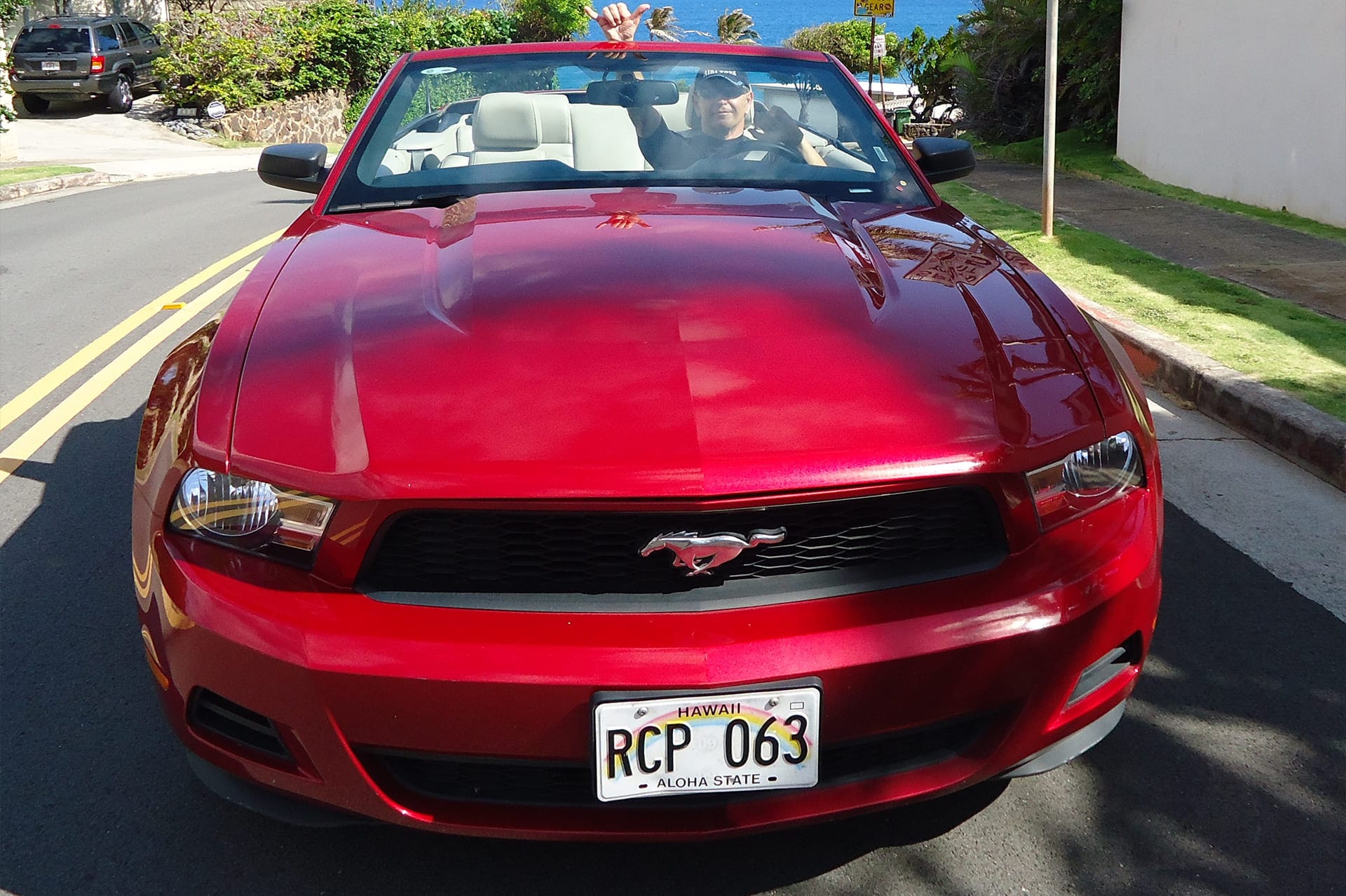
On this sunny morning, we drove the three minutes from our place to the Safeway. Along the way, we admired the green oasis on both sides of the road, right here in the middle of the Pacific Ocean. While the deepest winter reigned in Berlin, we had flowers, palm trees, blue skies, the sun, and the sea constantly before our eyes. When we came out of Safeway, we had picked up fresh rolls and everything else we needed for breakfast, just like every other morning.
After breakfast, as we walked down the stairs to our car, we ran into our landlady, Nancy. Like every morning, she was sitting on her gray wooden porch on the west side of the house, where the sun doesn’t shine, reading her newspaper. To her right, sitting on the railing, was Samy, her black cat. After a few minutes, we said goodbye to her and drove to the Public Beach, just as we did every day.
From the cul-de-sac of Kaimalino Street, where we lived in the second-to-last house, we drove about two miles down Kalaheo Avenue along the bay in Kailua. The entire route is fascinating because you are surrounded only by palm trees and flowers. From Kalaheo Avenue, we took a left onto the driveway to the Public Beach. About twenty meters further, I took a right and found myself in the parking lot. The Naish employees were already out there with their packed trailer full of windsurfing boards and sails. (Robby Naish—windsurfing champion for 15 consecutive years).
Their two employees were busy rigging the sails onto the masts so they could rent the windsurfing gear to tourists later when the wind picked up. At that moment, however, there was a total dead calm.
Because we had spent our winter vacations here in Kailua for three consecutive years, they already knew us. As we got out of the car, a Naish employee greeted us with a friendly smile.
“There probably won’t be enough wind here today,” he told me. Mischko translated everything he said.
“I heard on the weather forecast that it’s supposed to be good down south at Diamond Head.” With that, he gave me the tip that it would be better for me to head south. I looked at Mischko, and she nodded, meaning she agreed.
We thanked him, said our goodbyes, and on our drive south to Diamond Head, we took the east side of the island, passing through Waimanalo, Sea Life Park, Sandy Beach, and Hawaii Kai. After a drive of at least forty-five minutes, we parked on the busy, two-lane main road, Kalakaua Avenue.
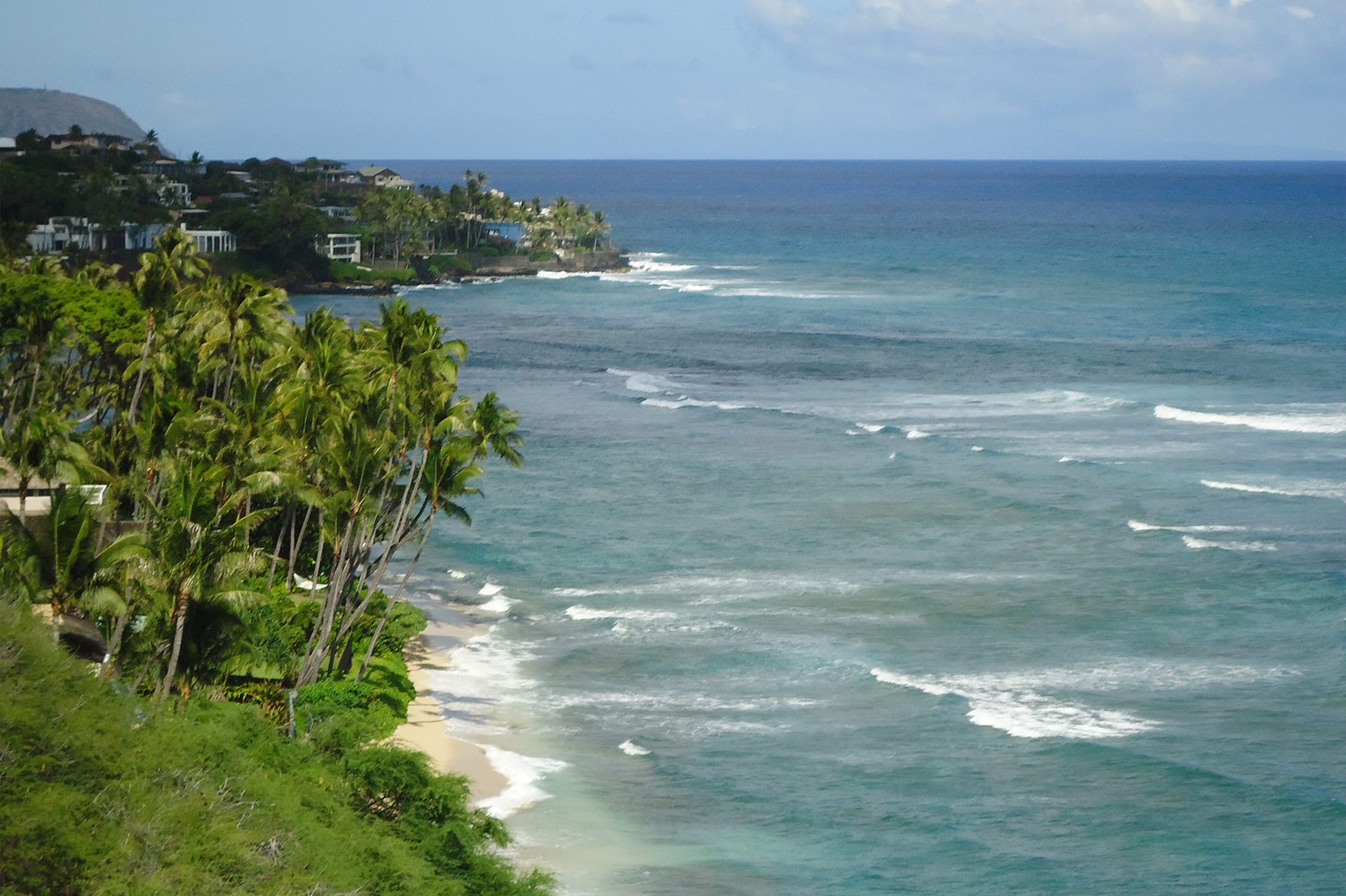
Diamond Head is a crater, a high mountain. The parking spots here were only on the ocean side, meaning you couldn’t park on the mountain side. In the lane next to the mountain, cars drove in the direction of Waikiki toward Honolulu.
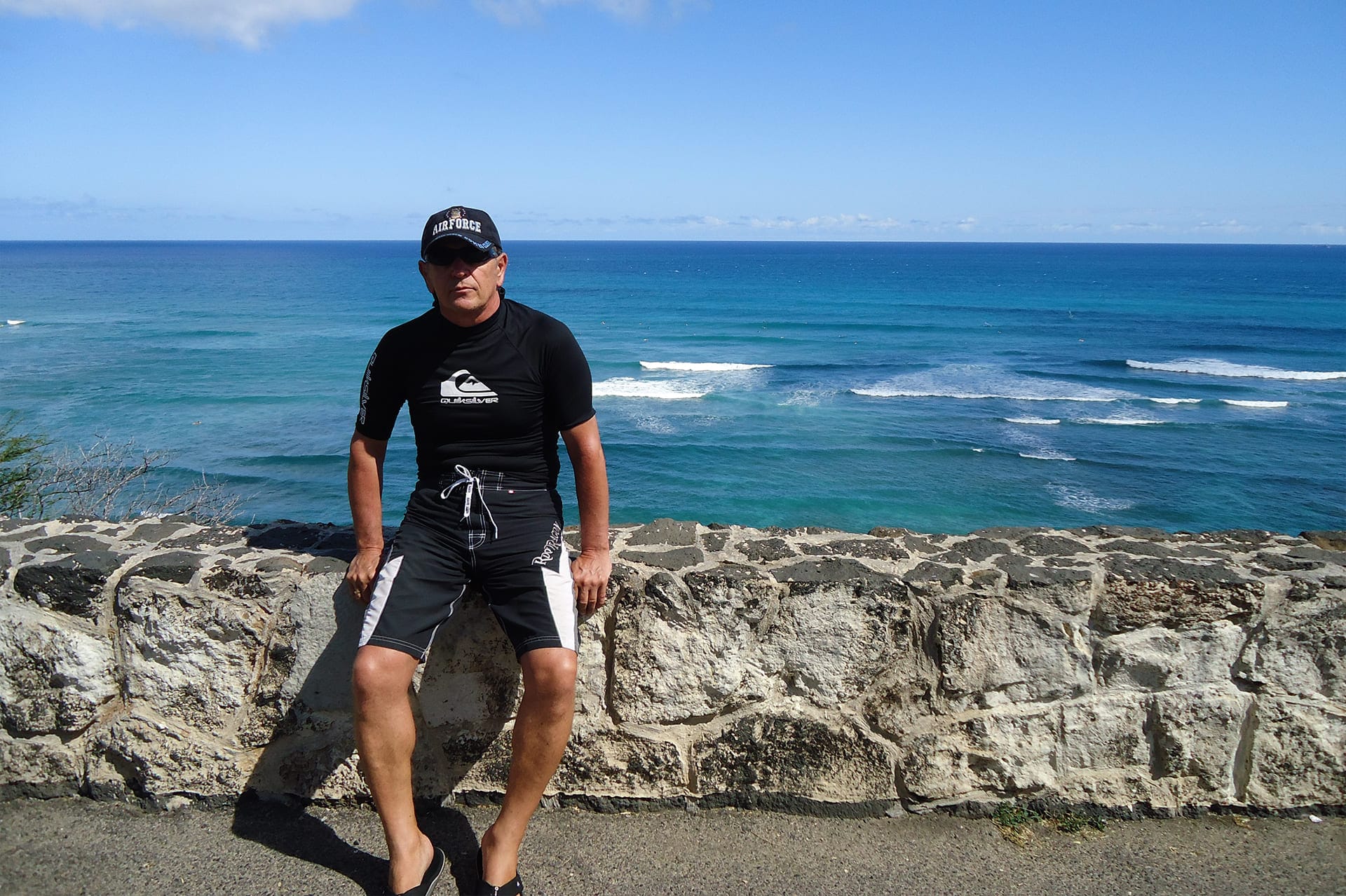
When we got out of the car, we walked two meters across the sidewalk to a wall that was about a meter high. This wall sat about thirty meters above sea level. With our legs dangling, we sat on this concrete wall and looked down at the blue ocean for a while. It was quite windy out there, and you could clearly see whitecaps on the water’s surface. Down below in the waves, there were at least fifty local surfers. There wasn’t a single windsurfer in sight. I guess I’ll be the only one, I thought to myself.
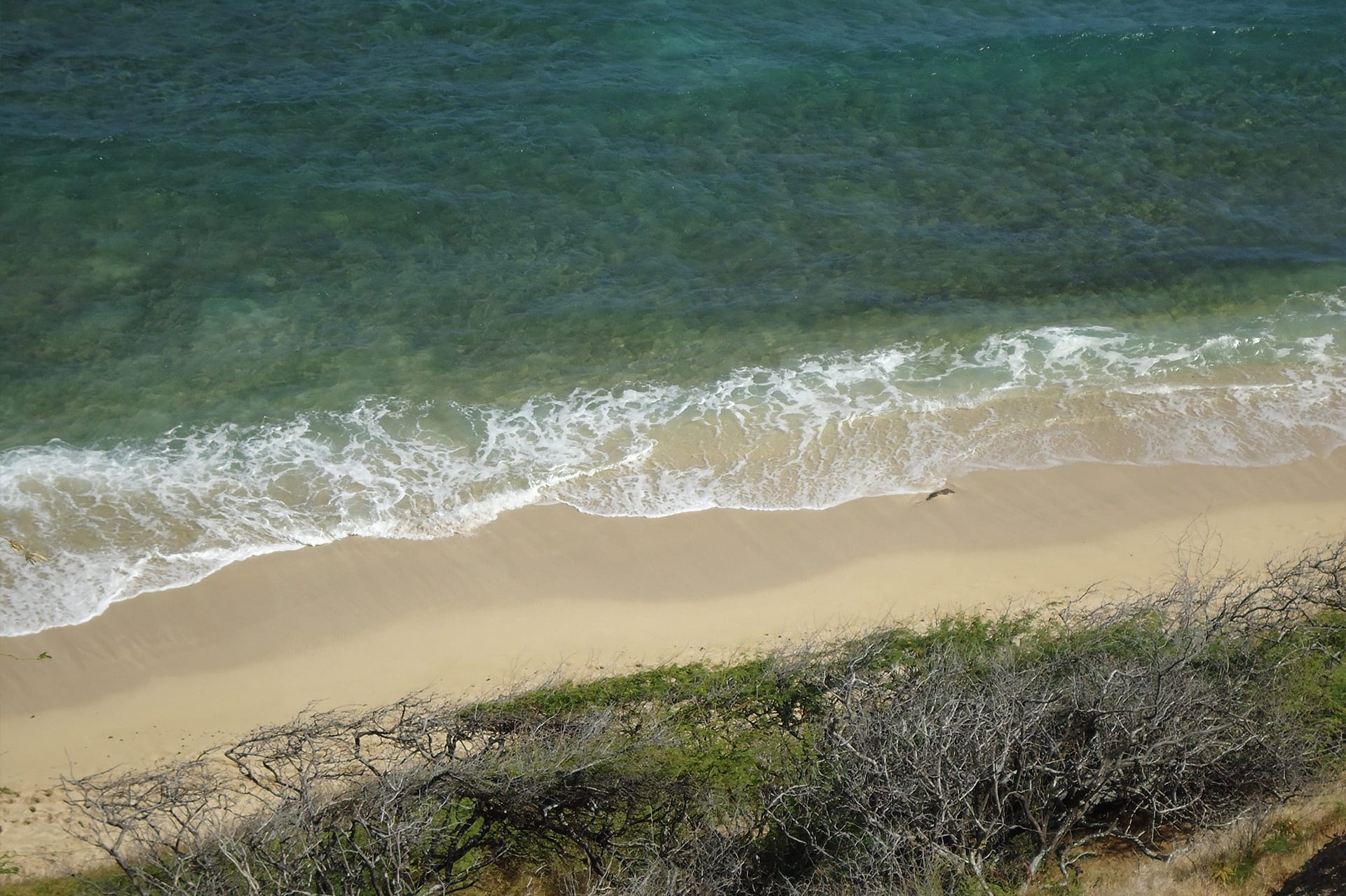
This beach isn’t very pleasant for tourists to swim at. Just beneath the clear water’s surface lurk gleaming black lava rocks. They are razor-sharp reefs, making it incredibly easy to injure yourself in the surf.
Down below, far off in the distance, two couples sat on the white sand. They were likely tourists, watching the surfers riding the waves about thirty meters from the shore.
After about ten minutes, we went back to the car. Carrying our beach gear and my windsurfing equipment, we walked to an opening in the concrete wall that led downward. Leaving the wall behind us, we walked down the mountain in our flip-flops along a narrow dirt path made of red earth. The path had been trampled down by countless feet.
Because the descent was quite steep, it was rather dangerous. We had to squeeze past bushes and be careful not to slip.
Once we reached the bottom, I had to go all the way back up to bring down the sail and mast. By the time I had walked down with Mischko the first time, I was already drenched in sweat. It was simply so hot that by the second trip, my T-shirt was completely soaked and clinging to my body.
As soon as I was back down with Mischko, I had to jump straight into the water to cool off. Since my T-shirt was soaked with sweat, I just kept it on. Because she was hot too, Mischko joined me. Once she had had enough of swimming, she got out of the water, dried off, and sat down on her towel. She had a Stephen King book in her hands.
CHAPTER II
Half an hour passed after I got out of the water. That’s how long it took me to rig my sail. I love windsurfing, but because I am impatient, I hate rigging the sail and the boom; I can hardly wait to get the board into the water.
After impatiently wrestling my wetsuit on, I drank my sports drink and said goodbye to Mischko.
As she always did before I went into the water, she wished me fun and told me to be careful. A second later, I grabbed the board and sail and walked across the soft sand into the water. In this naturally wide bay, about two hundred meters across, the wind wasn’t as strong as it was out in the open ocean. Standing knee-deep in the water, I waited a while for a gust of wind to do a beach start. When I saw smaller waves rolling in from the east on the water’s surface, I figured I would have enough wind.
As soon as those smaller waves reached my level, I put one foot on the board. When I placed my second foot on the board and transferred my entire body weight onto it, the board sank almost up to my knees in the next second. Wobbling and moving slowly beneath the surface like a submarine, my board crept forward.
To get the board out of the depths and up onto the water’s surface, I needed much more wind. Unsteady and wobbling, I barely reached the halfway point between the beach and the break where the surfers were gathered before the gust of wind died. Without wind, I couldn’t windsurf, so I had to jump off the board into the water. Upon impact with the cold water, I felt razor-sharp lava rocks under my feet but thought nothing of it.
Standing waist-deep in the water, I looked to the east, waiting for the next gust. After about three to four minutes, I saw smaller waves on the surface again. That was the sign that the wind was coming. This time, the gust seemed a bit stronger.
When the gust reached me, I successfully executed a water start.
I only had fifteen meters left to sail before reaching the surfers in the break. Just before the break, the wind picked up, effortlessly pulling me and the board out of the depths and onto a plane across the surface. Shortly after, I crossed the danger zone.
As I sailed past the surfers in their black wetsuits out of the danger zone, they looked like seals to me.
I immediately hooked into my harness and slipped my feet into the foot straps. My custom Naish board instantly hit top speed, exactly as you’d expect from a fiberglass board. I was completely alone on the open ocean. The water and the sky were blue. The sun was shining, the wind was whistling in my ears—what more could you want? I heard the hum of my three fins at the tail and turned my head to look behind me.
I was leaving a long white wake on the blue water’s surface, as if I were drawing a white line across the ocean behind me.
Shortly after, I turned my head back to look forward. Even though it was the open ocean, I now had to be fully concentrated every fraction of a second, making sure the path ahead was clear. I had to be prepared for any situation and every oncoming wave, ready to react correctly with my feet.
At full speed, leaning into my harness, I enjoyed the velocity and the freedom. I had probably been riding for half a minute when I suddenly felt something smack against my left foot. I glanced down briefly—”Holy crap!” slipped loudly from my mouth.
On top of my foot, from the big toe upward, I saw a gash over ten centimeters long. My skin had peeled back and was lying on top of my foot, flapping like a flag on a mast at this high speed. I immediately realized when it had happened. It was the moment the gust died and I had jumped into the water. No wonder, with those razor-sharp reefs, I thought. When I hit the water, I had felt a hard rock beneath my feet. It was hard, but that’s normal when you land on rocks in cold water. I hadn’t given it a second thought at the time.
Taking a closer second look, I checked to see if blood was visible or if I was actively bleeding. I kept sailing at full speed. The nose of the board was cutting through smaller waves, so the white spray was constantly washing over my feet and the open wound. Even my black sunglasses were catching the spray.
I couldn’t see anything on my foot. Without giving it another thought, I continued riding at full speed. I was probably bleeding, but the bubbling white water washed it away before I could see it. The board shredded across the blue ocean surface, gliding like a rocket through space. Behind me at the tail, the fins made a noise that sounded like I was driving a Formula One car. Water continuously sprayed into my face and onto my glasses.
My board was new; I had bought the latest board from world champion Naish that year. His father had shaped the board with his own hands. I still needed a bit of practice with this 6-foot board. I looked down at the board and its colors again.
Then it occurred to me that I was moving further away from land. The water beneath me was now at least five hundred meters deep. Maybe even a thousand, I thought. Ahead of me to the east, and behind me to the west, the waves looked like giant, dark blue mountains! Looking toward the horizon in the east, all I could see was the light blue sky and the dark blue color of the ocean surface. For the moment, I was down in a valley. From where I stood, it was up to fifty meters to the crest on the eastern horizon.
It was the same to my right, in the west. Light blue sky, and the back of the mountain (the crest of the wave) was visible. I was about twenty meters deep in the valley.
From the depths, I shot up the fifty-meter smooth, dark blue mountain at full speed. Upon reaching the top, I cut through the small break and surfed down the icy-smooth valley—the back of the wave—at full speed again. It was almost like skiing in the winter. But in winter, I have snow beneath my skis; here, it was the dark blue abyss. Thinking about being entirely alone out here, and how deep it was beneath me, I felt a slight tremble of fear in my knees. Windsurfing at Public Beach in Kailua, where we stayed, was child’s play compared to this.
If there had been another windsurfer out here beside me right now, I probably would have felt safer.
While surfing down the back of the wave and looking south toward the horizon into the blue sky, I watched the ocean slowly drop, centimeter by centimeter, like a slow-motion swing. Back down at the lowest point in the valley, holding my five-square-meter sail, I felt so incredibly small, as if I were gripped by a giant, dark blue monster’s hand.
When I surfed diagonally out of the valley, all I saw was a massive mountain of dark blue water. These mountains were true monsters. After crossing and surfing down the wave mountains several times, I glanced back to see how far I was from the beach. I estimated it was between two and three kilometers, so I decided to turn around. The moment I tried to turn, I ended up in the water, just as expected.
I still needed to master jibes. As mentioned earlier, I had bought the latest board from world champion Naish this year and didn’t have that much experience with it yet. While swimming and turning the board into the correct position for a water start, I took another quick look at the board and its colors. The purple, yellow, and blue colors glittered in the sun, making me proud to have bought it. My pride had cost me $1,200 (just the bare board, without the sail, mast, or boom).
With both hands on the board, submerged up to my head with my feet dangling in the deep, I suddenly felt even smaller, making these thoughts even more terrifying. I looked behind me to the east, where the wind was rolling the dark blue wave toward me. I was about twenty to twenty-five meters down at the deepest point of the valley. Actually, these mountains weren’t all that steep. From the wave rolling in slow motion from the eastern horizon to the crest in the west, it was at least a hundred meters, with me right in the middle.
For the first time in my life, I saw how massive and monstrous the ocean could be. I felt so puny and insignificant in the water at that moment, like a grain of sand.
As the wave from the east (the dark blue mountain) approached, I slowly began to rise automatically.
Eventually, I emerged from the valley and reached the very top of the break, where I was washed by the wave and the fizzing white spray. Looking left toward the southern horizon, I watched in slow motion as I sank back into the depths with the wave, moving to the lowest point of the trough without doing a thing. I didn’t even dare think about what might be swimming beneath my feet in the dark abyss at that moment.
CHAPTER III
For about ten minutes, I observed the beach in the distance where Mischko was reading her book. Partially covered in green bushes, the Diamond Head crater, along with the blue sky and the sun, beautified the scenario. The wind howled and whistled in my ears. The ocean surface was blue. The thought I am truly in a real paradise went through my mind. I was so happy in that moment, being completely alone out here to observe it all.
At the same time, not far from me, I thought I saw something on the surface of the water. Since I was almost at the bottom of the valley, I decided to head back to the beach. As I prepped for the water start, the Diamond Head crater remained in the distance before my eyes.
The wind howled in my ears—a sign that getting out of the water would be easy. As soon as I was on the board, preparing to slip my feet into the straps and hook into the harness, I suddenly saw four fish not far from me! They were heading northwest.
There was a fin in the middle of their backs, and another smaller fin near the tail end. In that moment, I remembered that earlier, while hanging in the water with both hands on the board, I had thought I saw something on the surface. That was exactly why I had decided to return to the beach!
Because these fish were about six meters away from me, I could roughly estimate their size: up to a meter and a half. Their backs were black, while I could make out a slight white color underneath their heads. I was certain they were dolphins.
Why was I so sure? From the movie Jaws, I remembered a scene where only one fin was visible on the shark’s back. Not far from those four fish, I spotted two more to my left. Those two were further south, while the four were spread out toward the northwest. I was practically three-quarters surrounded. While I was thrilled to have seen six dolphins, I simultaneously heard several noises. The wind howled in my ears, and then I heard the roar of an approaching wave. My eyes had been glued to the fish the whole time, so I hadn’t even noticed that I was currently right at the crest above the valley. In the next moment, the wind pushed the break toward me and my board.
Since I had no speed, I had to keep the board under control in the break to avoid falling into the water. Almost the exact moment the wave washed over my board and passed, the fish were caught in the break and washed over as well. Once the break passed, nothing but white spray and white foam remained. In that moment, I felt and saw in slow motion how the ocean slowly sank beneath me, and I began to drop into the depths again.
I took one last look for the fish. Nothing was visible. I thought to myself: I have to hurry back; I want to tell Mischko what I just saw.
The beach was at least two kilometers away. I was thrilled because I had seen six dolphins. I have to tell her. It was beautiful being alone on the ocean. The blue sky, the shining sun, the crater in sight, and I was high on the rush of speed in paradise. I felt like the king of this ocean, as if it belonged only to me.
While enjoying these moments, I thought about the dolphins the entire time and was simply overjoyed. I could hardly wait to reach the beach and tell Mischko. Whenever I found myself in a trough, I surfed up the mountain of water and crossed the wave’s break.
After my board collided with the break, taking a full load of white fizz to the face, I sped back down the icy-smooth back of the wave. The back of the wave was so smooth it was practically like being on a sheet of ice. Surfing down that smooth surface was simple and quite easy, which made speeding diagonally down the fifty-meter water mountain all the more fun.
Back down in the valley, sandwiched between the two dark blue mountains of water, I felt like a tiny fly that was about to be swallowed by a monster’s gaping mouth in the next second.
At full speed, I enjoyed the rest of the ride and climbed the mountain. After about five minutes at top speed, I reached the break where the fifty or so surfers were gathered, riding the waves.
I had to slow down here because of the surfers. Once I crossed the danger zone, I had to be careful not to damage my fin on the reefs in the shallow water behind the break. There was still barely any wind here in the bay, so I was just glad to reach the beach without falling in.
I saw Mischko lying on her towel, reading her book. As I got out of the water and approached her, she was so engrossed in her book that she didn’t even notice me.
“Mischko, do you know what I just saw out there?” I asked. She was surprised I had come out so quickly.
“No idea. You’re out already?”
“Yes, I wanted to tell you what I just saw. I saw six dolphins!”
“Really?” she said, beginning to share my excitement.
“Yes! They were dolphins. Their backs were black, and underneath they were slightly white!”
“Wait a minute. Dolphins aren’t black. They’re more gray or bluish, but never black,” she said.
“How many fins do dolphins have on their backs?” I asked. “I saw two. One in the middle of the back, and a second smaller one near the back.”
We couldn’t agree. I walked over to the couple not far from us. They were still watching the surfers.
It was funny—there were hardly any tourists on the beach, just these two couples, and the two I spoke to happened to be German. They confirmed that dolphins have two fins, but they weren’t entirely sure.
When I came back, I told Mischko that the couple said dolphins have two fins, but they weren’t completely sure either.
CHAPTER IV
After about three to four hours, we packed our things and drove back up the east coast to Kailua. When we got home to the apartment, the first thing we did was satiate our curiosity. There were two books about Hawaii in the apartment. They detailed all the marine life. Mischko placed the large book on the waterbed and flipped through it.
After turning several pages, a picture suddenly appeared.
We looked closely at the image. It was a dolphin. In that exact moment, we turned our heads and looked at each other. Our eyes met, wide and questioning. The dolphin only had one fin on its back! But I had talked about seeing two fins on their backs.
At that moment, we realized that what I had seen were definitely not dolphins!
“Those weren’t dolphins!” I thought out loud.
“Probably not, since you said there were two fins on the back,” she replied.
Mischko kept flipping through the book. A few pages later, she opened to a new page. In that moment, we saw the fish I had described.
This fish had a large fin in the middle of its back and a slightly smaller fin toward the tail. Their backs were black. Under the head, white color was visible—exactly what I had seen.
At the same moment, we looked at each other for a second time. This time, our eyes were even wider.
Tiger sharks!
I nodded my head. “Yes, those were the fish.”
Tiger sharks! They were actually tiger sharks.
“Oh man,” I said out loud. “Was I lucky!” I said to Mischko.
“Yes!” she said. “Incredibly lucky.”
“Oh man!” I continued. “I was so happy I’d seen dolphins, and they were sharks all along.”
“Did I really bleed so much that I attracted the sharks, or was it just a coincidence?” I had been riding for at least five minutes, maybe longer, before taking a break out there. I had probably lost track of time hanging in the water with both arms on the board, admiring the Diamond Head crater from the open ocean.
Since it has been scientifically proven that sharks do not react to human blood, I think it was more of a coincidence. Besides, there was no immediate danger because they were still a fair distance from me, and I had just spotted them by chance.
That evening, before we drove to Pizza Hut for dinner, I absolutely had to go downstairs and tell our landlady, Nancy, about the encounter. “A nice adventure,” she remarked. She had lived here for so many years but had never seen a shark. Since she’s an older woman who sits on the sofa on her porch all day, she probably never will see one either, I thought to myself.
All three of us grinned; she was happy for me that nothing had happened. Shortly after, we said goodbye to her and went to Pizza Hut in Kailua Town for dinner.
While waiting for our pizza, with a grin on my face, I came to a realization and said to Mischko:
“It was a good thing I didn’t know they were tiger sharks at the time. If I had known they were sharks, I definitely would have gotten scared and probably panicked.”
She grinned back. “Yes, that was really good!”
© 2026 Hawaii Adventures Shark. All rights reserved. This story is based on true events and is my intellectual property. The text and content are protected by copyright. Any unauthorized reproduction, distribution, or publication (even in part) is strictly prohibited without explicit permission.