
The Hawaiian rainstorm
A frustrating attempt at building an Ikea-style chair turns into an impulsive midnight ride to Walmart to exchange a faulty leg. But the journey back quickly spirals into chaos when a sudden Hawaiian rainstorm plunges the streets of Pearl City into total darkness. Riding blind through torrential rain and a completely flooded road, a high-speed miscalculation leads to a terrifying crash. Battered, bruised, but miraculously unbroken, he must push through the pain to make it back home, learning the hard way that a midnight ride in the tropics is no ordinary adventure.
Home / Stories
CHAPTER I – Our Hawaii Ritual: Air Mattresses, Ikea Feelings, and Jet Lag
Whenever we travel to Hawaii and the previous tenant has moved out, we are greeted by the exact same scene: the apartment is completely empty. All we find is a bare room and a built-in kitchen.
That’s why our very first trip is always straight to Walmart. There, we buy two large, tall air mattresses to sleep on and two chairs—after all, we don’t want to sit on the floor while eating breakfast in the morning.
The brilliant part: When we leave Hawaii three months later, we simply return the items on our last day. Since we treat everything with care and return it in pristine condition, the full purchase price is refunded without any hassle.
In this particular year, we didn’t arrive until 11:30 at night. Completely exhausted from the long journey and plagued by jet lag, sleeping was the last thing on our minds.
First, the air mattresses had to be inflated and the small chairs assembled. The whole thing had a real Ikea feel to it. While Mischko insisted on screwing her chair together entirely by herself, I started working on mine at the same time.
(By the way, in the years that followed, we fully furnished the apartment. As a result, we were able to rent it out for significantly more money from then on.)
CHAPTER II – Craftsman Meets Banker: Our Ikea Moment for Two (Or Not)
We are currently putting together two chairs—a project very much in the style of classic Ikea furniture. The principle is simple: Each model has identical holes drilled for small, narrow wooden dowels. These pegs, usually 6 to 8 mm thick and 30 to 40 mm long, hold the wooden pieces firmly together and prevent the panels from slipping later on. A perfect teamwork project, or so I thought.
The plan was to work in parallel: While I screwed my chair together, Mischko would build hers. But the dynamic quickly shifted. On my chair, one of the holes in the leg was drilled crookedly, so I got stuck right away. The perfect opportunity, I thought, to keep working on Mischko’s chair together. But Mischko strictly refused my help. She absolutely wanted to finish her piece of furniture completely on her own. She probably just wanted to prove to me that she could do something like this without assistance. She really doesn’t need to do that—I already know how incredibly intelligent she is. But I guess the motto here was: The banker shows the craftsman how it’s done! Even if all I could do at first was watch, her ambition absolutely impressed me.
CHAPTER III – Escaping the Jet Lag
I am simply furious. The unfriendliness earlier was the final straw. While she calmly continues tinkering with her chair, I am boiling inside. It is midnight in Hawaii, but thanks to severe jet lag, sleep is completely out of the question.
Furious, I announce: “I’m going to Walmart right now to exchange this!”
I take the elevator down, leave our large parking garage on the second floor behind, and set off on my bike. First across the sidewalk to the exit, then left up the small hill. My destination: The Walmart in Pearl City at 1131 Kuala Street.
From Century Park Plaza, it’s a short, direct commute of about 800 meters (half a mile). By bike, it takes barely three to four minutes. I cross Kuala Street and turn left onto it.
The ride is surreal. While it’s the middle of the day and the dead of winter in Germany, I am cycling through the warm night here at the witching hour. I am completely alone on the sidewalk; not a soul is in sight. The intense, sweet scent of hibiscus and plumeria hangs in the air. Only very rarely does a car approach me from the direction of Walmart. The route challenges me briefly: First it goes uphill, and shortly after, downhill again. From the lowest point at the mall exit, it’s an uphill ride for the last stretch to Walmart. The entire trip takes less than five minutes.
CHAPTER IV – The Calm Before the Storm
Arriving at Walmart, I turn right off Kuala Road onto the property. Directly under a bright streetlamp, I lock my bike, unscrew the seat just to be safe, and walk the last 30 meters (100 feet) to the large entrance with the canopy. The returns department is located right on the right side, across from the restrooms. It is exactly midnight. I have to wait a moment until the customer in front of me is served. After about fifteen minutes, I’m done: The improperly drilled wooden chair leg has been successfully returned.
Inside the store, I go looking for a new, fitting wooden leg for the chair. At the exit, I show my return receipt, and as I finally step outside, a surprising scene unfolds before me: Several customers are huddled under the protective canopy. No one dares to step outside.
CHAPTER V – The Heavens Open Up
A fierce storm is now raging outside, and the sky has completely opened its floodgates—it is pouring buckets. Massive, heavy raindrops smack against the asphalt. This is typical for Hawaii at this time of year: The rainy season runs here from early December to late March.
Easily twelve to fifteen people are standing under the brightly lit canopy, waiting for the storm to let up. I am the only one here who is traveling by bike.
But instead of waiting, I don’t hesitate for a second. I just start walking as if it isn’t raining at all. I have my backpack on my back, holding the new wooden leg tightly in my hand—a little water won’t ruin the wood that quickly.
I walk a good thirty meters (100 feet) across the parking lot to the streetlamp on the left side of the entrance where my bike is parked. Although the parking lot is illuminated by several lamps, it is almost impossible to see anything through the dense sheets of rain.
As I screw my bike seat back on in the pouring rain, the heavy drops relentlessly pelt down on me. Paired with the extreme jet lag in my head, it feels completely surreal: Every thick drop feels as if it shakes my brain cells. On my scalp, it feels like someone is beating a drum on my skull with full force.
CHAPTER VI – Flying Blind in Absolute Darkness
It’s not just heavy drops crashing down on me—in the bright glow of the streetlamp, I see them literally exploding into hundreds of tiny droplets right in front of my eyes. The background noise is deafening. The loud rustling of the palm leaves being whipped by the rain mixes with the violent splashing on the asphalt. Deep puddles have already formed everywhere, and small, rushing streams flow down the slope toward Kuala Street.
I slot my bike seat in, tighten it with a quick turn, and swing myself onto the bike. I immediately ride through the pouring water and the newly formed flash floods down to Kuala Street. When I reach the sidewalk and turn left, I am suddenly surrounded by total darkness. The next streetlamp isn’t until the intersection with Acacia Road—a good hundred meters further down the slope. I can barely see my hand in front of my face. It is pouring like crazy, and without any street lighting, I only know one thing: The sidewalk is completely flooded and slippery as ice.
As I ride further down the incline, dirt and dense bushes close in on me from the left. Palm trees tower above my head. Their rustling in the storm is so incredibly loud that it’s almost terrifying. My visibility is less than three meters (ten feet). The lower I go, the taller the hibiscus bushes by my side seem to grow, separating the Walmart parking lot from me and the street. To my left, there is absolute darkness; to my right, not a single car is on the road. Darkness. Total, pitch-black darkness and a merciless downpour. This is the rainy season in Hawaii. It feels as if someone is hosing me down with full water pressure from hundreds of hoses at the same time.
CHAPTER VII – The Invisible Enemy
I know exactly what to do: Just don’t go too fast now. But as I approach the intersection, the next shock hits—the traffic lights are completely dead. It seems as if all of Pearl City has suddenly suffered a power outage. Not even the large streetlamp in the middle of the Acacia Road and Kuala Street intersection is burning. I try to be as careful as possible, but for these extreme weather conditions, I am already going too fast on the wet sidewalk.
To be able to brake at any moment, I let my fingers rest lightly on both brake levers. But it barely helps—the rims and tires are so soaking wet that the brakes practically grip nothing but air. Just before the intersection, I get my bearings: To the right are the military housing complexes, to the left the road goes down the hill to the main road via Acacia Road and directly onto Kamehameha Highway, which later runs past our Ocean Tower.
The traffic light system is completely dead; at this hour, it doesn’t even switch to flashing mode. Everything is pitch black. I am lucky that not a single car is on the road during this storm. It continues to pour buckets. Because the massive volumes of water are constantly slapping against the palm leaves, a deafening roar echoes in my ears. The water doesn’t just splash; the heavy drops strike my bare head like physical blows from above. As I prepare to cross the street, I see the full extent of the storm: All the rain coming from further up is shooting down Acacia Road.
Because the road is on a steep slope, it has turned into a massive, raging river that I have to cross with my bike. Fear shoots through my head. The rain washes the typical Hawaiian red earth from the hibiscus hedges straight onto the asphalt. I know the road surface must be slippery as ice because of it. Very carefully, I steer my bike through the deep stream. When I finally reach the other side of the street, I decide against riding on the road—the total darkness there is simply too dangerous.
CHAPTER VIII – The Fatal Impact
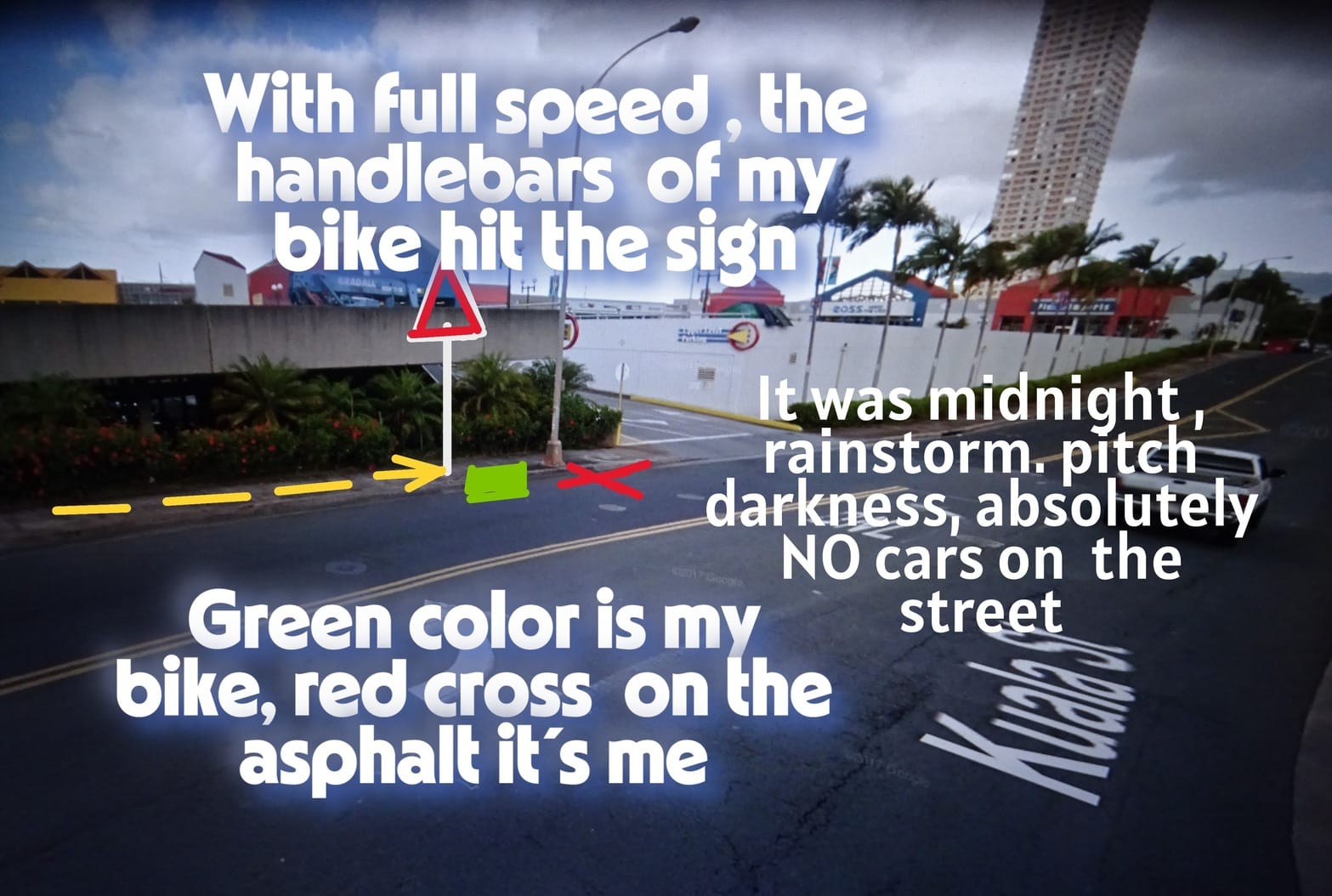
I steer straight toward the sidewalk. My visibility is well under three meters. But since I know this route in my sleep—after all, we have walked or cycled it dozens of times—I just let my bike coast. I have absolutely no intention of pulling the brakes now. On the contrary: I want to use the momentum. When I reach the lowest point of Kuala Street at the bottom, the entrance and exit to the mall will be on my left. Because the road goes steeply uphill right after that, I need maximum speed. I want to race up the hill without having to pedal laboriously until I reach the main pedestrian entrance and the security guardhouse at the top.
Even though I can barely see three meters ahead, I fixate my gaze on the sidewalk directly in front of my front wheel. In this absolute darkness, I focus all my energy on staying exactly in the middle of the path. Nothing can really happen to me, I tell myself. The water splashes endlessly, and from the right side, the torrents shoot down into the storm drains that run beneath the Sam’s Club parking lot. I reach the middle of the slope.
Because of my high speed, the rain now hits my face with full force. The heavy drops whip directly into my eyes, making me almost completely blind. I am almost at the exit when a thought suddenly shoots through my head: There was a street sign under the lamp that always shines during normal weather! At the very moment I think of it, something round appears out of nowhere in front of me—the vertical, white metal pole of the sign I had just remembered.
My bike is heading unbraked and head-on toward the white metal tube. I know I cannot jerk the handlebars too sharply now, or I will crash immediately. In a fraction of a second, I yank the bike very slightly to the right, toward the street. But it is too late. In the blink of an eye, the left side of my handlebars slams into the sign with full force. The handlebars catch and practically wrap themselves around the pole.
The brutal impact rips me from the saddle, sending me flying through the air for meters. Luckily, my left shoulder misses the metal pole by a hair’s breadth. I sail through the darkness and the whipping rain until I hit the ground hard—landing with my back halfway on the sharp edge of the sidewalk and my feet in the raging stream flowing down from Acacia Road.
The sheer momentum of my high speed spins me around in circles multiple times like a stuntman. I slide right down the middle of Kuala Street through the torrents of water shooting down from the Acacia intersection. When the spinning finally stops, the enormous momentum sends me sliding for several more meters. The asphalt is completely covered in water, while the heavy raindrops explode all around me. I slide down the stream on my right thigh and elbow until I finally come to a motionless halt right at the exit of our mall.
Amidst the chaos, the first relieved thought shoots through my head: I was incredibly lucky. My head is intact, and I can think clearly. Had I not hit the sign, I would have ridden another thirty meters (100 feet) across the flat section and started climbing the hill again. In dry weather, this is routine for me: I use this momentum every time to effortlessly clear the incline up to the main pedestrian entrance. But tonight, that exact routine became my downfall.
As I lie on the asphalt in the flowing water in the middle of the darkness, the background noise is terrifying. Right behind my ears, the water slaps and gurgles continuously as the flash floods plunge into the storm drains. The fierce downpour whips into my face and stomach with full force. I feel the backpack on my back—but there is no sign of the hard-earned wooden leg. Probably because I was simply too surprised by the sudden impact and this completely unexpected flight through the air to hold onto it.
CHAPTER IX – Surviving Without a Bad Word
When I finally come to a halt under the merciless downpour, my head is absolutely clear. Now I lie here in the middle of the darkness, forced to keep my eyes tightly shut because torrents of water are running down my face. I know exactly what just happened: I am lying in the middle of the street, in the middle of a raging stream. I try to stand up. As if absolutely nothing had happened, I push myself off the wet asphalt with both hands. I want to check immediately to see if all my bones are still intact.
Only when I am back on my feet, standing in the middle of the small flash flood, do I look down at myself. I examine my elbows and watch the giant raindrops smack against my right hand. Then I inspect the other hand. Although I can barely see anything in the deep darkness, my senses don’t deceive me: Everything is perfectly fine! No broken bones; my hands are working. I can also stand and walk on my legs without any problems—though my new white sports shoes are involuntarily serving as rubber boots in this moment.
Now I have to find my bike in the pitch-black Pearl City. I wade through the water back toward the sign—back to where I just started sliding across the asphalt. As I scan my surroundings in the dark, I notice something astonishing: I haven’t uttered a single bad word. I haven’t even cursed. This is a completely new side of me. Normally, a curse slips out at the slightest inconvenience. In this moment, the pure relief and sheer luck that I hadn’t broken anything simply overpowered everything else.
The rain continues to splash down unabated. With my soaked shoes, I wade through the stream on the road, where the water is now at least an inch (three centimeters) deep. Suddenly, I see a faint gleam in the dark—the metal of the pedals. Since my bike frame is dark blue and there isn’t a single light burning down here, the handlebars and pedals are the only things that stand out against the blackness. The bike is lying not far from the sign that the handlebars had just wrapped themselves around.
I grab the bike, lift it up, and give it a quick inspection: Everything actually seems to be intact. I swing myself onto the saddle as if nothing had happened. Now I have to do what I had originally tried to avoid with that risky burst of momentum: I have to pedal up the steep incline using my own strength. With burning muscles, I finally reach the highest point, where the road flattens out for about thirty meters. To the left is the mall; to the right, the path leads to our main entrance, where the security guardhouse stands. Only twenty more meters, and then I can finally let myself roll down the hill. I pick up speed and ride downhill. But this time, I am careful. You don’t tempt fate twice on a rainy Hawaiian night.
Part 10: The Shock in the Mirror
I turn right. Above my head towers the largest tree I have ever seen in my life—its canopy measures an impressive twenty to thirty meters (65 to 100 feet) in diameter at its highest point. Finally, I stand before the entrance to the second level of our parking garage. I open the gate and push my bike inside into the comforting dryness of the parking deck, passing the sleeping cars. After securely parking my bike, I walk to the elevator and ride up to the 31st floor.
When I enter the apartment, the anger really boils over—I am unbelievably mad at Mischko because she simply wouldn’t let me help her with the chair earlier. She looks at me and asks drily: “So, did you exchange it?” Since I am so charged up and absolutely do not want to provoke a fight, I barely dignify her with an answer and head straight to the bathroom.
I lock the door and turn on the bright light. In the darkness out there in the rain, I hadn’t felt anything, but now I want certainty and need to examine my body for injuries. I turn around and look over my shoulder into the mirror. The shock hits me like a physical blow. I literally recoil in horror. My entire right thigh is torn open over a large area all the way up to my buttocks—a souvenir from the rough asphalt I had slid across earlier. And that’s not all: When I examine my arm, I see that my right hand is totally scratched and scraped bloody all the way up to the shoulder.
Even though I had slid across the street like a wet sack in an inch-deep stream, the water had barely been able to buffer the brute force of the rough asphalt. First, I painstakingly have to wash myself and rinse the dirt out of the abrasions. The next morning, my skin burns like fire, and my first trip isn’t to the beach, but to search for a pharmacy to get healing ointment for my wounds.
Had I not hit the sign back then and been able to take my usual running start for the hill, none of this would have happened. In dry weather, that ride was pure routine for me. But as it was, with an aching body covered in friction burns, my very first day of vacation in Hawaii had officially begun.
© 2026 Hawaii Adventures Shark. All rights reserved. This story is based on true events and is my intellectual property. The text and content are protected by copyright. Any unauthorized reproduction, distribution, or publication (even in part) is strictly prohibited without explicit permission.