
Memorial Day in Laughlin: An Extreme Heat Bike Tour
Before we climb the steep mountain together, prepare yourself for a gripping Nevada desert survival story. Read about pushing the absolute limits of the human body during a grueling bike tour in blazing 108°F heat—a pure test of willpower and a relentless battle against the scorching elements.”
Home / Stories
Foreword
Dear reader, before we climb the steep mountain together, I want to thank you. On my website, you will already find over 20 long, gripping stories and island adventures that you can read completely for free—my gift to you for your loyalty. Now, join me on one of my most intense borderline experiences in the scorching desert sand of Nevada. Buckle up!
CHAPTER I – The heat, the expired insurance, and the wrong sail
It is Memorial Day in the US, a holiday to remember fallen soldiers. I am still lying in bed, thinking about the weather forecast I read online the day before: the thermometer is supposed to climb to an unforgiving 108 degrees Fahrenheit (about 42 degrees Celsius) today. My thoughts are spinning, as they often do when I lie awake patiently waiting for Mischko to show a first sign of life.
Trapped in the Shade I review the past few days. Recent events have frayed my nerves—most notably the injury to my right big toe. While Mischko regularly cooled off in the freezing river over the past three weeks, I was forced to strictly rest my foot to avoid an infection. With daily temperatures hovering around 104°F (40°C), this was a true test of patience. I spent most of my time in the shade of our ramada, which fortunately protected us all day. But on windless days, the heat by the river was almost unbearable. Despite the shade, I felt several times as if I were on the verge of heatstroke.
A Risky Game with My Health The bizarre—and simultaneously reckless—part of the situation: Just a few days before my injury, our ADAC international health insurance had expired after its regular 45-day term. I had wanted to save the money on an extension for another 45 days. I was fully aware that traveling without insurance carries an enormous risk, and a single severe accident or hospital stay could mean financial ruin. The painful realization that I don’t always make the smartest decisions hit me right then. Before making my choice, I had tried to comfort myself with the past: in all my years abroad, nothing serious had ever happened. So, stinginess won. For the second half of our US stay, I firmly resolved to simply take better care of myself.
The Most Expensive Gamble in the USA This morning, the whole thing runs through my head again, and I know: foregoing international health insurance in the US is the biggest financial gamble a tourist can take. The US healthcare system is privatized; even minor medical treatments immediately result in four- or five-figure bills. And the sad truth is: mere caution protects you neither from accidents caused by others nor from a sudden infection or acute appendicitis.
The Instant Solution Most standard insurance policies must be taken out in Germany before departure. However, there are specialized providers where you can retroactively purchase international health insurance online from within the US, effective immediately.
The Wrong Sail and the Injury It happened on the fifth day after my insurance expired. I arrived at Lake Mohave around noon, located right in the middle of the Arizona desert within the Lake Mead National Recreation Area. The opposite shore already belongs to Nevada—the state where we had actually set up our base. As I slowly rolled my car down the unpaved, sandy path and came out of the curve, I already saw several vehicles in the parking lot. The forecast had predicted wind speeds of 35 miles per hour (about 55 km/h). The sky was flawlessly blue, and the sun had already passed its peak. Before me stretched Lake Mohave in the deepest blue. Out on the lake, the waves were crashing over each other; their white foam crests instantly reminded me of Hawaii. My God, if the red rocks on the other side hadn’t been there, you would think you were somewhere on the open ocean.
Gear Choice and Fickle Winds There were already a few windsurfers and two kitesurfers out on the water. Although I had a smaller 5.0-square-meter sail with me, I made a fateful choice and opted for the large 7.5-square-meter sail. Just looking at the white wave crests out there, I should have realized that the 5.0 sail would have been perfectly adequate. The conditions were extremely fickle: the wind fluctuated between calmer phases of around 18 mph (30 km/h) and violent gusts of up to 43 mph (70 km/h). I naively hoped that the larger sail would help me during the lighter wind moments. My plan for the strong gusts was simple: just let the pressure pass and immediately head for the beach. Right after rigging, I hit the water.
A Poor Decision on the Water After just fifteen minutes on the board, I became painfully aware of my mistake: the sail was way too big. The north wind had noticeably picked up again and was now blowing unforgivingly and consistently strong. While all the other surfers were out there comfortably riding 4.7 or 5.0 square meters, I was agonizingly battling the forces of nature with my 7.5 square meters. It was pure bad luck—and the receipt for my poor decision. I didn’t hesitate long and decided to abort the session immediately and turn back.
An Encounter on the Beach of the Windsurf Mecca On the way back, standing in waist-deep water, I met Dave from Phoenix, Arizona, waiting by his anchored sail. Our region in the western US is considered an absolute mecca for windsurfers. Yet there are hardly any locals here; besides me, there is only one other windsurfer in the entire town, who was in Oregon at the time. The few other surfers travel long distances, coming from states like Arizona, Texas, Utah, California, or Washington—some even from Canada. Dave immediately offered to help and held my board steady so I could recover the heavy sail.
The Sail Swap As I detached the sail from the board, I had to balance over slippery, algae-covered rocks that lie everywhere underwater here. I focused on not ending up in the lake along with my gear. After three steps in the shallow water, I reached the shore. But the rocky rubble lay in wait on land, too. My bare, water-softened soles were extremely sensitive; every step hurt like walking on sharp nails. In addition to the sharp edges, I was particularly worried about the wildlife—I absolutely did not want to step on a scorpion or a venomous snake. After five careful steps, I placed the sail in a spot sheltered from the wind. Our cars were parked just three meters higher up on the embankment. This spot was ideal because it offered perfect protection from the strong north wind, allowing us to store our gear safely on the shore.
CHAPTER II – The bloody toe and the painful ascent
The Disaster On the way back to the water, I looked down with intense concentration to see where I was stepping barefoot. “Oh nooo! I’m bleeding!” I yelled to Dave. I stared in shock at my right big toe, around which fresh, dark red blood was suddenly pooling. What was I supposed to do now? The board was still drifting out there. Amidst the rising panic, a fragment of medical advice I had picked up somewhere calmed me: as long as a wound bleeds heavily, the pressure flushes out the germs—an infection has a hard time entering the bloodstream immediately.
Dangerous Waters So, with a bleeding toe, I waded back into the water and grabbed the board, which Dave had presence of mind to secure. However, walking through the shallow meters, I felt the cold, soft mud squeezing inexorably between my bare toes and straight into the fresh wound. As true as it is that heavy bleeding mechanically cleans a wound: in this moment, I was standing in bacteria-infested muck—the pathogens had an easy target.
The Painful Ascent Once on shore, I hastily set the board down next to the sail. My car was parked about three meters higher on a small cliff. The path up was brutal, as even the smallest stones were as sharp as glass. With every step, a painful gasp escaped me as the warm rubble dug mercilessly into my soft, water-soaked soles. Every step on stones up to three centimeters in size had to be calculated.
An Unappetizing Sight I meticulously scanned the ground—just don’t step barefoot on a scorpion or a venomous insect! I fought my way up the narrow, steep, and slippery rubble path, past a lone, dried-out bush. At the top, I passed the dreary toilet building made of gray concrete blocks on my left. When I finally reached the car, my gaze drifted downward. The toe was an absolute disaster: an unappetizing mixture of red blood and grayish-brown beach mud. Then I saw how the blood really began to pour, already covering the entire toenail.
The Receipt for Recklessness Because the climb up the steep hill was extremely exhausting, my pulse was racing; my heart pumped the blood through my body at a frantic pace. I was frustrated and infinitely angry at myself. All the other windsurfers here at the lake wore special surf shoes. I had at least three or four pairs of them in my car—but I never liked wearing them. Barefoot, I just felt freer on the board and had a much better feel for the gear. This was the receipt for that.
In the Crosshairs of the Storm Although I had parked my car in the wind shadow of the gray toilet building, the north wind howled mercilessly around my ears. The swirling sand whipped into my face and stuck to my dry lips. Now the next procedure began: finding the car key. To keep it absolutely safe, I wore it on a string around my neck, hidden under my wetsuit on my chest. All the other surfers pragmatically hid their keys under a rock or by a car tire, but that had always been too risky for me.
The Struggle with the Gear Now I paid the price for my caution: to get to the key, I first had to take off my black T-shirt, which I wore over the harness. Only then could I unlock and remove the heavy harness. Then I took off my gloves and hastily wedged them under the windshield wipers so the storm wouldn’t blow them away. Only now could I reach my hand down the tight neckline of the wetsuit and pull the key from my chest. It was in a small nylon bag to protect it from the water.
Images That Linger While I lie in bed this Memorial Day morning waiting for Mischko to finally wake up, every single detail of that day passes before my mind’s eye like a movie. I see the images crystal clear. It had taken an eternity back then to finally free myself from the surf gear and hold the key in my hand. During that time, so much blood had pooled on my foot that the big toenail had completely disappeared under a thick, red layer.
The Whipping Tarp Next to the car, on our blue tarp, sat several gallons of drinking water. I had spread this large, durable plastic tarp—the length of my car—over the stony ground and secured it to the vehicle. It served as protection for the sensitive sails so they wouldn’t tear while rigging on the sharp surface. Caught in the violent gusts, the blue tarp now slapped and rustled with a deafening noise. It slammed wildly against the sandy ground, while the wind caught underneath, formed large air bubbles, and whipped the fine desert sand from beneath it across to the other side of the bay.
CHAPTER III – Surfer chaos and the hour of duct tape
Surfer Chaos Before getting into the car, I grabbed the first gallon of water. I poured nearly four liters of tap water over my toe to wash away the blood and prevent stains in the car. A real first-aid kit? No chance. Surfer chaos reigns in my car. In the US, carrying one isn’t mandatory. Now I was in a fine mess. How I missed my German first-aid kit!
Chocolate Instead of a First-Aid Kit Before the flight from Berlin to the States, I had specifically thought of it, but our suitcases were chronically overloaded. Because we hauled tons of chocolate for our friends, there was simply no room left. A fatal prioritization: friends first, then me. Now I was paying the price. While my toe throbbed, in my mind, I saw our first-aid kit sitting in the hallway closet in Berlin. I got into the car. Despite the silver sunshade on the windshield, a wave of heat hit me. To avoid getting the seat wet, I leaned far toward the center.
The Discovery in the Center Console I expected to find my salvation in the center console: that’s where I usually keep glass cleaner and Kleenex tissues. I flipped the compartment open and found: a single, already used Kleenex. Perfect. Dried glass cleaner on an open wound—exactly what I needed right now. Because the tissue was folded multiple times, I carefully felt around for a soft, clean spot. In vain. The heat in the car had dried out the paper so much that it was as stiff as a potato chip. I gave up, searched the rest of the car instead, and opened every tiny compartment. The result? I found absolutely nothing.
An Infected Nightmare? I tore off a piece of the dry Kleenex that smelled of glass cleaner. Back on the blue tarp, sobering reality set in: the toe was completely red with blood again. I set the gallon aside and grabbed my half-full drinking water bottle instead. The lukewarm water had to suffice to flush the mud out of the nail bed. With a semi-clean towel from the back seat, I patted the skin dry. The wound burned like fire. What had I cut myself on? I hadn’t felt anything in the water. No wonder—when every step with water-softened soles over sharp stones hurts as if you’re walking on nails anyway. Even this morning, as I lie in my bed, this question keeps running through my head. At the car, I only thought in a panic: I hope it wasn’t anything rusty. Although my tetanus shot was only two years old, a queasy feeling remained.
Desert Acquaintances In my mind, I see the scene again: while I was searching for tissues in the car, Dave came to his car for a break. Dave is 57, about my height, with a slight paunch. Mike from Seattle was also there, a head taller than me, another windsurfer our age. The two were chatting. Mike had come to Bullhead City on the Colorado River in Arizona with his father. His father had sold his house in Seattle and bought a cheap place here in the desert. Mike had subsequently bought a small van, which he now lived in—packed to the brim with six windsurf boards, sails, a bed, and a kitchen. He told me he planned to live in the van even after returning in May. Mike is a quiet, highly intelligent guy, an electronics engineer by profession. When he told me that, I was speechless. I never would have thought a guy like that would live in a car. What an adjustment: from the constant rain in Seattle to a van in the Arizona desert.
Improvised Rescue Luckily, Dave didn’t see me wasting his medicine. When the wound was buried under a thick layer of ointment, I stuck Mike’s two band-aids over it. At first glance, it looked like it would hold. But the relief didn’t last long. After a few steps, the next setback: the band-aid didn’t stick. Presumably, the skin was still too wet from the blood, or the ointment was oozing out. I hobbled to the toolbox in the car. It was the hour of a true American myth: Duct Tape.
The Hour of Duct Tape Every medical instinct screamed at that moment: Don’t do it! Duct tape is not sterile, lets no air reach the wound, and traps germs in a moist environment. It is the perfect invitation for an infection. But in my car, surfer chaos ruled, not reason. I pulled out the black roll. The universal tool for torn sails, broken boards—and today, for my own body. Normally, I patch tears in the sailcloth with this wide, black tape. Now it mutated into bandage material. I also had blue and white tape, but I chose black—it seemed the sturdiest.
An Indestructible Armor Since sterile pads were missing, I tore off a piece of tissue as a buffer, placed it on the injured nail, and wrapped the duct tape tightly around the toe with a firm pull. Tight enough to stop the bleeding, loose enough not to cut off circulation. The tape stuck solid as a rock to the salty skin. An indestructible armor. I stood there and stared at my foot. What now? Go home? I showed the result to Dave and Mike. Both grinned and agreed that at least no water could get in anymore. The pain had turned into a dull throb from the constant pressure of the tape. Dave looked in disbelief at the black toe, gave a quick nod—the session was saved.
Back into the Waves “Ah, shit,” I thought anyway. I fetched a smaller sail from the car. Since my matching boom was already junk, I had to swap the boom from the large sail. It took twenty minutes until the big sail was off the mast and the smaller five-square-meter cloth lay rigged on the ground. Dave was long back in the water. Mike was just packing up; he had been at the lake early and had gotten enough wind for the day. Since I lived nearby, I was rarely in a hurry—from our apartment to Lake Mead took me at most twenty minutes. With the smaller sail on the mast, I finally hit the water. Dave watched me from the shore, saw the black tape on my foot, and grinned. A silent nod between surfers. I grabbed the boom, hoisted the rig, and waded through the shallow water until it reached my knees. The duct tape held up to the pressure.
CHAPTER IV – The broken boom and Rambo’s verdict
The Broken Boom In windsurfing, the boom is the component you grip continuously with both hands. I stood waist-deep in the water, holding onto the boom, waiting for the wind to pull me up. At that moment, the sail had to heave my 187 pounds (85 kilograms) of body weight out of the water. At that exact moment, I heard an ugly crack at the mast connection. This couldn’t be true: my boom had broken right at the clamp.
An Unmistakable Sign It was the unmistakable sign that I should have stayed in bed today with my injured toe—just like I am doing right now while Mischko sleeps peacefully next to me. But on that day, almost the exact moment it cracked, the board shot into a plane. As the board flew across the lake, I thought: any reasonable surfer would have immediately turned back in this wind with a cracked boom. But not me. What a reckless idiot without health insurance I was that day. Despite the damage, at full speed, I risked a look at the fracture right at eye level. The plastic connection was split, a crack about four inches (ten centimeters) long.
The Lifesaving Emergency Cord I had suspected that the plastic would eventually give way in the unforgiving heat. That’s why, as the only windsurfer at Lake Mead, I always had a safety line wrapped around the clamp. Despite the break, I recklessly kept surfing. Only when I was about a kilometer away from the Arizona shore and had almost reached the other side in Nevada (Cabinet Site) did I decide to turn around. I pulled the boom toward me with both hands—and heard the second crack. The boom had completely detached from the mast. The component was hanging loosely, barely held by my emergency cord. I had never seen such a setup on the Americans; they all rode brand-new gear. I cursed myself for not turning back at the first crack. The cord kept the boom just close enough to the mast—like a shipwreck stubbornly continuing to sail despite a broken mast. In the middle of the lake, I could see Mike still standing on the shore behind the toilet building seeking shelter from the wind. He was watching us. When I finally made it to the beach and stepped off the board, I yelled up to him that now my boom was junk too. Mike was speechless. So much bad luck in a single day was practically impossible.
Junk Gear and Reflections You have to keep things in perspective: every windsurfer at Lake Mead rode the latest high-tech gear. I was the only oddball arriving with equipment from the athletic Stone Age. Sail, mast, board—all junk. But to my credit: I was also the only one at the lake who owned property in Hawaii. You have to set priorities. It took half an hour on the beach to knot the boom back onto the mast. The injured toe throbbed, the boom was cracked—but my will to surf remained unbroken. I wrapped the emergency cord around the connection at least ten times until neither the plastic nor the black mast was visible. My rig was held together only by a massive tangle of red cord.
Rambo’s Verdict When I finally waded back into the water, Mike was just packing up to drive to his father’s. As I surfed out onto the lake toward Nevada, it gnawed at me: everyone has the newest super-gear, and I’m cruising around here with bulky trash. I was embarrassed. I was sure they talked about me behind my back. Only one person had the courage to say it straight to my face: a muscular kitesurfer from Las Vegas, a buddy of Dave’s who looked like Rambo. During a break on the beach, while he was cooking rice on the rocks, he asked me bluntly: “Why do you come here with this junk? You can surf damn well. You deserve better. Finally buy yourself some decent gear!”
An Absurd Balance He meant well. And this morning in bed, while waiting for Mischko to finally wake up, I chewed over those exact words. Why did I never buy anything new? The answer was simple: we lived extremely frugally because neither of us worked, living solely off the Hawaii income. And yet, every year we shipped kilograms of chocolate and candy care packages worth $600 from Berlin to our friends in the US. An absurd balance. That has to change, I thought back then on the water.
The Price of Recklessness The receipt for my stinginess came during the healing process. On the day of the accident, I surfed for four hours with the black duct tape around my toenail. At home in the bathroom, the dismantling followed. It took Mischko and me five minutes with fine scissors to cut the tough duct tape off my foot. The result was a shock: the toe was completely white, macerated, and shriveled. I sat on the balcony to air-dry the wound and smeared Neosporin ointment on it. Despite the gaping cut and lacking health insurance, I stood on the board at Lake Mead every single day for the next four days.
A Stroke of Genius in Stupidity An absolute stroke of genius in stupidity. I was consciously risking blood poisoning. Before every session, Mischko and I simply wrapped the toe back up in the trusty black duct tape. The bitter result every evening after the shower: zero healing. The toe remained white and mushy. When I recap this today, I shake my own head. I risked my life for a few hours in the wind. But that’s how I’ve always been.
CHAPTER V – New gear from Oregon, the balcony operation, and the 108°F morning
The Turnaround from Oregon On one of those days, a surfer from California gave me the crucial tip about a website. A shop called Windance Boardshop in Hood River, Oregon, sold gear at rock-bottom prices. Mike had mentioned the place before, but I had distrusted online mail-order. Now Mischko and I went all in and ordered three booms, surf shoes, and harness lines. UPS delivered within a few days. Suddenly I had the perfect gear—but couldn’t use it for the next twenty days.
The Miracle at the Front Door The toe finally demanded a forced break. After five days of continuous surfing in strong winds, I was so exhausted anyway that my body went on strike. That I escaped without sepsis was a miracle. But the injury had a silver lining: I originally wanted to buy used stuff in Germany—probably just more junk. For the money that just the expensive flight transport from Berlin would have cost me, I now had factory-new gear from Oregon delivered straight to my front door. No hauling through Berlin airport, no trembling at the baggage claim in Las Vegas. And all of it for a mere 300 dollars.
Two Doctors, Two Opinions The healing itself remained slow. It wasn’t until the fifth day that I consistently stayed on land. We drove to the river, the tape stayed off. At 104°F (40°C) in the shade, a dry crust formed quickly. The river water was taboo to avoid risking germs. “How long is this supposed to take?” I wondered, worn out. While grocery shopping, I sought advice from two doctors who offered free consultations in supermarkets. A young doctor said: “Ointment twice a day and change the band-aid.” A 70-year-old doctor at Sam’s Club advised exactly the opposite: “Just leave the wound open to air dry.”
The Balcony Operation I tried the ointment method first, but the Neosporin only macerated the skin more. So, from then on, I left the toe uncovered. However, this meant torture at the beach: Mischko went swimming while I sat under our ramada in the boiling heat. The desert wind blew so hot that I urgently needed to cool off. On the fifteenth day, I lost my nerve and reached for the ointment again—with the result that the skin was completely macerated again the next day. Furious and impatient, I sat under the ramada by the river and stared at the mishap. I didn’t hesitate long: I grabbed the edge of the loose, macerated layer of skin on my big toe and simply ripped it off in one go.
A Breathtaking Sight When I dared to look at the toe, my breath caught: underneath, a perfectly healed, rosy, new layer of skin had long since grown. Thanks to the ointment, the old, dead skin had merely sat like a wet sponge over the healed wound. I wanted to completely remove the old skin, which was hanging by a tiny piece of tissue. But as I pulled, red flesh suddenly appeared. “Holy shit! What do I do now?” escaped me. I immediately slapped ointment back onto the open wound and pressed a band-aid over the toenail. After two days of anxious waiting, relief: the skin had bonded cleanly to the wound. From now on, the rule was: let it dry. For twenty days, due to the risk of infection from sweat, I hadn’t put a foot on a bicycle pedal.
108°F in the Shade The long Memorial Day weekend traditionally meant a state of emergency. As they did every weekend, thousands of Californians flocked to Laughlin, filling the hotels and laying siege to the Colorado River. Because the masses overcrowded our stores and practically plundered them, we consistently stayed home on such holidays. But this morning I felt rebellious. Despite the damaged toe, I wanted to challenge my cardiovascular system. I lay in the darkened bedroom, impatiently waiting for a sign of life from Mischko. When she rolled over after half an hour, I silently reached for the small clock on the glass shelf behind our heads. 7:30 AM. The unforgiving daylight of the desert pushed its way through the cracks in the blinds. “What time is it?” she mumbled from my right. I told her the time, went to the bathroom briefly, and lay back down with her for fifteen minutes to let my circulation boot up. Then I announced: “I think I’m going to ride my bike today.”
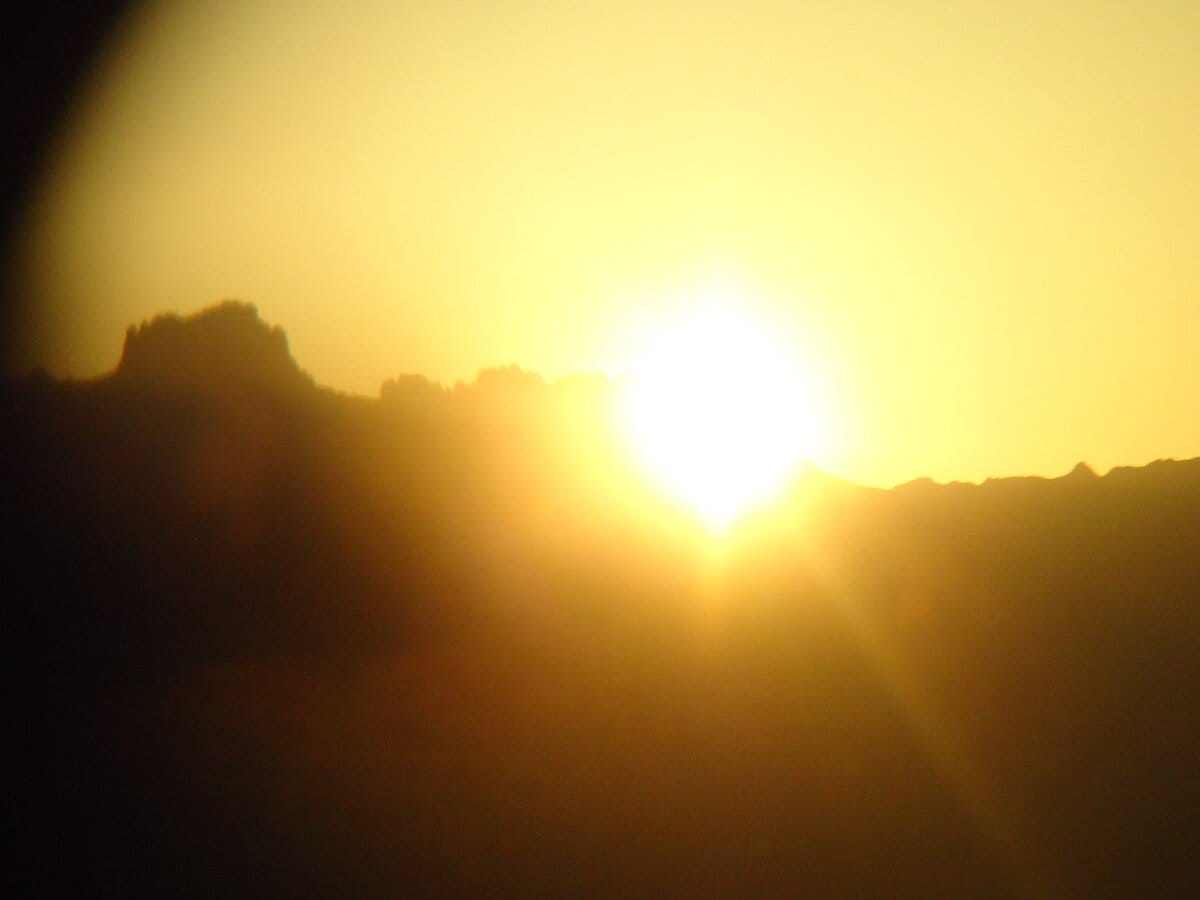
Like an Old Western As I do every morning, the first place I went was our east-facing balcony. Sliding the large glass door open hit me like a physical blow: 86°F (30°C) in the shade—and it was just before eight in the morning. I also opened the front door to create a minimum of cross-ventilation and stepped back outside. Despite the heat, it was beautiful. The loud chirping of various bird species gave the place the flair of a dense jungle. The flowers in the shade of the two-meter-high wall glowed in intense colors. Later, when the sun hit the bougainvillea, the scene would be bathed in glaring light. It was like an old Western. The mountains of Arizona on the other side of the river radiated meditative calm in their endless expanse. Anyone unaccustomed to the heat would think it was midday sun at this hour. The air shimmered; the sky was an aggressive blue.
The Oasis in Mountain View Park On the left side, in Mountain View Park, there was not a soul to be seen. Anyone wanting to play tennis, walk, or take the dog out here at this time of year comes in absolute darkness, waiting for the first twilight before the sun crests the mountains of Arizona. Our park was an oasis. The baseball field was perfectly mowed; the trees stood in deep green. Even the residents of Bullhead City, Arizona, came over to us, traveling miles from their own front doors just to celebrate birthday parties and play sports. I glanced over at our neighbor. She had barricaded herself in as usual. All blinds down, the AC cranked to the max. $250 a month in electricity bills was worth her protection from nature—we rarely topped $60. She was probably already lounging by the pool. Since I hadn’t applied sunscreen yet, the rays burned on my skin after just five minutes. I fled back into the apartment.
Undecided – The Decision We closed the doors, and Mischko fired up the air conditioner, which immediately cooled down the apartment. It was time for breakfast. Normally, I leave nothing to chance before a long bike ride: the night before, I eat spaghetti and potatoes. The last big meal belongs on the table two to three hours before the start—easily digestible carbohydrates that fill the engine without burdening the stomach. But the idea this morning was an absolute spontaneous inspiration. The day before, I hadn’t given a single thought to the bike, which meant I now had to let the fridge surprise me. Fortunately, toast, jam, and bananas were in stock.
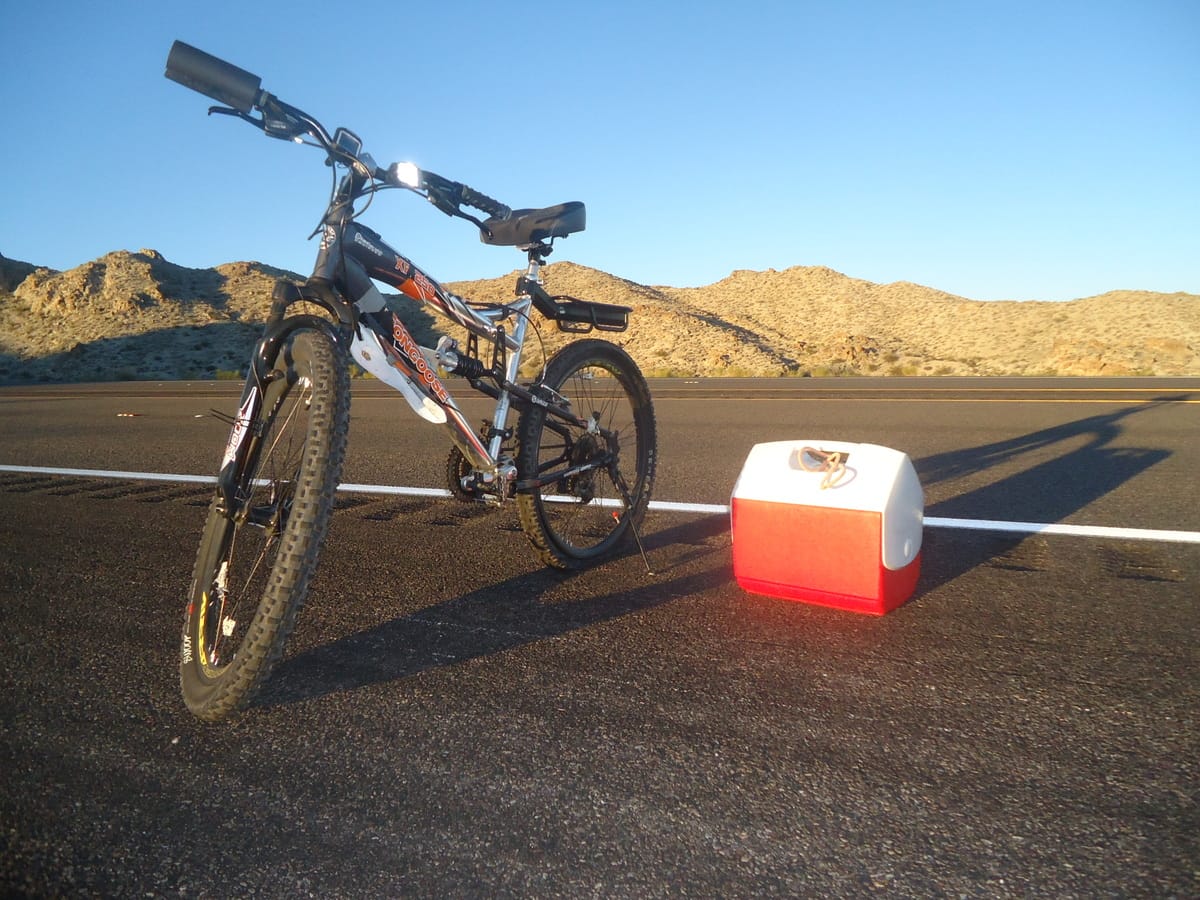
Playing Poker with the Desert The nervousness remained. Was it madness to ride with a forecasted 108°F (42°C)? My toe still showed a menacing, bloody crust that under no circumstances could be allowed to soak through with sweat. Even though the large glass table—designed for six people but equipped with only four chairs—was loaded with muesli and mountains of fruit, I could barely get a bite down. My stomach felt tied in knots. Should I ride or not? At these temperatures, the rational thought crossed my mind that a ride in the desert could also be my last. But exactly this risk triggered a strange defiance in me. I went into the bedroom, opened the closet, and ignored the smallest of our four coolers, which I usually used for bike tours. I grabbed the second smallest Igloo box. It held twice the amount of liquid. Whether I could safely mount the bulky thing onto the luggage rack didn’t matter to me at that moment.
The Ice-Cold Foundation As if in a tunnel, I stood in front of the freezer compartment. I packed four deep-frozen, rock-hard water bottles into the box as an ice foundation. This was followed by six bottles of Gatorade. I couldn’t have enough of this electrolyte fuel in my pack today. I also packed two cans of Mountain Dew and two bottles of water. Along the way, I tossed in three mandarins that Mischko had already peeled and wrapped in cling film, a third of a chocolate bar, a sandwich, and some hard candies. My cooler was now packed to the brim. Since I also have a small bag that I attach to the front handlebars, I stowed my phone, more candies, two more water bottles, and an additional can of Mountain Dew in there.
The Battle Against My Weaker Self It was now 9:15 AM by the time I was fully dressed. Even though my cooler was full, I still stood undecided and pensive in the apartment. It was pure madness: the heat outside was already blazing, and it was supposed to get much hotter throughout the day. I was ready to ride, but I would have preferred to just stay home. Since I had barely done any sports for the past twenty days, I finally forced myself to cross the threshold. I at least wanted to try; if the heat became unbearable, I could turn back at any time. For the moment, the decision was made.
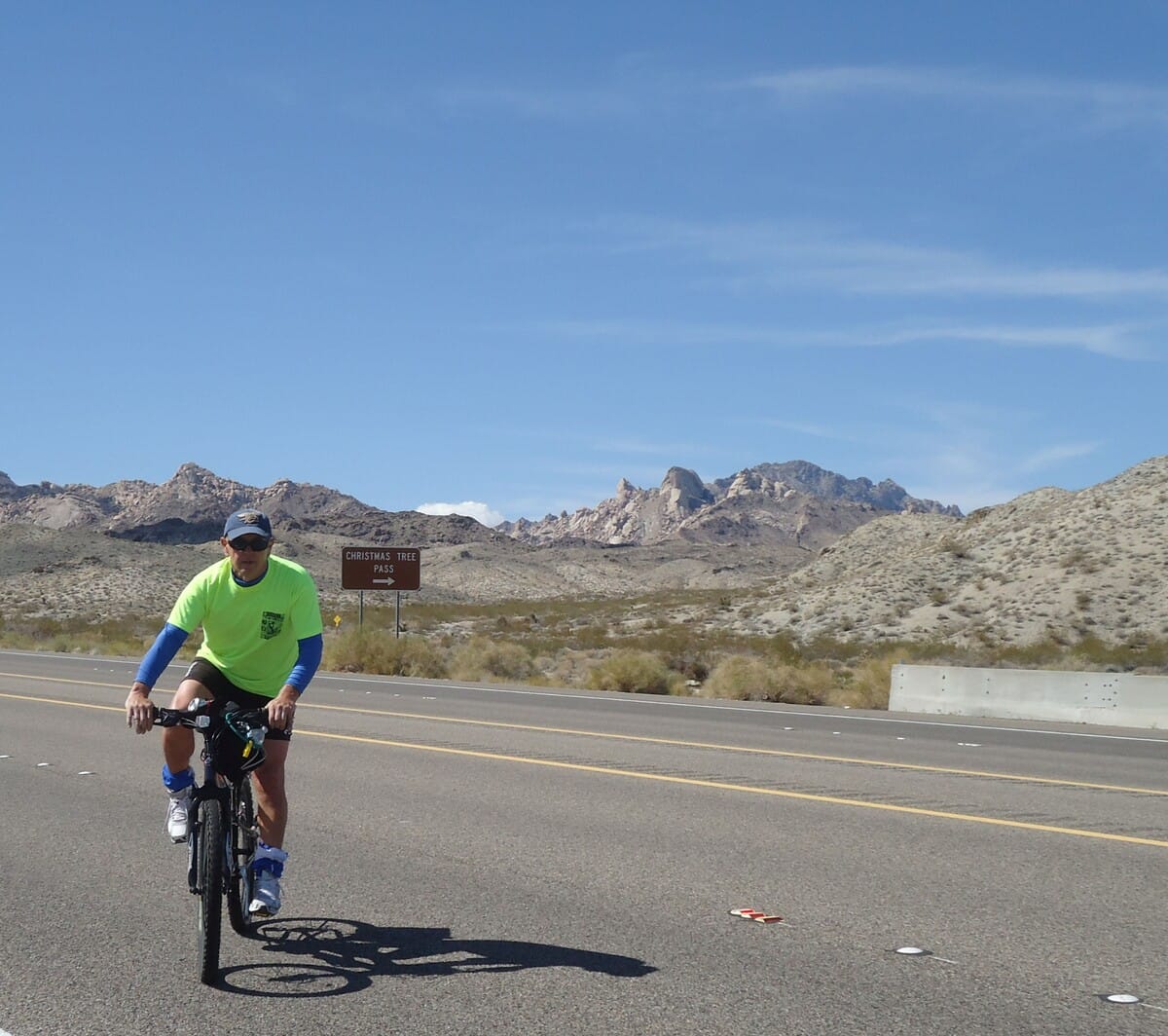
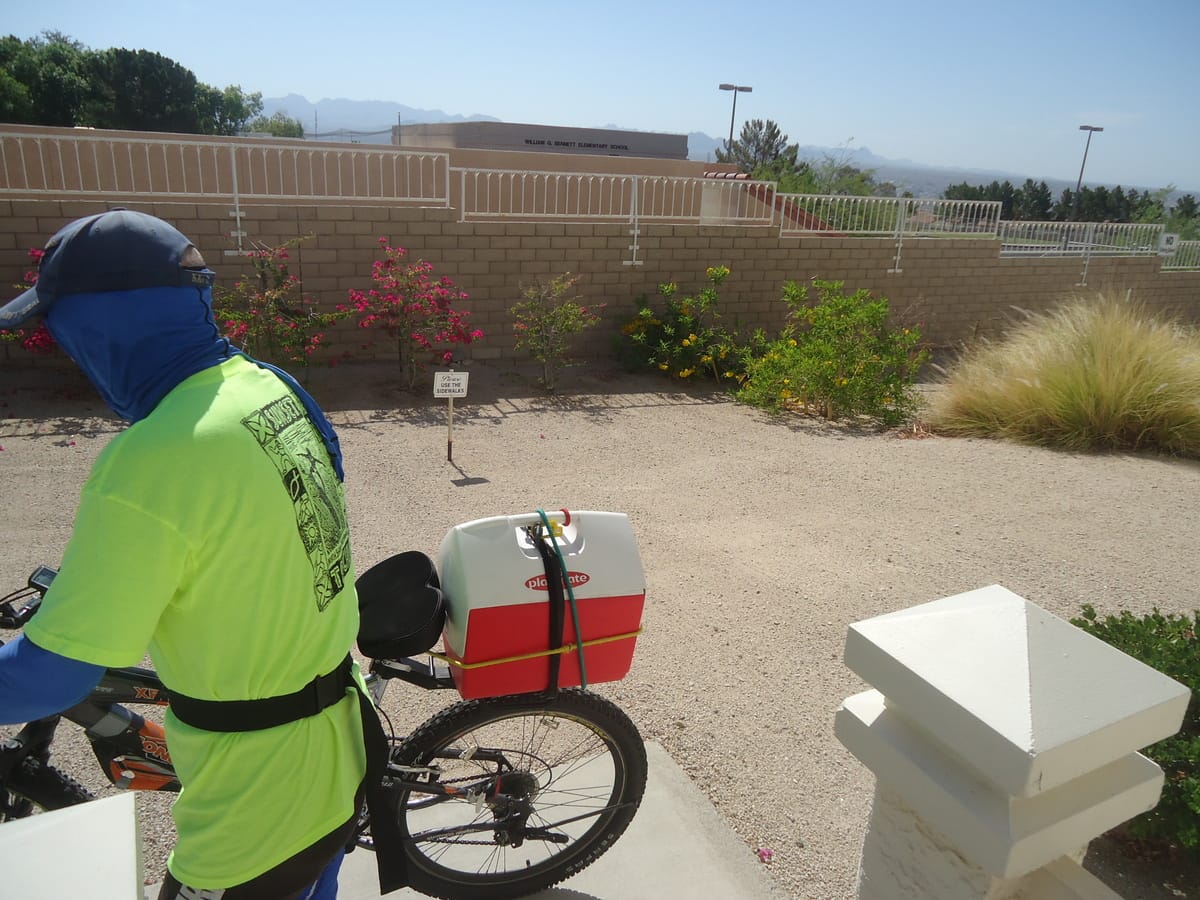
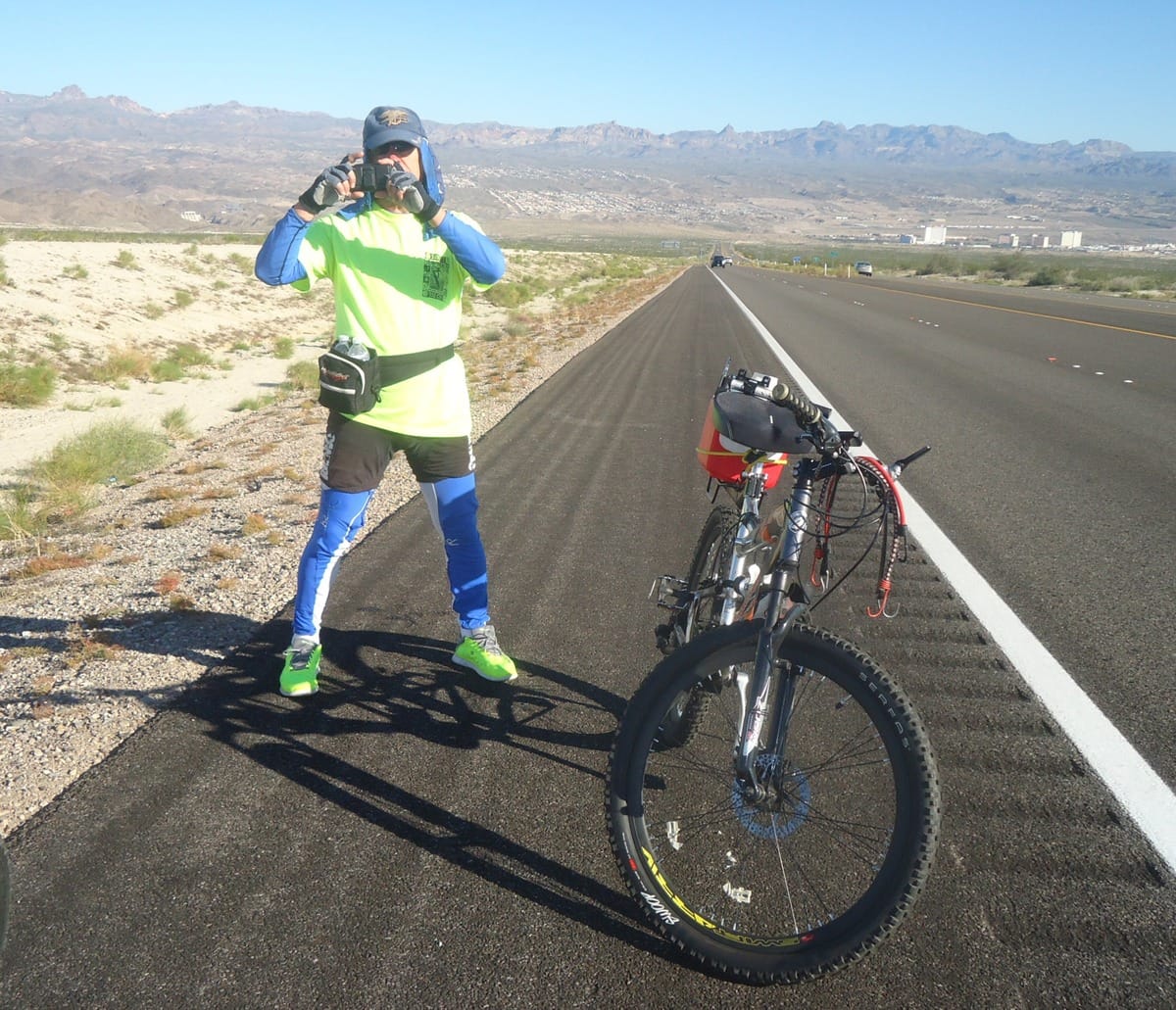
The Hawaii Armor I was perfectly dressed for this extreme day. I had fashioned my own tight cycling shorts for my legs by cutting up the long-sleeved, blue-and-white top of my Xcel rash guard. I simply pulled my original black cycling shorts with the white lettering on the sides over them. On my upper body, I also wore a blue Xcel rash guard that I had once bought in Hawaii for swimming, which had white lettering on the chest. I own at least six of these shirts in various colors here in Laughlin. Over this blue rash guard, I wore a bright yellow T-shirt that a friend in Hawaii had given me. A Hawaiian motif was printed on the back. This glaring yellow made me highly visible to drivers from a long distance.
The Navy SEAL Project On my head, I wore my Navy SEAL cap, which I had independently transformed into a functional safari hat. The idea came to me one day when, during an earlier bike tour, I discovered a discarded, roughly three-foot (one-meter) long bag for a camping fishing chair in the ditch next to the Laughlin Highway. Because it was designed like an American flag, I got off my bike and took it home. In hours of painstaking work, I cut out the stars of the flag and sewed them onto the Navy SEAL cap. The result was so precise that the hat looked like it was bought originally in a store. When I ride, I can even completely shield my entire face from the sun with an additionally sewn-on piece of this flag.
A Handy MacGyver Trick When I put on my sunglasses, I noticed that the lenses were completely smeared again. After cleaning them, I took a piece of paper towel, soaked it thoroughly with glass cleaner, folded it up, and wrapped it airtight in cling film. If I needed to clean my sweat-drenched sunglasses on the road, I would always have a damp cloth handy. The current weather report flickered across the TV screen: it was already 91°F (33°C). Moreover, wind was forecast, with a stiff south wind between 20 and 25 miles per hour. So far, so good, I thought, and asked Mischko to briefly hold open the apartment door so I could maneuver my bike outside from its parking spot by the fireplace. No sooner had I crossed the threshold than she hastily pulled the door shut behind me so the precious cool air wouldn’t escape the rooms.
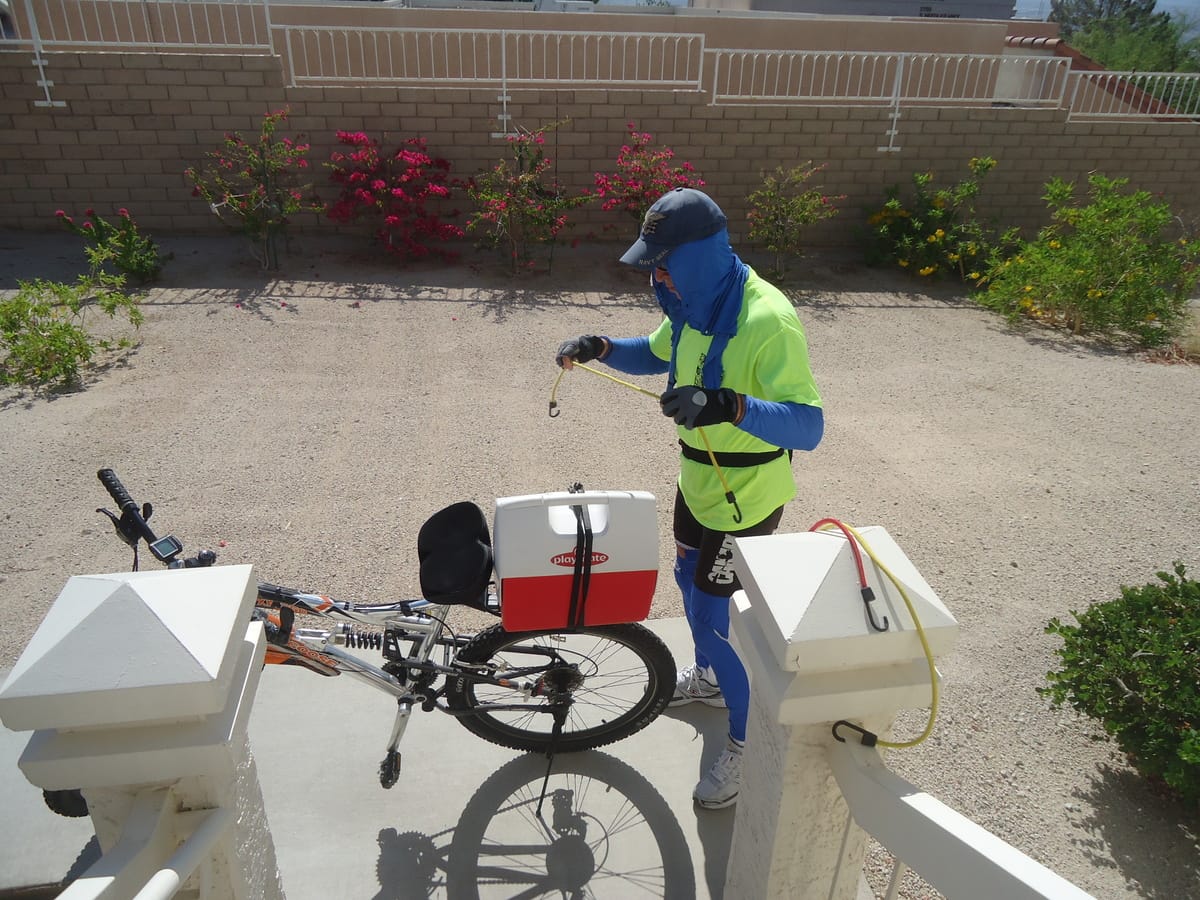
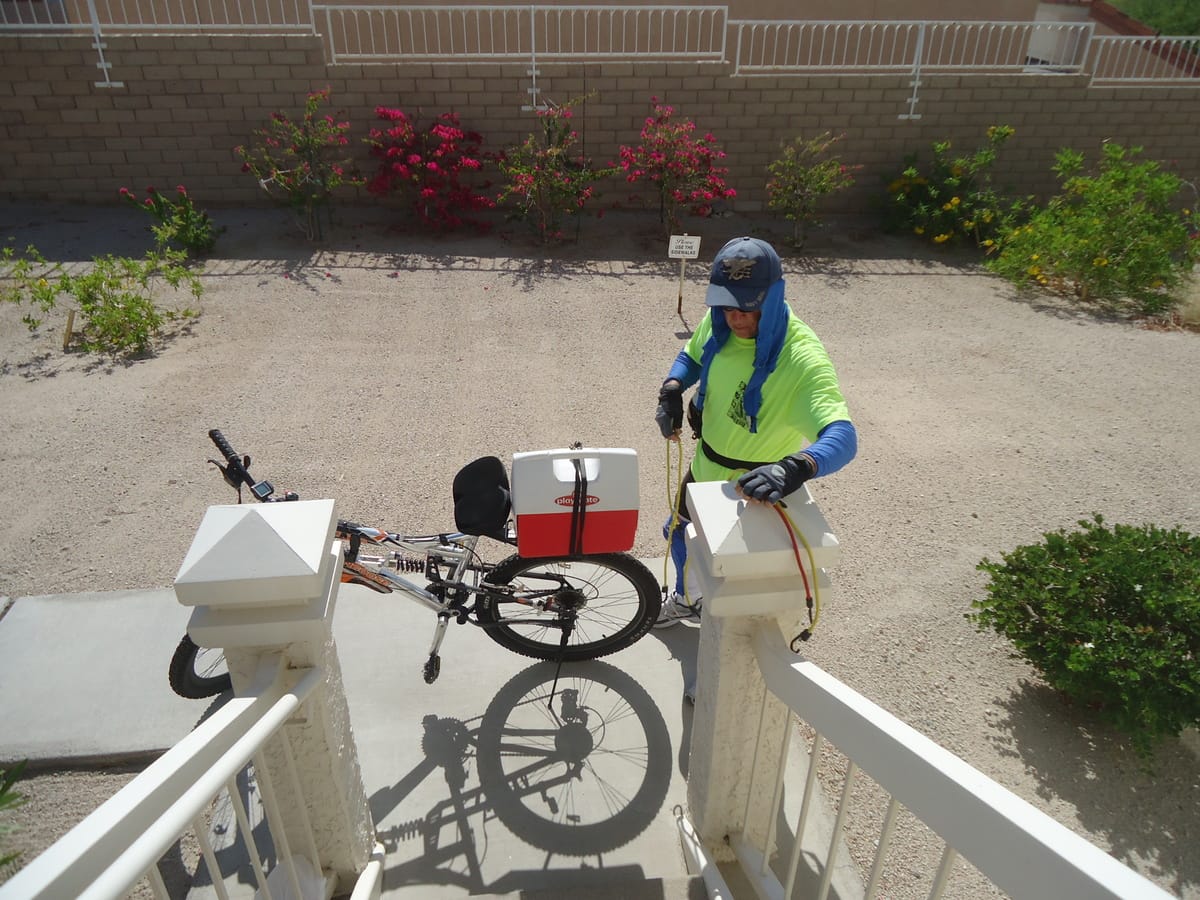
The Street Finds Wearing only white socks, I balanced the almost 45-pound (20-kilogram) bike under my arm down the stairs. After placing the heavy machine down on the concrete slab in front of the stairs, I climbed the steps once more to retrieve my red-and-white cooler with the provisions. At the same time, I grabbed a couple of old bungee cords—elastic straps for securing the cooler—that I had found on the ground in a side street off the Laughlin Highway the previous year. Down on the hot concrete in front of the stairs, I fumbled around for a solid five minutes until I was absolutely certain that the bulky cooler sat rock-solid and wobble-free behind my saddle. I had to sprint up the stairs one last time to finally put on my sports shoes. Before heading out for good, I took one last large gulp of ice-cold water straight from the fridge in the kitchen. There, finally ready to go. Passing by, I cast one last, checking glance at the TV to confirm the exact time and temperature: it was exactly 9:20 AM. The thermometer showed an unforgiving 91°F (33°C).
CHAPTER VI – Start of the tour and the snake in the oleander
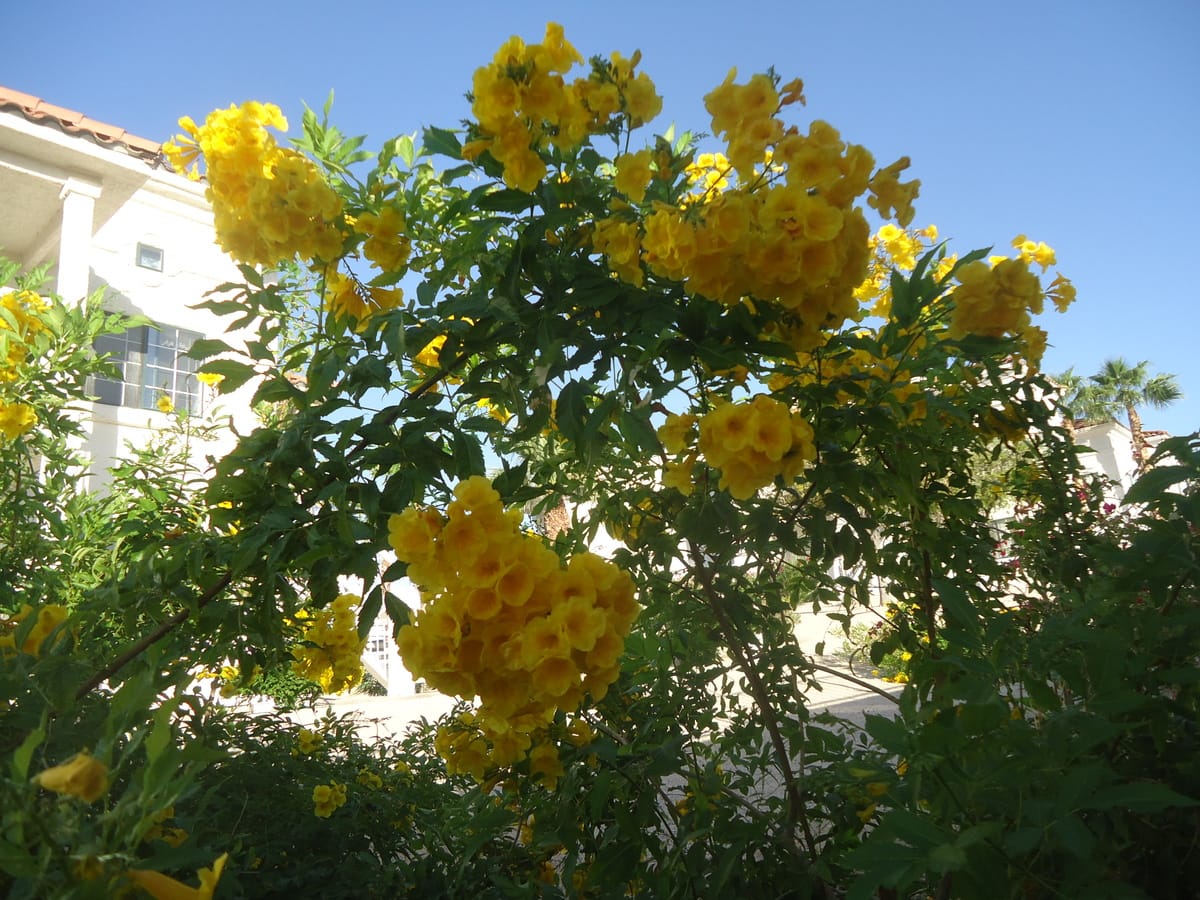
Start of the Tour – My Bougainvillea Whenever I walk down the stairs, I admire my flowers. I planted them directly in front of our residential complex’s wall precisely for moments like this. From above, it offers a beautiful view—like a small paradise, a true oasis in the desert. This sight is expected to be even more beautiful in a few years when the plants have grown and completely cover the bare walls. This image presented itself to me today as well: about a meter from the first step, my dark red and purple flowers grow wildly. There are six sturdy bougainvillea trunks in total. They are flanked on the right and left sides by my Yellow Bells, the yellow trumpet flowers. These have shot up nicely over the last two years and now proudly measure over a meter tall. Directly opposite the stairs, the oleander runs rampant, as tall as I am and at least a meter and a half high. Down on the concrete path, my bike gleamed in silver and orange under the unforgiving sun. The red-and-white Igloo cooler sat majestically on the luggage rack.
An Uneasy Feeling in Paradise Once at the bottom, I was struck by a spontaneous desire to take a few souvenir photos. Mischko quickly dashed back into the apartment and returned with the camera. While I stood here alone waiting, I felt uneasy. It wasn’t the heat. Why, then? Because of an incident that had recently occurred right here.
The Snake in the Oleander One day, while I was walking from our neighbor’s place across the sand toward us, I startled a snake. Spooked, it slithered right over my foot and instantly disappeared into this large oleander bush. Because the animal had startled me so much—and I had startled myself even more, feeling it glide over my foot—I was in shock. I was completely spaced out and just stared at the spot where it had happened. When I realized it had disappeared into the bush, I called Mischko. I asked her to stand at the top of the stairs and watch to see if the snake moved. Meanwhile, I had somewhat regained my senses, ran up the south side of our stairs into the apartment, and called management. I told them to send our gardener over.
Uproar in the Neighborhood While we waited anxiously, our neighbor from Washington, whose living room borders our bedroom, came out. He wanted to know what was going on. Mischko explained, “We have a snake, it’s sitting in the bush.” Playing the tough guy, he went over, poked around in the bushes, but saw nothing. Mischko insisted: “It has to be in there!” I added: “It’s a snake at least five feet (1.5 meters) long.” While he was still poking around in the bush, our gardener Oscar arrived with his boss after about fifteen minutes—both are Mexican. I explained to them once more how the snake had slithered over my foot—I had never seen a snake move so fast. Young Oscar, about 25 years old, looked into the bush and said, “There’s nothing in the bush.” I maintained, however, that it had to be there, as I hadn’t seen it run off anywhere else.
The Perfect Camouflage When Oscar’s boss noticed that his employee hadn’t discovered anything despite parting the branches, he looked himself. After barely a few seconds, he said, “There it is. It’s looking right at me.” Our neighbor Jim stepped closer, looked, but still saw nothing. Then the Mexican explained that the snake had wrapped itself around the shrub higher up and was looking in their direction. Only then did neighbor Jim spot it, too. Shortly after, our gardener saw it as well, after his boss explained that the snake had slightly changed its color to take on a pink hue—perfectly camouflaged, matching our pink oleander.
The Battle with the Water Snake The boss instructed him: “Get it out, it’s just a water snake.” Oscar didn’t dare at first. His boss told him to simply pull it out by the tail. However, because the snake clung tightly to the branch, Oscar had to use a lot of force to get it loose. It was his first time holding a snake in his hand. When he finally pulled it out, it started thrashing wildly and slipped through his fingers. It fell onto the sand and vanished with incredible speed toward the south, where more shrubs grow. It left an uneven, winding trail on the sand freshly maintained by the gardener. Since the two Mexicans reassured us that the animal was absolutely non-venomous, we could slowly relax and try to forget the incident. However, because this experience left a deep shock in me, an uneasy feeling remains. Every time I walk down the stairs now, I fear the thought that something is watching me from the bush.
The Last Photo? In that moment, Mischko came down the stairs with the camera. “Just in case I don’t come back from this heat—then at least you have one last beautiful memory,” I joked. She just shook her head. Normally, I always carry the camera on my tours, but this time I wasn’t in the mood. In this blazing inferno, my desire to take pictures would quickly vanish anyway. On this day, my only goal was to return home healthy and in one piece. After the snapshot, we said our goodbyes. “Ride carefully, you hear!” Mischko warned. When I climbed onto the saddle at exactly 9:25 AM, the thermometer already showed an oppressive 91°F (33°C). A foretaste of the brutal 108°F (42°C) heat that would challenge me today. The burning sun rays already dominated everything.
START OF THE TOUR I looked at her, smiled, and put my sunglasses on. Before I started pedaling, I looked up at her one more time and held up two fingers in the Hawaiian greeting: Hang Loose. “Have fun—and don’t open the door for anyone! Got it?” She nodded. I first rolled along the small footpath lined with our flowers until I reached our car.
The Best Parking Spot in the Complex How often had I talked with Mischko about how we scored the absolute best parking spot in the entire complex! Not a single soul parks next to us on the right side. When we come back from shopping, unloading is child’s play for us. While other residents have to laboriously squeeze between tightly parked cars and be extremely careful not to scratch their neighbor’s paint, we have it easy. I braked carefully and got off the saddle at the front of the car, as there is a high curb here. Once both tires were securely on the asphalt, I turned around one more time. Mischko was still standing there, waving at me. One last time, I called out to her: “See you later!” With the Hawaiian two-finger greeting—Take it easy—I finally said goodbye and swung back onto the bike.
CHAPTER VII – Hour 1 | 9:25 AM & The resident cop
Hour 1 | 9:25 AM Since the path slopes slightly downhill from our car, the bike rolled all by itself. Meanwhile, I sorted out my gears. After not even ten seconds, I turned the first right corner, only to carefully roll over the bump—an asphalt speed bump—twenty meters later. These bumps force drivers in the complex to drive slowly. A car came toward me. Before I could turn left toward the exit, this driver steered to the right, directly toward the gate.
A Little Side Story After slowly rolling over the speed bump and the car in front of me stopped to wait for the automatic gate to open, I slowly rolled up behind the vehicle—right up to the bumper. Since I came from the other side, I had to turn left. Inside the car sat Moerl and Bessi. The two American retirees are around 80 years old. Bessi is severely ill and can no longer climb stairs on her own. He, too, suffers from his own ailments. While the gate opened agonizingly slowly, I couldn’t help but grin behind his bumper. A bizarre episode that had taken place right here exactly three years ago flashed through my mind.
The Resident Cop Flying Low Moerl is actually a very nice, small, old man. His shoulders are built completely normally, but he walks with his head so extremely bowed downward as if he had a hunchback. But he doesn’t have one at all! That’s just his very specific walking style. For years, he had voluntarily made himself useful as a kind of “resident cop”. Every morning at exactly 7:00 AM, he unlocked our clubhouse, and at 10:00 PM, he locked it again. He also ensured with iron discipline that every car had the required parking permit sticker for our community on its windshield. He actively looked out for unregistered vehicles that didn’t have Nevada license plates. He reported such cases immediately to management. If he discovered an unfamiliar car without a sticker, he didn’t hesitate to call the towing service. The illegally parked cars were removed from the property in record time. Since our old neighbor’s husband across the way passed away, Moerl often visited her in the mornings. He would spend at least half an hour with her on the balcony. Their voices were the first thing, aside from the birdsong, that we heard in the mornings when we opened our bedroom window.
The Crash into the Guardhouse When we returned from Germany at midnight three years ago, we could hardly believe our eyes: our entrance was completely altered. The Guard House, the small security booth, was no longer in its place in the middle. It had been completely shifted and utterly destroyed. Only the American flag still waved unimpressed on its thirty-foot (ten-meter) pole above the ruins. Our old neighbor finally enlightened us: Moerl had crashed his car into the booth unbraked on a Friday afternoon. He was driving home, stopped at the barrier, and stuck his left arm out the window to enter the code on the keypad. Unfortunately, he slipped, stomped full force on the gas pedal, and shot straight into the hut. Because he had presumably parked too far from the keypad, he must have leaned clumsily outside. The Guard House stood only ten feet (three meters) from the pillar. When he slipped off the brake pedal, he instinctively gripped the steering wheel tightly and steered the car straight to destruction. Someone had watched the incident via the security cameras, and the police showed up at his front door immediately. At first, Moerl stubbornly refused to open the door. Only when the officers acted more aggressively did he finally open it. The accident was officially recorded. We later learned from our neighbor that he had probably been drunk that afternoon. That also explained why he initially didn’t want to open the door for the police.
The End of a Career Bizarrely, he later wanted to sue our homeowners’ association—for whatever reasons. In the end, he had to grudgingly report the damage to his own insurance, after which his premium skyrocketed astronomically. Since this incident, good old Moerl no longer shows his face at the pool. He no longer visits the old neighbor, nor does he unlock the clubhouse. His career as the self-appointed head of the Neighborhood Watch ended abruptly. The homeowners’ association had the destroyed guardhouse completely torn down and erected a round pavilion, a so-called gazebo, in its place. Actually, it had been much better with the Guard House. It served as a real deterrent to strangers or potential thieves. After all, they couldn’t know that we hadn’t employed real security personnel for a long time. The community used to pay for guards, but they slept more at night than they kept watch. It had been a waste of money, which is why the service was abolished.
The Privilege of the Desert Whenever I see these old people, it gets me thinking: you should enjoy your life as long as you somehow can. Once it gets to the point where those two in the car in front of me are, it’s simply too late. I enjoyed my healthy state to the fullest as I left the complex behind and passed through the gate. It was time for the desert. What a privilege to even be able to hop on a bike in this inferno! I did it for my health. Who knows what the retirees in the car in front of me thought when they spotted me in full gear on the saddle. Moerl steered his car ten meters forward to the cross street and stopped at the stop sign at Las Palmas Lane. I rolled past him on the right and waved. Hidden beneath my blue-and-yellow full-body disguise, I was unrecognizable, but perhaps Sally, our 80-year-old neighbor, had told him about my desert training. In any case, he smiled and nodded at me through the window. While he stayed behind, I rolled down the street to the right. To my right, the 500-foot (150-meter) long perimeter wall of our community stretched to the Needles Highway; to my left lay the deserted library parking lots. A glance in the rearview mirror showed that Moerl was only now slowly pulling away.
CHAPTER II:
Needles Highway I turned right, directly into the steep incline of the highway. Ten minutes of hard climbing lay ahead of me—and that in morning temperatures of 95°F (35°C) in the shade. I used the bus lane on the far right. Towering over the sidewalk was the west side of our residential complex. While our apartment rested quietly on the east side, from here on the outside you looked at magnificent white oleander bushes lining the perimeter wall. Las Palmas held true premium status here on the edge of town. Every time, the Moorish architecture fascinated me: light brown and pink walls, palm trees, and red roofs under a radiant blue sky. This sight filled me with pride. We had found an undisturbed paradise. We lived better than in Berlin; I had my car, my windsurf boards, played tennis, and went swimming. Casinos, a lake, and a river were right at our doorstep, with Las Vegas and California within striking distance. We lacked nothing.
A Ton of Weight in Second Gear Reality, however, caught up with me quickly. After a twenty-day break from sports, pedaling felt extremely difficult. My legs were soft, my stamina was shot. In third gear, I agonized my way upwards, feeling the ton-like weight of the cooler on my back. The eight frozen bottles made their brutal presence known. I had to shift down to second gear. As if that weren’t enough, the bike began to squeak pitifully. Rhythmically, with every turn of the pedal, always in the exact same spot. It was exasperating. I suspected the front shock absorber. A real annoyance, while the first drops of sweat appeared on my forehead. At least my improvised sweatband made from the old Hawaii rash guard under my cap worked perfectly—the sweat finally stopped burning my eyes. Even before reaching the crest, I reached for the first water bottle in the handlebar bag. Since it was exposed to the sun, I wanted to drink it while it was still cold. I instantly regretted not covering the bottles with a T-shirt as I usually did. Cars zipped past me on my left. In the valley beyond the oncoming lane lay the gray roofs of another residential complex. I thought every time: My God, who buys a place there? The residents looked out from their valley directly against the massive walls of our west side—with absolutely no view. The dead silence of the desert was interrupted only by my chain rattling and this monotonous squeaking. I felt like I was riding a hundred-year-old clunker. Occasionally, a car sped past me by a hair’s breadth, pushing its engine up the incline. The noise blared so unfiltered into my left ear that I had to plug it with my finger. Again I thought: What luck that we live on the quiet east side. We would never have bought an apartment here on the street.
The Temptation to Turn Back I had divided the tour into stages, just like the Tour de France. The first goal was the intersection of Bruce Woodbury Drive and Needles Highway. Up there, the climbing ended, followed by four miles of flat, gentle rolling hills to the Laughlin Highway (163). But right now, midway up the mountain, my courage failed me. In this brutal heat, I was already completely drenched in sweat and doubted whether I should even head for Highway 163. I was still wavering. Should I really risk the route via 163? The heat was murderous, my body completely wet. When I reached the intersection, perhaps I would surrender and turn right onto Bruce Woodbury Drive. From there, it was just five miles downhill to Casino Drive—right to the cooling river.
Ants on My Back The sun burned into my back from the right, while my bike provided a rhythmic double concert of a rattling chain and a squeaking shock absorber. It was maddening. Beneath my T-shirt, the sweat felt like hundreds of ants crawling down my back. Mentally, I was at my limit; in my thoughts, I was already up on the plateau. Normally, I conquer this incline in third gear in five minutes. Because I was saving strength in low gear today, I crawled forward at a mere 7 miles per hour. They became endlessly long minutes. Except for pedaling, staring, and thinking, there was nothing left for me to do. There was absolute dead calm. I silently begged for a breeze—whether from the front or the back. The forecast called for a strong 25-mph south wind, but in this region, the wind usually only wakes up in the afternoon. For now, the calm reigned. The high outer wall of our complex, which ran in a slight right curve here, blocked any hint of a tailwind anyway. I was completely alone on the asphalt. A yellow-and-blue mummy in self-sewn cycling shorts, agonizing my way up the incline in crackling heat and dead silence.
Deadly Silence No cars, no birdsong. Only this monotonous squeaking sawed through the silence. As I reached the end of the community wall, I took a deep swig from the bottle. The water in the top part was already lukewarm. I shook the bottle vigorously to mix it with the cooler contents at the bottom—after that, it tasted tolerable again. Because I was panting from the exertion, I had to be extremely careful when drinking. Anyone taking large gulps while inhaling heavily risks getting water into their lungs. At the end of our complex, the wall transitioned into Mountain View Park. From here, 150 meters of hard climbing remained to the park entrance. The few drivers who passed me must have thought I was crazy. To my right, the concrete wall now gave way to a ten-foot (three-meter) high mound of sand, decorated with cacti and desert plants. Jim, a gardener from Kingman who maintained the area, had planted them. The whole thing was financed by the municipality of Las Vegas, which Laughlin belongs to with the same area code.
The Circulatory Shock My focus now lay solely on my circulation. Last year, I had ridden at 95°F (35°C); today it was almost thirteen degrees (Fahrenheit) hotter. Back then, after the tour, I made the mistake of immediately pouring liters of cold water down my throat in the cool apartment and lying flat in bed. The brutal temperature shock caused my circulation to crash. I became so nauseous that I thought I was going to die. I should have acclimatized in the shade for fifteen minutes. I wouldn’t repeat that mistake today. The squeaking was my constant companion. I prayed that the chain would hold, the tires would stay intact, and I would return home healthy. A few minutes later, I reached the crest and passed the park entrance. My legs suddenly felt lighter, and a massive relief set into my mind. The torment was over. Now it was just about concentration. At the desert intersections, you constantly had to dodge slippery sand and sharp, small stones that the wind and vehicles had carried onto the roadway.
CHAPTER III:
Mountain View Park Up here, level with Mountain View Park, I shifted back into third gear for the first time—and cursed the squeaking for the umpteenth time. It was maddening. I actually just wanted to ride my bike in peace today and forced myself to do it simply to finally do something for my health again. But in this eerie heat, it was pure torture. Was I supposed to lubricate these shock absorbers regularly? I had absolutely no idea. In that moment, I deeply regretted not treating the fork with a good dose of WD-40 spray from the garage before leaving. But it was too late for that now. At least I had almost reached the crest and was now moving significantly faster than during the entire agonizing slog up the steep highway.
A Small Miracle Sweat clung heavily to my upper back and under the sewn-in fabric strip of my cap on my forehead. When I finally shifted up into fourth gear, a small miracle occurred: The rattling sound of the chain disappeared from one second to the next. Only now did the scales fall from my eyes: I had exactly the same problem the year before. The chain only ran completely silently from the fourth and fifth gears onwards. So this problem had fortunately resolved itself. As I left the park entrance behind me on my right, I looked into the barren landscape. From here on, only the naked desert reigned. A high security fence ran alongside the road. However, it wasn’t erected to keep wild animals from crossing the highway. There used to be a large power plant there. Since it was a strategically important facility, the entire area was massively secured. The land and the entire landscape belong to the state of Nevada. A few years ago, they completely demolished the power plant, so the eye could now stretch across a vast, untouched plain all the way down to the casinos on the riverbank. Although it was a desert, besides the parched, dry earth, there was an incredible amount of green. The entire territory extending about five miles downhill to the river from here is state property and has not yet been released for private sale.
The Crossroads of Decision On this now flatter stretch of road, and thanks to the higher speed, breathing finally felt noticeably easier again. Shortly before the intersection at Bruce Woodbury Drive, I fortified myself with one last deep swig from the bottle. I cast an assessing glance into my new rearview mirror, which had cost me almost thirty dollars at the store. Since I had to cross the intersection soon and my destination lay dead ahead, extreme caution was required. A look back: no cars from behind. Bruce Woodbury Drive branched off to the right and led down the mountain for five miles (eight kilometers). If you followed this road, after about 500 meters you passed a low-income housing development on the left, which was built there three years ago. Just before this residential complex stood a bizarre sight: a tiny, old post office—completely isolated in the middle of the dusty desert. From there, the road continued straight down to the glittering casino towers by the river.
Endless Expanses Cars coming up the mountain from the casinos had to stop at a stop sign up here at the intersection. Since I had the right of way and continued straight on the Needles Highway toward Route 163 and Las Vegas, a driver waited patiently for me at the stop sign. He probably had pure pity for me, seeing me pedaling away in this murderous inferno. He willingly let me pass. Once I rolled past him, I could watch in the mirror as he hit the gas and turned exactly in the direction I had just agonized my way up from—he drove down the mountain. On my right side, the high metal fence had now completely disappeared. My gaze swept over the endless desert expanse down to the post office and the residential complex behind it. Beyond that opened a gigantic panoramic view of almost four miles (seven kilometers). Nothing but sandy desert, yet covered with an incredible number of sturdy green bushes.
The Green Miracle of the Desert It was still an absolute mystery to me how anything could be so lushly green in this extreme heat without ever being artificially watered. Since I had now left the intersection behind and the route transitioned into a gentle, barely noticeable incline compared to the hard climb earlier, I shifted another gear higher into fifth. Cars rarely strayed onto this stretch of the route. Because Laughlin is a rather tranquil town and this part of the Needles Highway sweeps widely toward Las Vegas, drivers hardly used this route. The early morning was an exception: The students had built their college right in the middle of the desert somewhere a mile downhill; it couldn’t even be seen from the highway. I wouldn’t reach their turnoff for about two miles (three kilometers). Since today was a holiday, the highway was yawningly empty anyway. This road was normally used mostly by Californians coming from the direction of Needles, or by locals on their way to the Indian reservation eleven miles south and the casino there.
Playing Poker without Health Insurance It was a great, liberating feeling to be completely alone in the desert here on this stretch—even in this brutal heat. Although it still went slightly uphill, I could increase my pace without much effort. For the first time, I felt something like a cooling breeze from the front all over my body. It was pure speed that created the wind. In about fifteen minutes, I would reach the end of the Needles Highway. However, while flying fairly fast over the asphalt, a momentous question ran through my head again: Should I really charge up the pass on Route 163 later? Wouldn’t it be far wiser to simply turn around just before the junction and just do a few safe laps back and forth here on the Needles Highway? If I started feeling sick here, I just needed to turn my bike around and let it roll down the slight incline completely on its own all the way home. I was suddenly seriously worried because I didn’t have health insurance in the States. Then the next clever thought shot through my head: At the end of the Needles Highway, I could just turn right onto the 163 and let myself roll down the mountain. Without having to exert myself in the slightest, I would dive-bomb on the bike all the way down to the large bridge over the Colorado River. From there, I could comfortably ride along the river via Casino Drive and finally pedal back up the mountain via Bruce Woodbury Drive as an athletic challenge. That would be the perfect solution and a great challenge in this heat!
The Path Through the Hollow Way The Needles Highway stretched from the Bruce Woodbury intersection, where I currently was, for about four miles (six kilometers) to Highway 163 (the Laughlin Highway), which led away to the left toward Las Vegas. From the intersection, the slight incline continued for about another mile (1.5 km), where I was currently moving at a rapid pace. After that, the road flattened out and transitioned into a slight downgrade. When I reached the next small rise on the bike, I would be right at the right-hand turnoff to the Laughlin College. The annoying squeaking of the shock absorber had meanwhile become less frequent and not quite as loud due to the higher speed, but it was still there. The road planners had cut through a small hill here to level out the grade of the highway. As a result, the road ran flat, but I was now riding as if through a deep hollow way, flanked by steep walls of dry, brown sand. The college itself remained invisible; it lay half a mile off in a depression in the middle of the desert, connected by a fresh asphalt road. Most students arrived befittingly in their own cars; for the rest ran the typical American school buses.
CHAPTER VI:
I Leave the Needles Highway To this day, it often happens to me: when something flashes in the desert sand in the distance, my first thought is that it’s another one of those special stones. But when I get closer, it usually turns out to be something completely different—like the broken glass of a turn signal or a car headlight.
Victory Over the Mountain I am sweating, breathing heavily. Despite my rash guard and the yellow T-shirt, my back burns. My gaze is fixed rigidly forward. I can hardly wait to finally reach the summit and spot the signs far ahead of me: the signs for the Laughlin Highway. With the right gear, I fight my way up the last hundred meters. In my calves, I already feel that the hardest part is done—pedaling becomes noticeably easier. Mentally, too, an enormous weight falls from me. Yes, the time has come! When I stand at the top in a moment, I will have unexpectedly put the first big stage behind me. And that despite my toe, which still hasn’t fully healed.
Solitude at the Landfill Just a moment ago I was battling my way up the exhausting incline, and now I passed the entrance to the landfill on my left. The facility lay about a kilometer away, isolated and embedded in the no-man’s-land between the Needles Highway and the red mountains that jutted sharply into the deep blue sky. Beyond this entrance, the road finally leveled out. It was the last three hundred meters of the Needles Highway, which tapered off here in a shallow depression. There was still no car to be seen. No oncoming traffic, no one in the rearview mirror. The glowing heat seemed to have swallowed all life. Everything that breathed had retreated into deep caves or the rare shade.
The Junction with Highway 163 As I approached the intersection, an oppressive dead silence lay over the desert. I couldn’t help but think of the people back home in the city, who were barricading themselves in their houses with roaring air conditioners right now. A look at the speedometer and the clock told me: I had been on the road for almost half an hour now. Finally, I reached the junction of the Needles Highway onto the Laughlin Highway (Highway 163). The sign in front of me was unambiguous: to the left was the direction to Las Vegas.
CHAPTER VII – Needles Highway and the temptation to turn back
Needles Highway I turned right, directly into the steep incline of the highway. Ten minutes of hard climbing lay ahead of me—and that in morning temperatures of 95°F (35°C) in the shade. I used the bus lane on the far right. Towering over the sidewalk was the west side of our residential complex. While our apartment rested quietly on the east side, from here on the outside you looked at magnificent white oleander bushes lining the perimeter wall. Las Palmas held true premium status here on the edge of town. Every time, the Moorish architecture fascinated me: light brown and pink walls, palm trees, and red roofs under a radiant blue sky. This sight filled me with pride. We had found an undisturbed paradise. We lived better than in Berlin; I had my car, my windsurf boards, played tennis, and went swimming. Casinos, a lake, and a river were right at our doorstep, with Las Vegas and California within striking distance. We lacked nothing.
A Ton of Weight in Second Gear Reality, however, caught up with me quickly. After a twenty-day break from sports, pedaling felt extremely difficult. My legs were soft, my stamina was shot. In third gear, I agonized my way upwards, feeling the ton-like weight of the cooler on my back. The eight frozen bottles made their brutal presence known. I had to shift down to second gear. As if that weren’t enough, the bike began to squeak pitifully. Rhythmically, with every turn of the pedal, always in the exact same spot. It was exasperating. I suspected the front shock absorber. A real annoyance, while the first drops of sweat appeared on my forehead. At least my improvised sweatband made from the old Hawaii rash guard under my cap worked perfectly—the sweat finally stopped burning my eyes. Even before reaching the crest, I reached for the first water bottle in the handlebar bag. Since it was exposed to the sun, I wanted to drink it while it was still cold. I instantly regretted not covering the bottles with a T-shirt as I usually did. Cars zipped past me on my left. In the valley beyond the oncoming lane lay the gray roofs of another residential complex. I thought every time: My God, who buys a place there? The residents looked out from their valley directly against the massive walls of our west side—with absolutely no view. The dead silence of the desert was interrupted only by my chain rattling and this monotonous squeaking. I felt like I was riding a hundred-year-old clunker. Occasionally, a car sped past me by a hair’s breadth, pushing its engine up the incline. The noise blared so unfiltered into my left ear that I had to plug it with my finger. Again I thought: What luck that we live on the quiet east side. We would never have bought an apartment here on the street.
The Temptation to Turn Back I had divided the tour into stages, just like the Tour de France. The first goal was the intersection of Bruce Woodbury Drive and Needles Highway. Up there, the climbing ended, followed by four miles of flat, gentle rolling hills to the Laughlin Highway (163). But right now, midway up the mountain, my courage failed me. In this brutal heat, I was already completely drenched in sweat and doubted whether I should even head for Highway 163. I was still wavering. Should I really risk the route via 163? The heat was murderous, my body completely wet. When I reached the intersection, perhaps I would surrender and turn right onto Bruce Woodbury Drive. From there, it was just five miles downhill to Casino Drive—right to the cooling river.
Ants on My Back The sun burned into my back from the right, while my bike provided a rhythmic double concert of a rattling chain and a squeaking shock absorber. It was maddening. Beneath my T-shirt, the sweat felt like hundreds of ants crawling down my back. Mentally, I was at my limit; in my thoughts, I was already up on the plateau. Normally, I conquer this incline in third gear in five minutes. Because I was saving strength in low gear today, I crawled forward at a mere 7 miles per hour. They became endlessly long minutes. Except for pedaling, staring, and thinking, there was nothing left for me to do. There was absolute dead calm. I silently begged for a breeze—whether from the front or the back. The forecast called for a strong 25-mph south wind, but in this region, the wind usually only wakes up in the afternoon. For now, the calm reigned. The high outer wall of our complex, which ran in a slight right curve here, blocked any hint of a tailwind anyway. I was completely alone on the asphalt. A yellow-and-blue mummy in self-sewn cycling shorts, agonizing my way up the incline in crackling heat and dead silence.
Deadly Silence No cars, no birdsong. Only this monotonous squeaking sawed through the silence. As I reached the end of the community wall, I took a deep swig from the bottle. The water in the top part was already lukewarm. I shook the bottle vigorously to mix it with the cooler contents at the bottom—after that, it tasted tolerable again. Because I was panting from the exertion, I had to be extremely careful when drinking. Anyone taking large gulps while inhaling heavily risks getting water into their lungs. At the end of our complex, the wall transitioned into Mountain View Park. From here, 150 meters of hard climbing remained to the park entrance. The few drivers who passed me must have thought I was crazy. To my right, the concrete wall now gave way to a ten-foot (three-meter) high mound of sand, decorated with cacti and desert plants. Jim, a gardener from Kingman who maintained the area, had planted them. The whole thing was financed by the municipality of Las Vegas, which Laughlin belongs to with the same area code.
The Circulatory Shock My focus now lay solely on my circulation. Last year, I had ridden at 95°F (35°C); today it was almost thirteen degrees (Fahrenheit) hotter. Back then, after the tour, I made the mistake of immediately pouring liters of cold water down my throat in the cool apartment and lying flat in bed. The brutal temperature shock caused my circulation to crash. I became so nauseous that I thought I was going to die. I should have acclimatized in the shade for fifteen minutes. I wouldn’t repeat that mistake today. The squeaking was my constant companion. I prayed that the chain would hold, the tires would stay intact, and I would return home healthy. A few minutes later, I reached the crest and passed the park entrance. My legs suddenly felt lighter, and a massive relief set into my mind. The torment was over. Now it was just about concentration. At the desert intersections, you constantly had to dodge slippery sand and sharp, small stones that the wind and vehicles had carried onto the roadway.
CHAPTER VIII – Needles Highway and the temptation to turn back
Mountain View Park Up here, level with Mountain View Park, I shifted back into third gear for the first time—and cursed the squeaking for the umpteenth time. It was maddening. I actually just wanted to ride my bike in peace today and forced myself to do it simply to finally do something for my health again. But in this eerie heat, it was pure torture. Was I supposed to lubricate these shock absorbers regularly? I had absolutely no idea. In that moment, I deeply regretted not treating the fork with a good dose of WD-40 spray from the garage before leaving. But it was too late for that now. At least I had almost reached the crest and was now moving significantly faster than during the entire agonizing slog up the steep highway.
A Small Miracle Sweat clung heavily to my upper back and under the sewn-in fabric strip of my cap on my forehead. When I finally shifted up into fourth gear, a small miracle occurred: The rattling sound of the chain disappeared from one second to the next. Only now did the scales fall from my eyes: I had exactly the same problem the year before. The chain only ran completely silently from the fourth and fifth gears onwards. So this problem had fortunately resolved itself. As I left the park entrance behind me on my right, I looked into the barren landscape. From here on, only the naked desert reigned. A high security fence ran alongside the road. However, it wasn’t erected to keep wild animals from crossing the highway. There used to be a large power plant there. Since it was a strategically important facility, the entire area was massively secured. The land and the entire landscape belong to the state of Nevada. A few years ago, they completely demolished the power plant, so the eye could now stretch across a vast, untouched plain all the way down to the casinos on the riverbank. Although it was a desert, besides the parched, dry earth, there was an incredible amount of green. The entire territory extending about five miles downhill to the river from here is state property and has not yet been released for private sale.
The Crossroads of Decision On this now flatter stretch of road, and thanks to the higher speed, breathing finally felt noticeably easier again. Shortly before the intersection at Bruce Woodbury Drive, I fortified myself with one last deep swig from the bottle. I cast an assessing glance into my new rearview mirror, which had cost me almost thirty dollars at the store. Since I had to cross the intersection soon and my destination lay dead ahead, extreme caution was required. A look back: no cars from behind. Bruce Woodbury Drive branched off to the right and led down the mountain for five miles (eight kilometers). If you followed this road, after about 500 meters you passed a low-income housing development on the left, which was built there three years ago. Just before this residential complex stood a bizarre sight: a tiny, old post office—completely isolated in the middle of the dusty desert. From there, the road continued straight down to the glittering casino towers by the river.
Endless Expanses Cars coming up the mountain from the casinos had to stop at a stop sign up here at the intersection. Since I had the right of way and continued straight on the Needles Highway toward Route 163 and Las Vegas, a driver waited patiently for me at the stop sign. He probably had pure pity for me, seeing me pedaling away in this murderous inferno. He willingly let me pass. Once I rolled past him, I could watch in the mirror as he hit the gas and turned exactly in the direction I had just agonized my way up from—he drove down the mountain. On my right side, the high metal fence had now completely disappeared. My gaze swept over the endless desert expanse down to the post office and the residential complex behind it. Beyond that opened a gigantic panoramic view of almost four miles (seven kilometers). Nothing but sandy desert, yet covered with an incredible number of sturdy green bushes.
The Green Miracle of the Desert It was still an absolute mystery to me how anything could be so lushly green in this extreme heat without ever being artificially watered. Since I had now left the intersection behind and the route transitioned into a gentle, barely noticeable incline compared to the hard climb earlier, I shifted another gear higher into fifth. Cars rarely strayed onto this stretch of the route. Because Laughlin is a rather tranquil town and this part of the Needles Highway sweeps widely toward Las Vegas, drivers hardly used this route. The early morning was an exception: The students had built their college right in the middle of the desert somewhere a mile downhill; it couldn’t even be seen from the highway. I wouldn’t reach their turnoff for about two miles (three kilometers). Since today was a holiday, the highway was yawningly empty anyway. This road was normally used mostly by Californians coming from the direction of Needles, or by locals on their way to the Indian reservation eleven miles south and the casino there.
Playing Poker without Health Insurance It was a great, liberating feeling to be completely alone in the desert here on this stretch—even in this brutal heat. Although it still went slightly uphill, I could increase my pace without much effort. For the first time, I felt something like a cooling breeze from the front all over my body. It was pure speed that created the wind. In about fifteen minutes, I would reach the end of the Needles Highway. However, while flying fairly fast over the asphalt, a momentous question ran through my head again: Should I really charge up the pass on Route 163 later? Wouldn’t it be far wiser to simply turn around just before the junction and just do a few safe laps back and forth here on the Needles Highway? If I started feeling sick here, I just needed to turn my bike around and let it roll down the slight incline completely on its own all the way home. I was suddenly seriously worried because I didn’t have health insurance in the States. Then the next clever thought shot through my head: At the end of the Needles Highway, I could just turn right onto the 163 and let myself roll down the mountain. Without having to exert myself in the slightest, I would dive-bomb on the bike all the way down to the large bridge over the Colorado River. From there, I could comfortably ride along the river via Casino Drive and finally pedal back up the mountain via Bruce Woodbury Drive as an athletic challenge. That would be the perfect solution and a great challenge in this heat!
The Path Through the Hollow Way The Needles Highway stretched from the Bruce Woodbury intersection, where I currently was, for about four miles (six kilometers) to Highway 163 (the Laughlin Highway), which led away to the left toward Las Vegas. From the intersection, the slight incline continued for about another mile (1.5 km), where I was currently moving at a rapid pace. After that, the road flattened out and transitioned into a slight downgrade. When I reached the next small rise on the bike, I would be right at the right-hand turnoff to the Laughlin College. The annoying squeaking of the shock absorber had meanwhile become less frequent and not quite as loud due to the higher speed, but it was still there. The road planners had cut through a small hill here to level out the grade of the highway. As a result, the road ran flat, but I was now riding as if through a deep hollow way, flanked by steep walls of dry, brown sand. The college itself remained invisible; it lay half a mile off in a depression in the middle of the desert, connected by a fresh asphalt road. Most students arrived befittingly in their own cars; for the rest ran the typical American school buses.
CHAPTER IX – Mountain View Park and the green miracle of the desert
Mountain View Park Up here, level with Mountain View Park, I shifted back into third gear for the first time—and cursed the squeaking for the umpteenth time. It was maddening. I actually just wanted to ride my bike in peace today and forced myself to do it simply to finally do something for my health again. But in this eerie heat, it was pure torture. Was I supposed to lubricate these shock absorbers regularly? I had absolutely no idea. In that moment, I deeply regretted not treating the fork with a good dose of WD-40 spray from the garage before leaving. But it was too late for that now. At least I had almost reached the crest and was now moving significantly faster than during the entire agonizing slog up the steep highway.
A Small Miracle Sweat clung heavily to my upper back and under the sewn-in fabric strip of my cap on my forehead. When I finally shifted up into fourth gear, a small miracle occurred: The rattling sound of the chain disappeared from one second to the next. Only now did the scales fall from my eyes: I had exactly the same problem the year before. The chain only ran completely silently from the fourth and fifth gears onwards. So this problem had fortunately resolved itself. As I left the park entrance behind me on my right, I looked into the barren landscape. From here on, only the naked desert reigned. A high security fence ran alongside the road. However, it wasn’t erected to keep wild animals from crossing the highway. There used to be a large power plant there. Since it was a strategically important facility, the entire area was massively secured. The land and the entire landscape belong to the state of Nevada. A few years ago, they completely demolished the power plant, so the eye could now stretch across a vast, untouched plain all the way down to the casinos on the riverbank. Although it was a desert, besides the parched, dry earth, there was an incredible amount of green. The entire territory extending about five miles downhill to the river from here is state property and has not yet been released for private sale.
The Crossroads of Decision On this now flatter stretch of road, and thanks to the higher speed, breathing finally felt noticeably easier again. Shortly before the intersection at Bruce Woodbury Drive, I fortified myself with one last deep swig from the bottle. I cast an assessing glance into my new rearview mirror, which had cost me almost thirty dollars at the store. Since I had to cross the intersection soon and my destination lay dead ahead, extreme caution was required. A look back: no cars from behind. Bruce Woodbury Drive branched off to the right and led down the mountain for five miles (eight kilometers). If you followed this road, after about 500 meters you passed a low-income housing development on the left, which was built there three years ago. Just before this residential complex stood a bizarre sight: a tiny, old post office—completely isolated in the middle of the dusty desert. From there, the road continued straight down to the glittering casino towers by the river.
Endless Expanses Cars coming up the mountain from the casinos had to stop at a stop sign up here at the intersection. Since I had the right of way and continued straight on the Needles Highway toward Route 163 and Las Vegas, a driver waited patiently for me at the stop sign. He probably had pure pity for me, seeing me pedaling away in this murderous inferno. He willingly let me pass. Once I rolled past him, I could watch in the mirror as he hit the gas and turned exactly in the direction I had just agonized my way up from—he drove down the mountain. On my right side, the high metal fence had now completely disappeared. My gaze swept over the endless desert expanse down to the post office and the residential complex behind it. Beyond that opened a gigantic panoramic view of almost four miles (seven kilometers). Nothing but sandy desert, yet covered with an incredible number of sturdy green bushes.
The Green Miracle of the Desert It was still an absolute mystery to me how anything could be so lushly green in this extreme heat without ever being artificially watered. Since I had now left the intersection behind and the route transitioned into a gentle, barely noticeable incline compared to the hard climb earlier, I shifted another gear higher into fifth. Cars rarely strayed onto this stretch of the route. Because Laughlin is a rather tranquil town and this part of the Needles Highway sweeps widely toward Las Vegas, drivers hardly used this route. The early morning was an exception: The students had built their college right in the middle of the desert somewhere a mile downhill; it couldn’t even be seen from the highway. I wouldn’t reach their turnoff for about two miles (three kilometers). Since today was a holiday, the highway was yawningly empty anyway. This road was normally used mostly by Californians coming from the direction of Needles, or by locals on their way to the Indian reservation eleven miles south and the casino there.
Playing Poker without Health Insurance It was a great, liberating feeling to be completely alone in the desert here on this stretch—even in this brutal heat. Although it still went slightly uphill, I could increase my pace without much effort. For the first time, I felt something like a cooling breeze from the front all over my body. It was pure speed that created the wind. In about fifteen minutes, I would reach the end of the Needles Highway. However, while flying fairly fast over the asphalt, a momentous question ran through my head again: Should I really charge up the pass on Route 163 later? Wouldn’t it be far wiser to simply turn around just before the junction and just do a few safe laps back and forth here on the Needles Highway? If I started feeling sick here, I just needed to turn my bike around and let it roll down the slight incline completely on its own all the way home. I was suddenly seriously worried because I didn’t have health insurance in the States. Then the next clever thought shot through my head: At the end of the Needles Highway, I could just turn right onto the 163 and let myself roll down the mountain. Without having to exert myself in the slightest, I would dive-bomb on the bike all the way down to the large bridge over the Colorado River. From there, I could comfortably ride along the river via Casino Drive and finally pedal back up the mountain via Bruce Woodbury Drive as an athletic challenge. That would be the perfect solution and a great challenge in this heat!
The Path Through the Hollow Way The Needles Highway stretched from the Bruce Woodbury intersection, where I currently was, for about four miles (six kilometers) to Highway 163 (the Laughlin Highway), which led away to the left toward Las Vegas. From the intersection, the slight incline continued for about another mile (1.5 km), where I was currently moving at a rapid pace. After that, the road flattened out and transitioned into a slight downgrade. When I reached the next small rise on the bike, I would be right at the right-hand turnoff to the Laughlin College. The annoying squeaking of the shock absorber had meanwhile become less frequent and not quite as loud due to the higher speed, but it was still there. The road planners had cut through a small hill here to level out the grade of the highway. As a result, the road ran flat, but I was now riding as if through a deep hollow way, flanked by steep walls of dry, brown sand. The college itself remained invisible; it lay half a mile off in a depression in the middle of the desert, connected by a fresh asphalt road. Most students arrived befittingly in their own cars; for the rest ran the typical American school buses.
CHAPTER X – Laughlin College and the deceptive green valley
It is a huge, modern building complex with its own sports stadiums, palm trees, and an architecture that looks exactly like an American university campus.
Danger at the Junction Hundreds of small stones blocked the shoulder. Cars parking here in the sand inevitably dragged the loose rubble onto the route when pulling away. In the shimmering heat, there was absolute dead silence. I checked the rearview mirror and smoothly moved over into the left lane, which was free of stones. Two hundred meters further on, the hollow way opened up again. The glowing desert had me back. However, the drops of sweat running down my back like ants abruptly snapped me back into boiling reality. The green was deceiving. Deep down in the valley, the Colorado River gleamed in the sunlight. I passed the flat section, conquered the next gentle incline, and reached the apex. From there, it was a rapid dive-bomb downhill. The heavy bike accelerated in third gear in seconds, shot past the speedometer limits, and raced toward the valley at a breathtaking 43 mph (70 km/h).
The Deceptive Green To the left, a fascinating view offered itself across the wide plain all the way to the monumental mountains on the horizon. To the right dominated the usual desert scrub of creosote bushes, white sage, burro-bush, and brittlebush. By far the most common, olive-green desert shrub I saw on both sides was the creosote bush. It grows about three to ten feet (one to three meters) high and emits a very distinct, tar-like desert smell when it rains. The scenery appeared surprisingly green, dominated by wild, waist-high bushes. For a moment, I forgot the heat and imagined myself in a completely different landscape. After arriving at the bottom of the valley at top speed, I had a horizontal stretch of about two hundred meters ahead of me. I tried to take this at maximum speed in order to tackle the next incline at a high pace. As I targeted the incline, I downshifted the gears again to save my strength. Due to the high speed, the open rash guard under my cap flapped wildly around my ears and behind my back. Since I was completely shielding my face from the burning sun, I undid the Velcro strap under my mouth for the second time that day. I wanted my skin to be cooled at least a little by the headwind—because the sun was burning unforgivingly on my back.
A Lone Pursuer The headwind dried my face while I tried to maintain the pace. When I briefly took the cap off to cool my heated scalp, I instantly lost speed on the incline. The receipt followed promptly: after just a few seconds, I was pursued by the first fly. It was typical: of all things, I had to be the only sweating living creature far and wide today. To escape the annoying fly, I pedaled extra hard while simultaneously swatting at it wildly with my hand and my cap. Flat land still stretched on both the left and right sides, interrupted by the ubiquitous green desert bushes and smaller cacti. A few mesquite trees appeared on my right side. I would have loved nothing more than to stop and seek refuge in their shade for a moment. These trees were up to ten feet (three meters) tall. Whenever I rode along this route and saw their wide-spreading, green branches, I had to think of the Western books I had read here in Laughlin. When the cowboys used to ride alone and exhausted through the desert, they looked out precisely for these trees to lie down in their shade, tie up their horses, and chew their beef jerky.
The Chain of Casinos Looking to the right across the landscape, I could see the casinos, which lay about four miles away. Like a massive chain, the hotel complexes towered one after another along the Colorado River. Directly opposite the river stretched the residential areas of Bullhead City, Arizona. With heavy excavators, the people there had completely leveled an area of about one square mile (two square kilometers) to make room for new houses. These tightly packed settlements in Arizona offered a breathtaking view of the brightly lit casinos on the Nevada side at night. In the background of the residential areas, the red, jagged peaks of the Fire Mountains pierced into the deep blue sky in the east. Even from this distance of at least six miles (ten kilometers), the massive alteration of nature by man could be clearly seen.
CHAPTER XI – On the trail of the cowboys and the ocean of sand
It was the highway that snaked from the lowest point at the Colorado River like a red vein from left to right through the Fire Mountains. Where the rocks had been blasted away for road construction, the colors of the rock had changed. Sometimes the vein in the mountain shimmered white, sometimes dark—a testament to the various minerals from which the rocks had formed over the course of evolution. On my left side in the west, the same scenery presented itself, rising slightly. A vast sea of green stretched out before me—a mosaic of the most diverse desert shrubs and cacti.
The Looming Pass The pass on my left, which I was aiming for, was only a mile away as the crow flies. The peaks of the red mountains glowed under a radiant blue sky in the glaring sun. But as I looked toward the highest massif, a deep sense of dejection suddenly spread within me. A gloomy thought forced its way into my head. When I reached the end of the Needles Highway, my path would inevitably lead to the left onto Highway 163. And there the road winds steeply upward. Am I really going to make it all the way to the top today in this scorching heat? My injury still sat deep in my bones, and after more than twenty days of taking a break from training, I simply lacked the necessary stamina. With legs growing heavier, I pedaled uncertainly. The climb sapped my strength, and I got slower and slower. Dejected, I muttered almost loudly to myself: “Just keep riding. You’ll find out soon enough.”
The Ocean of Sand Being lonely in the middle of the desert carries a magic all its own. The endless expanse of sand gave me a feeling that surprisingly resembled drifting on the open ocean. Just as the surf washes the mind clean, the absolute silence did it here—two oceans, one of water, the other of sand. When I am miles out on the sea, the waves and the water belong to me alone. I felt exactly the same now here, because at this moment I was completely alone. If only my shock absorbers wouldn’t constantly squeak in this lonely, silent area! But between the squeaks, an awe-inspiring dead silence prevailed. I felt like a part of this landscape. Besides that, the only thing I heard was the quiet, even rolling of the tread of my new tire on the asphalt. For more than five minutes, not a single car had passed me—neither from the front nor from behind. A deep, almost meditative solitude lay in this dead silence, and it was exactly in such moments that I was fully in my element again. Suddenly I felt the urgent need for a big gulp of water. Although I had ridden this route countless times, I continuously kept my eyes open and scanned the surroundings. Every second something new could reveal itself—perhaps a desert animal that I had never encountered out here before.
The Magical Glitter On both sides of the road, absolute silence prevailed, embedded in a seemingly endless, barren landscape. My gaze fell on isolated, completely dried-out bushes whose roots had already broken off from the dusty ground. At the next strong gust of wind, they would roll across the highway as tumbleweeds in classic Western style. The scattered stones on the roadside appeared from a distance in every imaginable shape: small, large, perfectly round, or sharp-edged. They consisted of such diverse minerals that they glowed in the sunlight in green, black, red, and almost every other color. Shortly before I reached the glowing spot, the reflection abruptly disappeared—the magical glitter was gone. Despite the blazing heat, I took another very close look as I rode past: it was actually just a perfectly ordinary stone. On my earlier bike tours, there were moments when a single, perfectly striking sunbeam made such a pebble light up like a diamond. If I wasn’t sure while riding whether I had locked onto the right spot, I often simply turned around and rode up to a hundred meters back. I wanted to look closely from a distance to experience the moment of lighting up again. Sometimes I even got off the saddle and placed the suspected stone on the extreme edge of the road, so I could safely find it again on the way back. I often repeated this back and forth until I actually held the found object, which had mirrored the sun, in my hands. If the stones had a particularly beautiful shape or color, I simply packed them into my bike’s drink bag and later decorated our apartment with them.
CHAPTER XII – Leaving the Needles Highway and victory over the mountain
To this day, it often happens to me: when something flashes in the desert sand in the distance, my first thought is that it’s another one of those special stones. But when I get closer, it usually turns out to be something completely different—like the broken glass of a turn signal or a car headlight.
Victory Over the Mountain I am sweating, breathing heavily. Despite my rash guard and the yellow T-shirt, my back burns. My gaze is fixed rigidly forward. I can hardly wait to finally reach the summit and spot the signs far ahead of me: the signs for the Laughlin Highway. With the right gear, I fight my way up the last hundred meters. In my calves, I already feel that the hardest part is done—pedaling becomes noticeably easier. Mentally, too, an enormous weight falls from me. Yes, the time has come! When I stand at the top in a moment, I will have unexpectedly put the first big stage behind me. And that despite my toe, which still hasn’t fully healed.
Solitude at the Landfill Just a moment ago I was battling my way up the exhausting incline, and now I passed the entrance to the landfill on my left. The facility lay about a kilometer away, isolated and embedded in the no-man’s-land between the Needles Highway and the red mountains that jutted sharply into the deep blue sky. Beyond this entrance, the road finally leveled out. It was the last three hundred meters of the Needles Highway, which tapered off here in a shallow depression. There was still no car to be seen. No oncoming traffic, no one in the rearview mirror. The glowing heat seemed to have swallowed all life. Everything that breathed had retreated into deep caves or the rare shade.
The Junction with Highway 163 As I approached the intersection, an oppressive dead silence lay over the desert. I couldn’t help but think of the people back home in the city, who were barricading themselves in their houses with roaring air conditioners right now. A look at the speedometer and the clock told me: I had been on the road for almost half an hour now. Finally, I reached the junction of the Needles Highway onto the Laughlin Highway (Highway 163). The sign in front of me was unambiguous: to the left was the direction to Las Vegas.
CHAPTER XIII – The endless ocean of the Mojave and the trash minefield
Glowing heat, the sun burned on my back. Dead silence. I wiped the sweat from my eyes. For a brief moment, I looked up to the left, where the shimmering asphalt wound its way steeply up the mountain. No cars from above. Then I turned my head to the right into the valley. On the highway leading four miles downhill, everything was clear, too. When I crossed the intersection, I found myself on the other side of the route that leads high over the pass to Highway 95. I leave the familiar scenery of the Needles Highway behind. Before me lies the endless, arduous climb toward the glittering city. Every push on the pedals requires pure willpower, while the hot asphalt radiates the heat directly up to me.
A Breathtaking Sight After about a hundred meters of elevation in the hard climb, I turn my head to the left for a brief moment, wipe the sweat from my eyes again, and look back in the direction from which I just came. What presents itself to me there almost takes my breath away: nestled between the abandoned highway and the majestic, deep red mountains that I am inexorably driving toward, a massive, open prairie stretches out. The sun burns unforgivingly from the left onto my skin. The extreme desert heat makes the air above the ground shimmer in thick waves, as if the landscape itself were breathing. As far as the eye can see, a seemingly endless, dull green sea of millions of creosote bushes billows under this veil of heat. They stand proud, unimpressed by the drought, emitting their typical resinous scent. Far on the horizon, like a sharp contrast to the shimmering, green earth, stands an absolutely flawless, deep blue sky. Not a single cloud mars the view. It is a backdrop of lonely, raw beauty—and I, right in the middle on my bicycle, feel the pure, immense power of the desert.
Worth Dying For While on the Needles Highway, I had often asked myself: Will I even make it up there today in this murderous heat? Just the mere thought of the moment when I would reach the end of the Needles Highway and turn onto the Laughlin Highway toward Las Vegas made my stomach churn. And yet, the relief that my back can finally breathe predominates now. While I still ponder the painful agony I have taken upon myself, my gaze continuously wanders longingly to the left. I am still looking in the direction I came from, back to the end of the Needles Highway. Despite the uneasy thoughts of the impending hour of suffering and despite the burning sun on my skin, the panorama instantly captivates me. The view to my left is absolutely breathtaking. At this moment, I know: for this single view alone, it was worth going out today. It was worth exposing myself to this extreme danger—even at the risk of dying in this murderous heat. Whatever comes my way now: I am here.
Return to Reality While I laboriously moved upward meter by meter during this ascent, the stretch between the Needles Highway and the red, jagged mountains that I was inexorably driving toward lay before me. I simply cannot get enough of this sight. My eyes were magnetically drawn to the beauty of the prairie and remained glued to the vast, flat landscape. It was an olive-green sea, joined by smaller, highly specialized desert plants that defied this extreme heat backdrop—like the cottontop barrel cactus. Spherical to cylindrical, it grew here in dense, spiky groups right in the glaring, unforgiving sun. When I finally turn my head forward, a few meters in front of me I see my emergency lane, full of shattered green glass. “These unteachable idiots!” I have to get out of my emergency lane and onto the highway. My thought in this moment throws me back to the day we arrived here in the spring.
The Trash Minefield of the Desert When we had arrived in the US in mid-March and I rode my first bike tour of the season, the shoulder had still been completely clear of glass. Actually, this shoulder is an emergency lane for broken-down cars. But in truth, it obviously serves as an unofficial garbage dump. Especially in the summer, when tourists from California flock to our area in droves, you see an incredible amount of rubbish. Trash is simply thrown out of car windows while driving. The assortment ranges from empty cups, cans, and broken bottles to bizarre finds like dolls, books, boots, forks, knives, old wire ropes, hats, gloves, cardboard boxes, coins, and nails. You see almost everything that drivers can willfully dispose of or simply lose along the way. Most often, however, car or motorcycle drivers lose sunglasses, necklaces, hair ties, combs, brushes, and tie-down straps. The most dangerous items for me as a cyclist, however, are the countless screws of all kinds. The small lead weights attached to the rims for balancing, which eventually come loose, are also a huge danger. Since we were already experiencing extreme summer temperatures this Memorial Day, I suspected the worst: today, there would guaranteed be many drunk drivers on the roads again, blindly hurling their trash into the desert. And it was exactly on these dangerous minefields of glass and metal that I now had to move forward.
CHAPTER XIV – The most brutal stage begins and the trench of death
The Hardest Stage and a Mishap The next hour was to become the most difficult stage of my tour today. From here on, it went relentlessly uphill. The incline was about seven percent. I fought my way forward laboriously in third gear. The oppressive heat finally forced me to reach for the bottle in the front handlebar bag. But the disappointment followed right with the first sip: the water in the upper part of the bottle was already almost lukewarm from the sun. I knew that I had to stop soon to exchange the warm bottles for an ice-cold, crystal-frozen one from my red-and-white Igloo cooler. I had attached this to the back of the luggage rack so that it would slowly thaw in the sun there and provide me with perfect ice water later. In retrospect, I was incredibly annoyed by my forgetfulness: if only I had thrown a T-shirt over the front bag at home to protect the drinks from the direct rays! At least there was a small consolation: since I had been agonizing my way up this incline, the nerve-wracking squeaking on my bike had almost completely disappeared. The problem had probably resolved itself due to the changed weight distribution on the mountain.
The Trench of Death To my right, in the north, yawned a ditch about two meters deep. The perfect place to just drop dead if you get struck down in this heat, it shot through my head. The ditch was crisscrossed by deep ruts and holes. I preferred not to know exactly what else was hiding down there in the deep sand. These deep, serpentine tracks came from the massive monsoon rains that regularly washed everything away here as flash floods. Between the rubble, I spotted some discarded metal parts, torn fan belts, and old car tires as I rode past. Beyond the ditch, the actual landscape remained hidden. Excavators had piled the sand meters high into a shallow embankment. To my left, across the roadway, the view stretched far back into the plain. But the green of the landscape broke off abruptly in the north, giving way to naked, red rocks. These jagged, pyramid-like mountains rose about a mile away. Under the glowing heat, the asphalt shimmered like liquid glass. The sun burned unforgivingly from the left, surrounded by absolute dead silence. Only my own heavy breathing and a minimal squeaking could still be heard.
Pure Nature and a Stage Goal Since it now went so steeply up the highway, noticeably less pressure from my upper body rested on the grips. At that moment, I could literally hear the desert breathing and soak up every detail. That was pure nature. In this solitude before my eyes, I had only one single goal: to work my way up to the highest point of the pass road. Once I accomplished that, I wanted to decide how I felt and whether to continue the ride. If I was too exhausted, I would simply turn around and let the bike roll down the mountain. This most difficult part of the tour—from the intersection of the Needles Highway to the apex—was also divided into small stages in my head. While I pedaled up, I thought longingly of the marker on the right side: the Christmas Tree Pass. Once I reached that sign, I would know that two-thirds of this brutal drudgery lay behind me. But before you actually reach the entrance to the Christmas Tree Pass, you pass a prominent turnoff. This unpaved dirt road leads to our most beautiful beach in Nevada, located in the south of Lake Mohave.
The Stone Guardians of the Desert The path winds in tight serpentine curves for about four miles through the rugged mountains all the way down to the water. After I had left this turnoff behind, two extraordinary rock formations appeared shortly thereafter on the left side. Over millions of years, Mother Nature had chiseled various types of rock here like a sculptor. If you looked closely and brought a little imagination, you could instantly recognize animal or human figures. Had these monster figures really ever lived in prehistoric times? Who had carved this so professionally into the stone? If man had been responsible, he would have had to do the work from a helicopter. A completely unimaginable thought, especially when looking at the fine, natural cracks in the stones. You couldn’t just break off these multi-ton chunks and stack them as perfectly on top of each other as they had lain there for ages. I was firmly convinced that only the primal power of nature had been at work here.
Trapped in the Inferno As pedaling now became harder and harder, countless drops of sweat gathered under my tight, blue rash guard and the yellow T-shirt. Since the rash guard fit my body like a second skin, I silently wondered how the drops crawled down me at a snail’s pace and made their way to my bottom. In this inferno, I was still wearing the yellow T-shirt over the swim shirt. I am dressed way too warmly, it crossed my mind. But the next moment I thought that it actually wasn’t such a bad idea. This way, at least the sun wasn’t beating directly onto the elastic material of the rash guard. Compared to this brutal incline, the initial riding on the Needles Highway had been a pure treat. This here was now absolute hell. Shimmering, boiling hot air wafted over the glowing asphalt, and above me stretched a flawless, cloudless blue sky—the most beautiful and simultaneously cruelest thing nature had to offer on this day.
Mirage on the Asphalt My speedometer only moved between seven and eight miles, while my legs did heavy lifting. While I drove so endlessly slowly and fixed my gaze rigidly on the asphalt in front of me, the ride felt like pure crawling. It was as if I were climbing the mountain step by step, meter by meter. I glanced up to where the highway disappeared in a wide, first curve. Shortly before the bend, the sun glittered intensely on silver metal. It was the guardrails that lined the edge of the road on the left and right. They were presumably intended to catch speeding drivers if they lost control of their vehicle in the curve, so they wouldn’t land unbraked in the deep ditch. At the moment, however, on this long, straight section where I was slowly fighting my way up, only the unprotected, naked ditch could still be seen on both sides. While I stared upward, the first cars from the direction of Las Vegas or California rounded the curve. The aggressive sun rays reflected glaringly on the bodies of the two vehicles. In the distance, the asphalt shimmered so strongly that the cars completely disappeared in the heat mirage for a brief moment. Only as they got closer did they literally emerge again from the shimmering, black, hot air mass that wafted closely over the tar.
CHAPTER XV – Christmas Tree Pass and the cooler disaster on the highway
The Deceptive Silence of the Desert Since cars in the US naturally run very quietly—unless a loud motorcyclist or a heavy truck comes by—and they were still far away, it remained absolutely quiet around me. I involuntarily wondered whether my bicycle tires would be able to withstand this extreme heat of the asphalt permanently. Behind my back, I left the Colorado River and the red Fire Mountains for an uncertain time. I just wasn’t getting any faster. My speedometer stubbornly stayed at the magical seven miles. No matter, I had to get through this now. It was currently just as hot as about forty minutes ago when I agonized my way up the mountain along the outer wall of our Gated Community. Damn it!, I cursed inwardly. Still no relieving wind from the south. I hoped fervently that I would at least get a small breeze from the top left in a moment. After about fifteen grueling minutes of sweat-inducing pedaling without any draft of air, I had worked my way close to the two mountains on my left. To my right, the same two-meter-deep ditch still ran along. The piled-up, sandy hills behind it were now no longer quite as high, so the view of the vast landscape finally opened up to me again. Everything was littered with dried-out bushes and the finest desert sand.
The Territory of the Rattlesnakes Everywhere in the ditch, countless round holes had formed in the ground. They were connected by uneven, deep serpentine lines—exactly like earlier when I had freshly turned onto the highway. Every time I saw these underground passages, I thought involuntarily: This is the perfect territory for rattlesnakes. Here they could hide from this unforgiving heat in the depths of the earth. When it got too hot outside, they crawled deep into their cool holes. The first silver guardrails of the highway now finally appeared on the right side directly in front of me, too. Every time I looked over these rails into the small valley, I automatically scanned the surroundings for coyotes, desert hares, or any other sign of life. But today I had only startled two small geckos so far. When my tire approached, they disappeared into the deep ditch with lightning speed.
When Stones Sparkle Like Sapphires Once again, some of the monumental monster stones by the roadside embodied bizarre animal figures. Unique and completely different minerals gave the bare, ancient stones a completely different color and a strange shine, depending on the viewing angle. Some of them shimmered intensely like precious sapphires in the harsh light. On others, the sun reflected so perfectly as if the surface were made of pure mirror glass. Every imaginable color was represented in the rock. In between, tough bushes, various types of desert cacti, and isolated wildflowers clung to life. Some cacti grew flat on the ground, stayed small, and spread out like carpets. Others reached majestically upward, reaching a proud two meters. In spring, it is most colorful here. Even though I agonized meter by meter, there were always fascinating moments. The large cacti standing lonely in the naked desert looked like silent sentinels in this immense landscape. It was fascinating to see the green and watch how it grew in this dust-dry earth and survived completely without artificial water. It is incredible how perfectly these plants adapt to the extreme weather and the area. If you were to count the annual rainy days here, you wouldn’t come up with a large number. In some places in the desert, I even discovered smaller, truly lush green oases. These are hidden, underground water veins that feed life.
The Caravans of the Holiday Trippers Since cars rarely drove here during the week, I often remained undisturbed for up to ten minutes at a time. Due to today’s holiday, however, this was different. During the ascent toward the Christmas Tree Pass, there were phases of three to four minutes without traffic before a car drove past again. These vehicles were usually followed directly by several more before it got quiet again. After such convoys, absolute silence often prevailed for up to five minutes. Due to the group formation of the vehicles, they were presumably vacationers traveling together. They were Mexican families from California who wanted to spend the long weekend with friends at the nearby rivers or lakes.
CHRISTMAS TREE PASS SIGN IN SIGHT
The Warm Elixir and the Last Curve Due to the extreme exertion, an intense craving for water overcame me again. I took the bottle out of the front handlebar bag. I shook it vigorously a few times. This was supposed to distribute the cooler contents from the bottom. But as soon as I drank, I noticed: I really had to stop soon. The water was simply way too warm again. I agonized my way through the last, long-drawn-out curve in third gear. Soon it should finally be time. As soon as I left the right curve behind me, I would see the relieving sign in the distance. The inscription: “Christmas Tree Pass”—the first exit on the right. But what I currently saw in my lane was once again the usual picture of the highway. Above the low concrete wall lay a lost glove, small screws, burst fan belts, and shredded tire remnants. A few meters still separated me from the apex. The tires sang softly on the hot asphalt.
The Pit Stop at the Apex A few minutes later, I decided to dismount. Because of the warmed-up water, I briefly stepped off. I balanced the bike between my legs. First, I transferred the contents of the half-empty bottles. In the end, I had one empty can of Mountain Dew and one empty water bottle left. I wanted to pack the now full, but unfortunately warm, water bottle back into the cooler. I stepped off and stood at the rear. First, I had to release the three bungee cords. The elastic rubber straps were damn hard to pull apart. It took a while before I found the right grip. Because they were stretched so extremely tight, they had held the cooler rock-solid behind the saddle the whole time. When I finally released the last rubber strap, I lost control for a fraction of a second.
The Cooler Disaster on the Highway The rubber snapped loose. It flew to the other side of the bike. With one hand, I frantically grabbed for the wobbling bicycle. In the same moment, the red-and-white Igloo cooler already slipped off. It slid exactly between the rear wheel and my body. I was just barely able to grab it by the handle with my other hand. Thus, it jammed between the tire and me. Practically, the bulky thing now lay on my knee. I balanced the bike with one hand and the cooler with the other. Due to the unequal weight, the box twisted. It suddenly popped open with a loud clack. Several bottles fell out. They rolled over my knee directly onto the heated asphalt. Immediately they gathered speed down the highway—down the exact same mountain I had just agonized my way up with such difficulty! With a lightning reaction, I managed to stop two bottles with my shoe. At the same time, my bike threatened to tip over to the left. I desperately pressed the cooler against the frame with my knee. Barely had I placed my foot in front of the first bottles when the next load shot out of the box. Along with my three mandarins, which Mischko had specially wrapped individually in clear cling film. My opened chocolate and the sandwich also landed roughly on the tar. I cursed loudly. Exactly at this moment, three cars drove up the highway coming from the river. The occupants guaranteed had the perfect view of my dilemma as they drove past.
A Lonely Fiesta on the Tar The drivers must have thought silently: Not enough that it’s so unforgivingly hot outside. Now this too. The poor bastard. At my feet, it looked as if I wanted to throw a lonely fiesta right on the emergency lane of the boiling asphalt. Everything lay scattered on the road. Chocolate. The sandwich. The mandarins. The drinks. I was close to simply sitting down in frustration next to the bicycle. I could only just prevent it from falling. When the bike finally stood stable, I completely detached the cooler from the luggage rack. I placed it on the ground. In doing so, I promptly stepped half onto one of the mandarins with one leg. A sticky mishap. Gradually, I collected the bottles and the rest of the provisions again. Everything went back into the Igloo. To regain my strength, I first drank my cold Gatorade. A real blessing in this moment! Since one mandarin had burst open slightly anyway, I threw it forcefully far into the desert bushes. A feast for the animals.
The Mathematical Rescue A look at my speedometer told me: I had now been on the road for exactly one hour. I began to calculate. If I maintained my rationing, the drinks should easily suffice. Even if I pushed all the way through to the other side to Highway 95 today. I was still undecided about how far my path would lead me today. The desert dictates the pace. After treating myself to a few squares of chocolate, I took two completely deep-frozen bottles out of the box. I wedged them into the front bag on the handlebars, right in front of the speedometer. They were supposed to slowly melt in the sun there. This way, I would gradually have ice-cold water ready. As a third bottle that just barely fit into the handlebar bag, I added another Gatorade.
Memories in the Nissan Xterra Now it was time: secure the straps. It definitely took me three minutes to lash the cooler back onto the luggage rack properly. After this involuntary stop and a subsequent break of five minutes, I swung back into the saddle. I felt significantly better. I was fully motivated again. In the distance, the marker for the Christmas Tree Pass finally appeared. Again and again, when I am traveling here on the Laughlin Highway, I like to think back. I think of our first crossing with our white, four-wheel-drive Nissan Xterra.
The Secret Life of the Desert Back then in the Nissan Xterra, we discovered California juniper, single-leaf pinyon pines, shrub oaks, and Nolinas nearby. We were absolutely thrilled. On the slopes at lower elevations, in addition to creosote bush and bursage, one also finds brittlebush, Mojave yucca, buckwheat, teddy bear cholla, solitary barrel cactus, and Mormon tea. In some places, the teddy bear cholla is so dense that you can hardly walk through without the spiky stems catching on shoes or clothing. With a little luck, you can discover desert bighorn sheep, pocket mice, Merriam’s kangaroo rats, and even desert woodrats here. Coyotes, desert cottontails, and desert tortoises are native here. Meanwhile, chuckwallas and various snake species compete for burrows and the shade of the few shrubs. Western scrub-jays, black-throated sparrows, phainopeplas, red-tailed hawks, cactus wrens, and Costa’s hummingbirds encounter each other in the daily struggle for survival in this diverse desert.
CHRISTMAS TREE PASS EXIT With the cold drinks in my field of vision, I reached the exit to the pass after just five minutes of riding. Riding past, the signs on the roadside caught my eye. They unambiguously informed drivers that shooting was strictly prohibited in certain zones. Another sign warned against driving on the mountain roads without four-wheel drive. The distances to Grapevine Canyon and the Christmas Tree Pass were also signposted exactly here. As I left the exit behind me, the next thought shot through my head: In a good half hour, I should finally have conquered the highest point! The incline on the last kilometers before the pass summit is extremely steep, reaching up to seven percent. To shorten the way, I unceremoniously switched sides of the road. I wanted to cut the next curve on the inside—like an experienced pro at the Tour de France. This meant, however, that I was now traveling on the emergency lane of oncoming traffic, and cars were coming head-on. But what was much more important: the massive mountain on my left provided me with precious shade for a while.
The 45-Degree Hell Against Gravity After I had put this curve behind me, the route continued in a right bend. After about ten minutes followed a sharp left curve. A good fifteen to twenty minutes after the exit to the Christmas Tree Pass had fallen behind me, I finally reached the very last curve before the summit. When I lifted my gaze and stared at the asphalt, I was almost struck dead. A brutal ramp lay before me. It felt as if I had to conquer a diagonal of almost 45 degrees! This murderous incline now lay before me. I only know one thing: when you look up this asphalt, you see nothing but the naked, blue sky at the end of the incline. This passage was pure hell. I always lost the most strength here. The sun was now almost vertically above my head. A look at the clock showed: it was already 10:45 AM. My God! It had never taken me so long to reach this spot. Despite the extreme incline, I fought my way slowly but steadily upwards in second gear. Time continued to occupy me silently. Normally, I would have reached the summit long ago by this time. This time, it would still be a tough piece of work. But at the moment, only one thing mattered: I had to strictly ration my energy!
Heavy Labor for the Calves From a distance, I looked at the last mountain peak. Beyond it stretched the flawless blue sky. “Oh, if only I were already at the top!” I called out loudly into the wasteland. Because this thought depressed me for a brief moment, I retreated back into a quiet whisper. “Soon… soon you’ll be there,” I spurred myself on. Completely determined, I pedaled up the remaining meters. At this endlessly slow pace, I felt more like a mountain climber than a cyclist. Since I mostly only stand with the front of my foot on the pedal when cycling, my heel is free to move in the air. The calf has to work extremely hard continuously. It has to stabilize the ankle joint. It prevents my heel from sagging downwards. That is pure heavy labor against gravity. In the moment I push the pedal down at the top and grip the handlebars tightly, my entire body weight rests on a single calf for a brief moment. Added to this is the dynamic force of pushing. In normal walking, the weight is distributed much more gently. Up here, it is a brutal, merciless muscular act.
The Final Climb It was the feeling of climbing a steep rock solely with the power of the calves. The only difference to real rock climbing: My hands were not gripping the stone above my head, but held the handlebars of the bicycle in an iron grip. At the moment, while I was conquering the mountain like this, my calves burned like fire with every half pedal turn. Whenever I pushed the upper foot down and “climbed up”, pain shot through the muscles. Since I was completely drenched in sweat and the sun burned unforgivingly on my pelt from the left side, I had long since stopped thinking about the heat. There was simply nothing left to think about. I felt like I had been in naked hell for ages. But after another ten minutes, I suddenly felt a relieving ease while pedaling. The bicycle picked up speed. The speedometer finally climbed to ten miles. Just a little bit more! While I worked my way upwards in slow motion, meter by meter, like a mountain climber, I rolled at a snail’s pace past small metal discs and scattered screws. Only the last hundred meters remained. Then I had conquered the highest point and reached the plain. After a few minutes at a constant speed, I took a deep breath.
Finally at the Summit: A Break at Spirit Mountain A ton of weight fell from me. I had finally reached the summit. I made it! Exactly 630 meters (approx. 2,067 feet) in elevation. I was directly at the foot of the Spirit Mountain Wilderness. This ascent from Laughlin demanded everything from me. I had fought my way up State Route 163 on the bicycle for over 600 meters of elevation. The desert sun burned, and every push on the pedals was the hardest work. But when I finally reached the apex—at the border to the Spirit Mountain Wilderness—everything changed. The road dipped briefly, rose again, and I used this moment for a break. I got off the saddle and paused. In this moment, a deep, almost tangible silence enveloped me. Up here, surrounded by the rough granite rocks of the Newberry Mountains, not a single car could be heard anymore. During the week, hardly anyone strays up here. I was completely alone in the endless expanse of the Mojave Desert. But strangely enough, I did not feel lonely.
The Sacred Mountain in the Desert Right in front of me towered Spirit Mountain—Avi Kwa Ame, as the indigenous people call it. For them, it is a sacred place of creation, and that is exactly what I could feel in this moment. It was a magical feeling. As if the ancient mountains, in their absolute immobility, were silently watching and protecting me. In this peaceful silence, I found a deep connection with nature. It gave me the strength to continue my bike tour. Through this mental relief, my exhausted body slowly drew new energy. After another two hundred meters on the flat highway up here on the crest, I reached the southernmost point. With this, I had arrived at the official end of the Lake Mead National Recreation Area in Nevada. I passed the sign marking the end of the National Park on the left side. Majestic mountains towered on both sides. On each side, an unpaved dirt road branched off, leading steeply into the peaks.
The Rubble Carpet and the Gigantic Descent Suddenly, thousands of smaller stones lay on the asphalt before me. Some were up to six inches (fifteen centimeters) in size. The off-road vehicles that had come down from the mountains had probably rolled half the slope onto the road with their tires. To avoid this rubble carpet, I had to take a small detour. I swerved the bike into the middle of the highway. I hadn’t seen any cars there for almost ten minutes—neither from the front nor from behind. Since I was now back on smooth asphalt, I decided without much hesitation to continue riding. Before me lay a gigantic descent into the valley. It was at least as long as five football stadiums next to each other.
Euphoria in the Rush of Speed Even in the first few meters, the bike began to roll. Just from my body weight alone. Unstoppably downhill. An indescribable feeling of happiness rushed through me. This felt so incredibly good after that grueling toil! The headwind whistled wildly around my ears. The warm air pleasantly cooled my sweaty skin. When I had left almost half the distance into the valley behind me, I cast a curious glance at the speedometer. I could hardly believe my eyes. The enormous extra weight of my Igloo cooler on my back provided massive thrust: I was already chasing down the mountain at over fifty miles per hour! That converted to more than 80 km/h. I had never been this fast on my previous tours. Previously, I had always only loaded a cooler half the size. Everything that was drenched in sweat on my clothes dried within a few seconds in the brutal wind. While I shot along at this murderous speed, I was fully focused. My gaze was directed far ahead. Just don’t overlook any of the small stones that cars had hurled to the edge! At this pace, a single pebble was enough to lose control. That would inevitably have ended fatally at this speed.
The Canadian Oasis in Nevada When I arrived at the bottom of the valley after what felt like half a minute of this high-speed rush, something opened up on the right side. Deep below the highway yawned a massive gorge. During the monsoon season, enormous masses of water shoot through the rocks here. Just before the highway, there had to be an opening under the road so that the flash floods wouldn’t simply wash away the asphalt. Although this pipe lay somewhere invisible beneath me, a lush green backdrop had formed on the right side—as if one were suddenly standing somewhere in the middle of the forests of Canada! Although this green oasis was barely ten by ten meters in size, the contrast was breathtaking: everything around this patch of nature consisted of naked, red rocks and huge, chaotically scattered boulders.
The 45-Degree Ramp Brakes the Momentum When I reached the foot of the next mountain, the counter-climb began. I used the extreme momentum I had carried with me during the dive-bomb into the valley. On the approximately hundred-meter-long flat section, I was still traveling at over 48 miles per hour. Normally, I managed this subsequent 45-degree ramp easily in fifth gear. But because I was struggling with the heavy cooler on the back today, the bike rapidly lost speed going up. Even halfway up the slope, I was forced to downshift prematurely. I frantically kicked the chain from fifth down to third gear. While I agonized my way up the mountain, a deep loneliness overcame me again in this hellish heat. Not a single car had passed me for a good ten minutes. I worked my way about two hundred meters upwards. When I finally arrived at the top of the plateau, I made the sign of the cross three times. The most difficult and brutal part of my tour today was now finally behind me.
Did you enjoy this excerpt?
If so, I warmly invite you to discover even more gripping experiences and unforgettable island adventures! This chapter and the afterword are part of my exclusive book series, which will soon be available for purchase on Amazon. There, I present my most personal and thrilling books full of true stories that you won’t read anywhere else.
Dive deeper into the fascinating world of Hawaii and join us on our further journeys!
My current book recommendations for you on Amazon:
Hawaiian Gold Rush – Our unforgettable island adventures, secret paradises, and the true Aloha Spirit.
The Dance of the Fire and Ice – A fascinating contrast of the elements: Breathtaking forces of nature experienced up close.
Nine Hours Through Hell: The Day I Came Down from the Mountain Like Moses – The dramatic sequel and the profound experience of a return that changed everything.
Shadows Over the Wall – My secret escapes to the East, the eerie ghost stations, and survival in a divided city.
Nine Hours Through Hell – A merciless race against time and nature that pushed us to our absolute limits.
Breath of Death – A nerve-wracking fight for survival where every second counts and breath stops.
The Storm – When nature unleashes its untamed power: A dramatic experience amidst the storm.
Support my work as an author and bring pure adventure directly into your home. Simply click on the respective title to go directly to Amazon.
Thank you for your support, and I hope you continue to enjoy reading!
© 2026 Hawaii Adventures Shark. All rights reserved. This story is based on true events and is my intellectual property. The text and content are protected by copyright. Any unauthorized reproduction, distribution, or publication (even in part) is strictly prohibited without explicit permission.